
Fudan's verl-if Trains AI to Follow Instructions 100x Faster Without a Teacher Model
A new label-free reinforcement learning recipe teaches models to obey multi-constraint prompts using only the instructions themselves, no stronger teacher required.
Takeaways
- Fudan and Ant Group release a self-supervised RL framework for multi-constraint instruction following, no teacher model needed.
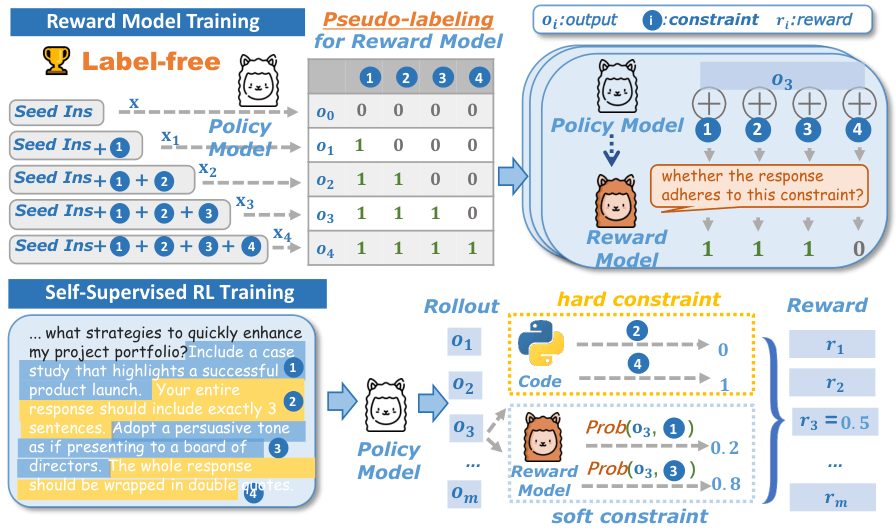
- Pseudo-labels are derived by comparing responses generated with and without a given constraint, matching human labels 90%+ of the time.
- A constraint curriculum decomposes prompts into incremental sub-instructions, solving the sparse reward problem in complex tasks.
- Qwen2.5-1.5B gains 21.6 points on IFEval; R1-0528-Qwen3-8B reaches 87.1, matching VERIF-8B trained with a 32B judge.
- The binary classifier reward model runs roughly 100x faster than QwQ-32B judges while producing better RL outcomes.
- Code, data, and checkpoints are available at github.com/Rainier-rq/verl-if.
Teaching a language model to obey a prompt that says write a poem, under 13 sentences, no commas, title in double angular brackets sounds trivial. In practice, models routinely violate at least one constraint. A team from Fudan University and Ant Group has released a reinforcement learning framework that fixes this without needing a stronger teacher model or human-labeled preference pairs, relying instead on the structure of the instructions themselves to bootstrap a reward signal.
The method, described in the paper Instructions are all you need, targets a stubborn failure mode: models can recite the constraints they are supposed to follow, then ignore them in the output. Code is available in the verl-if repository, with checkpoints released on Hugging Face.
Why multi-constraint prompts fall apart
Real conversations with users often stack several constraints into a single instruction, and reasoning-tuned models tend to trade adherence for chain-of-thought quality. The standard fix, reinforcement learning with verifiable rewards (RLVR), carries three nagging problems that this paper isolates:
- Supervision dependency. Existing approaches lean on stronger models, either directly as reward models or as sources for distilling reward-model training data, or on manual annotation. That caps the student at the teacher's ceiling.
- Sparse rewards. An instruction with five constraints is rarely satisfied all at once, so the model gets zero reward for most rollouts and cannot learn efficiently.