
Fudan's TheraAgent Predicts Prostate Cancer Treatment Outcomes at 75.7% Accuracy
A new multi-agent LLM system predicts which prostate cancer patients will respond to a nascent radioligand therapy, outperforming existing medical agents by over 20 percent.
 Pro
Takeaways
- TheraAgent is the first agentic framework for PET theranostic outcome prediction, targeting 177Lu-PSMA radioligand therapy.
- Hits 75.7% accuracy on 35 real prostate cancer patients and 87.0% on 400 synthetic cases.
- Beats MDAgents and MedAgent-Pro by over 20 percent, especially on misleading cases.
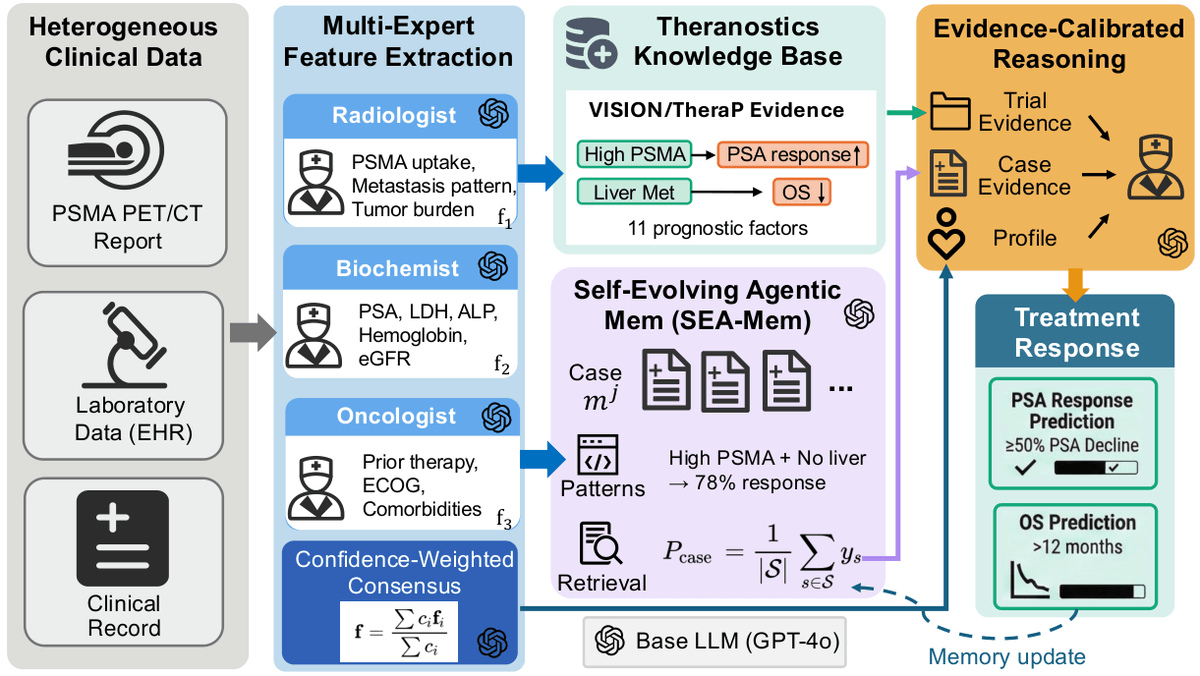
- Uses three role-specialized agents (Radiologist, Biochemist, Oncologist) with confidence-weighted consensus fusion.
- Self-Evolving Agentic Memory learns prognostic patterns from accumulated cases without retraining.
- Predictions cite specific VISION and TheraP trial passages to prevent hallucinated clinical reasoning.
Predicting whether a cancer treatment will work before administering it is one of the harder problems in precision oncology, and it gets harder when the therapy is so new that there is barely any training data available. A team from Fudan University, University of Bern, Nanjing University, and NUS has released TheraAgent, an agentic framework specifically built for this low-data regime, targeting a radioligand therapy that only received FDA approval a few years ago.
The system predicts treatment outcomes for patients receiving 177Lu-PSMA radioligand therapy (RLT), a targeted treatment for advanced prostate cancer. Evaluated on 35 real patients and 400 synthetic cases, TheraAgent achieves accuracy of 75.7% on real data and 87.0% on synthetic data, significantly outperforming single LLM and state-of-the-art medical agents, with especially strong gains on misleading cases where surface features contradict true prognostic factors.
Why prediction matters here
PET theranostics pairs diagnostic imaging with a targeted radioactive payload that hunts down the same molecular marker seen on the scan. The problem is response variability. The VISION trial demonstrated significant overall survival benefits, yet only 46% of patients achieved PSA response, while TheraP reported 66% PSA response in mCRPC patients with progression following docetaxel treatment. Non-responders still absorb cumulative radiation and burn through expensive cycles with limited benefit.
Existing medical agent frameworks like MDAgents and MedAgent-Pro have shown promise for general diagnosis, but the authors argue they hit three walls when applied to theranostics:
- Data and knowledge scarcity. RLT is a nascent therapy with limited documented cases and scarce curated knowledge; general-purpose LLMs lack sufficient theranostic domain expertise, making robust learning and reasoning difficult.
- Heterogeneous inputs. Predictions need to fuse PET/CT imaging reports, structured lab values, and free-text clinical notes, sometimes across multiple languages.
- Evidence grounding. Clinicians need predictions traceable to specific trial statistics rather than plausible-sounding LLM narratives.
Three specialists and an integrator
The first component splits the input across role-specialized agents that each parse one modality in parallel. The Radiologist Agent parses PSMA PET/CT reports to identify PSMA expression level (high/moderate/low/heterogeneous), metastasis distribution across bone, lymph node, and visceral sites, and qualitative tumor burden. The Biochemist Agent extracts laboratory values, PSA and its trend, hemoglobin, alkaline phosphatase (ALP), lactate dehydrogenase (LDH), and renal function (eGFR), from structured and semi-structured EHR data. The Oncologist Agent interprets clinical narratives to identify prior treatment lines (ADT, chemotherapy), ECOG performance status, and relevant comorbidities, handling multilingual documentation when necessary.
Each expert emits a JSON feature profile plus a confidence score between 0 and 1. A fourth Integrator agent then does confidence-weighted consensus, giving more weight to high-certainty extractions and resolving contradictions by looking at the underlying evidence rather than voting blindly.
A memory that grows with the clinic
The second piece, Self-Evolving Agentic Memory (SEA-Mem), is the team's answer to only having 35 real cases. Instead of fine-tuning, they store processed patients as retrievable entries. Each entry stores the extracted feature profile and documented outcome (PSA response, OS greater than 12 months) for a historical patient.
When three or more cases share a common feature combination, SEA-Mem computes the empirical outcome rate for that subgroup. So if eight prior patients had high PSMA and no liver metastasis and seven responded, the system learns a soft rule with a concrete base rate attached. For new patients, top-k similar cases are retrieved by weighted feature matching, and the memory updates whenever a fresh outcome becomes available. This is case-based reasoning in the classical AI sense, adapted as a lightweight substitute for training data.
Grounding predictions in trials, not vibes
The third component addresses hallucination. Under the guidance of nuclear medicine physicians, we constructed a knowledge base comprising 23 peer-reviewed publications on Lu-177 PSMA therapy. From these, the authors extracted 11 prognostic factors with quantified associations, then chunked and indexed the corpus for semantic retrieval.
At inference, the reasoning module builds targeted queries from the patient profile and pulls concrete passages like the VISION hazard ratio for liver metastasis, or the TheraP response rate for high-uptake patients. The final prediction cites all three sources explicitly, so a reviewer can trace any claim back to a paper or a similar historical case. The full pipeline is implemented with LangChain for the RAG components, using GPT-4o as the base LLM.
The numbers
On 35 real mCRPC patients, TheraAgent hit 75.7 percent overall accuracy versus 62.9 percent for MDAgents and 57.1 percent for MedAgent-Pro. The gap widens on the tough cases. On 400 synthetic patients stratified by difficulty:
| Method | Clear | Ambiguous | Misleading | Overall |
|---|---|---|---|---|
| GPT-4o | 79.5 | 63.3 | 40.0 | 66.8 |
| GPT-4o + RAG | 89.5 | 70.0 | 55.0 | 76.8 |
| MDAgents | 86.0 | 66.7 | 51.3 | 73.3 |
| MedAgent-Pro | 83.0 | 68.3 | 47.5 | 71.5 |
| TheraAgent | 95.0 | 79.2 | 78.8 | 87.0 |
The misleading column is the real story: cases engineered so that surface features contradict true prognostic factors. Baselines collapse to 40 to 55 percent, roughly a coin flip, while TheraAgent holds at 78.8 percent because it can override intuition with quoted trial statistics.
The ablation quantifies each ingredient. Multi-Expert contributes 10.0%, SEA-Mem contributes 5.7%, and Evidence-Calibrated Reasoning contributes 2.8%. The specialized extraction agents matter most, suggesting that cleanly structuring heterogeneous clinical inputs is where general medical agents leak the most accuracy.
What this is good for, and what it isn't
TheraAgent is a decision-support prototype, not a deployable clinical tool. The authors are candid that current performance leaves room for improvement due to task complexity and data scarcity; future work will focus on multi-center datasets, reinforcement learning from clinical feedback, and prospective validation. The 35-patient cohort comes from a single hospital, and 80 percent of the synthetic evaluation set is generated by Claude Opus rather than drawn from real charts, which limits how much the 87 percent number should be trusted.
Still, the design pattern travels. A three-way split of specialized extractors, a case-based memory that accumulates institutional experience, and a retrieval layer anchored to curated trial literature is a reasonable blueprint for any medical subdomain where FDA approval is recent, data is scarce, and hallucination is unacceptable. Code will be released upon acceptance.