
Fudan's RC-NF Catches Robot Failures in Under 100ms, Beating GPT-5
A conditional normalizing flow watches robot execution in real time, flagging out-of-distribution behavior in under 100 ms and triggering rollback or replanning for VLA policies.
 Pro
Takeaways
- RC-NF is a conditional normalizing flow that monitors VLA robots and flags out-of-distribution behavior in under 100 ms.
- Trained unsupervised on successful demos only, using SAM2 masks, robot state, and task embeddings as conditions.
- Novel RCPQNet affine coupling layer decouples robot state and object point features, then fuses them via cross-attention.
- Beats FailDetect and GPT-5, Gemini 2.5 Pro, Claude 4.5 monitors by ~8% AUC and ~10% AP on LIBERO-Anomaly-10.
- Plug-and-play with π0 on a Franka arm, triggering homing rollback or LLM replanning on real anomalies.
- Paper and project code available via the arXiv listing and the authors' project page.
Vision-Language-Action (VLA) models like π0 can turn a natural-language prompt into low-level robot control, but they inherit a familiar imitation-learning weakness: when the world drifts away from the training distribution, the policy quietly keeps executing the wrong thing. A team from Fudan University and Singapore Management University has proposed a lightweight monitor that watches the robot in parallel with the policy and flags trouble in under 100 milliseconds. The paper, accepted to CVPR 2026, is called RC-NF, short for Robot-Conditioned Normalizing Flow.
Why VLA policies need a runtime babysitter
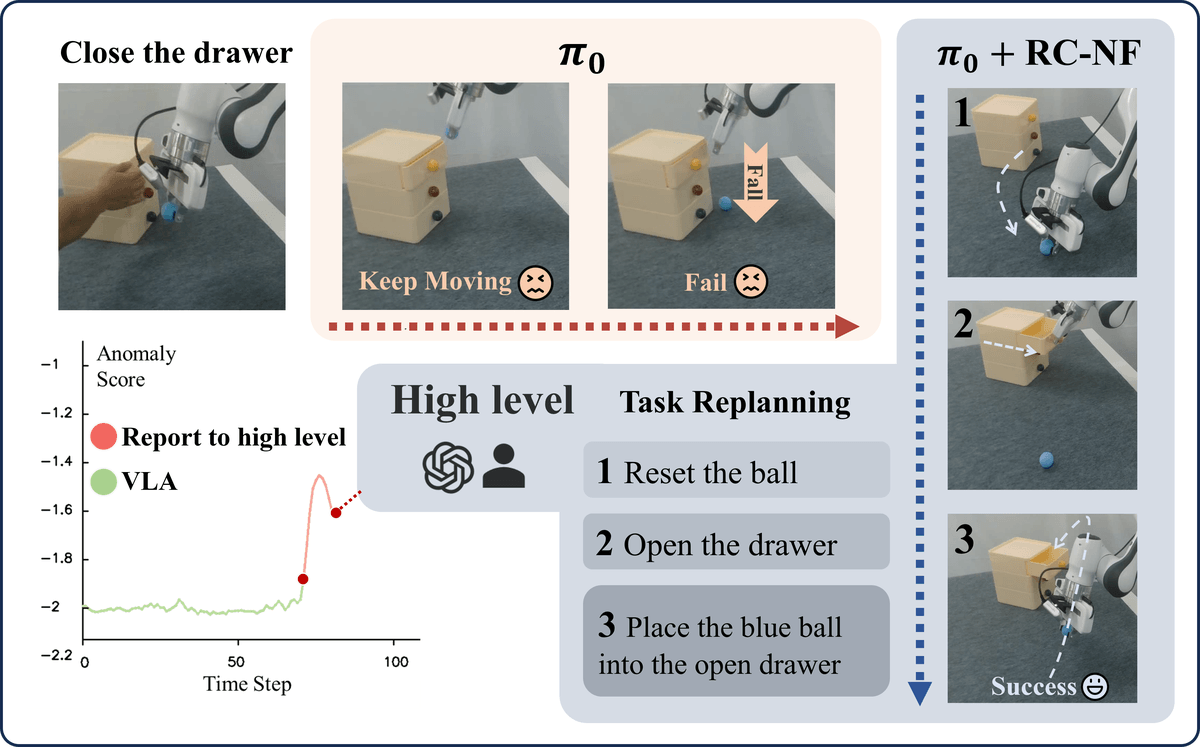
Recent VLA models can execute increasingly complex manipulation tasks, but because they are trained through imitation learning, they struggle to operate reliably in dynamic environments and often fail under Out-of-Distribution (OOD) conditions. The authors split those failures into two flavors that matter for recovery: task-level OOD, where the environment no longer matches the instruction (a drawer closes mid-task), and state-level OOD, where the instruction is still valid but the robot's trajectory has drifted (the ball slips out of the gripper).
Prior monitors tried to catch this in two ways, both unsatisfying. Classifier-style detectors need someone to enumerate every abnormal condition ahead of time. The more recent VLM-based approach, exemplified by dual-system architectures and Sentinel, uses a big multimodal model to reason about failure but pays for it with multi-second latency, which is too slow to stop a robot before it commits to a bad grasp.
Modeling "normal" as a probability density
RC-NF takes a different route borrowed from anomaly detection literature: learn what normal execution looks like as a probability distribution, then flag anything that scores as unlikely. It uses a conditional normalizing flow, a class of generative model that learns an invertible mapping between a complex data distribution and a simple Gaussian. Because the mapping is invertible, you can compute the exact likelihood of any observation, which becomes your anomaly score.
RC-NF decouples the processing of task-aware robot and object states within the normalizing flow. It requires only positive samples for unsupervised training and calculates accurate robotic anomaly scores during inference through the probability density function. In practice that means you only need successful demonstrations, no labeled failures.

Inside RCPQNet, the affine coupling layer
The novel piece is the Robot-Conditioned Point Query Network (RCPQNet), a custom affine coupling layer that plugs into a Glow-style flow. The pipeline runs roughly like this:
- A wrist or third-person camera feeds video to
SAM2, which segments the manipulated objects. - The object masks are grid-sampled into 2D point sets, giving a compact shape-and-motion representation.
- Robot proprioception (joint states, gripper state, Cartesian pose) and the task prompt are packaged as conditioning.
- The task prompt is mapped to a vector on a hypersphere via spherical uniform encoding, so different tasks sit maximally far apart in latent space.
- K=12 flow steps transform the point set into a Gaussian centered on the task embedding; the negative log-likelihood is the anomaly score.
RCPQNet itself has two sub-designs worth calling out. A Task-aware Robot-Conditioned Query uses FiLM modulation to fuse the robot state with the task embedding, producing query tokens for a cross-attention transformer. A Dual-Branch Point Feature Encoding splits the object representation into a Dynamic Shape branch (normalized per frame to isolate shape changes) and a Positional Residual branch (to preserve absolute position). This decoupling is what lets the model reason about robot-object interactions without letting one modality drown out the other, which the authors argue is the failure mode of concatenation-based approaches like FailDetect.
LIBERO-Anomaly-10 and the numbers
To evaluate it, the authors built LIBERO-Anomaly-10, a benchmark on top of the LIBERO-10 simulation suite with three deliberately different anomaly types:
- Gripper Open: the gripper stays open when it should grasp, so the object never moves.
- Gripper Slippage: friction is zeroed while holding, and the object slips out.
- Spatial Misalignment: the arm moves to the wrong compartment, testing whether the monitor understands the semantic intent of the prompt.
RC-NF was compared against FailDetect (a flow-matching baseline) and three VLM-based monitors: GPT-5, Gemini 2.5 Pro, and Claude 4.5, all wrapped in the Sentinel prompt at 1 Hz sampling. Averaged across anomaly types, RC-NF hit 0.9309 AUC and 0.9494 AP, beating the best baseline by roughly 8 points of AUC and 10 points of AP. The gap is starkest on Spatial Misalignment, where the VLMs collapse to near-random performance (~0.5 AUC) because they cannot reliably ground spatial semantics from low-resolution frames.

Plugging into π0 on a real Franka arm
The real-world half is where this becomes practically interesting. On a Franka Research 3 arm running π0 as the base policy, RC-NF runs as a parallel monitor on a single RTX 3090. The latency breakdown: SAM2 inference takes about 50 ms, grid sampling 1.7 ms, the flow itself 30 ms, and roughly 5 ms of glue, for an overall 86.7 ms per frame.
When the anomaly score crosses a static threshold calibrated from expert demonstrations, a high-level module decides between two recovery paths. Task-level OOD, like a drawer closing mid-task, triggers replanning by an LLM planner or human. State-level OOD, like the ball rolling behind the gripper, triggers a homing procedure that rolls the arm back toward its initial state until the anomaly score drops, then hands control back to π0. In the reported demo, vanilla π0 keeps grasping air and lifting; π0 plus RC-NF catches the drift and recovers.

What it is good at, and where it will strain
The real breakthrough here is less about beating VLMs on a benchmark and more about producing a monitor that is fast enough to actually intervene during closed-loop control. A sub-100 ms plug-and-play OOD signal is a fundamentally different tool than a several-second VLM verdict, because it can gate individual control steps rather than just post-hoc auditing.
That said, there are constraints worth flagging. RC-NF depends on SAM2 masks and a bounding-box prompt on the first frame, which in the real-world setup is generated by Gemini 2.5 Pro in a zero-shot pass, so the pipeline still leans on a large model at initialization. The point-set representation is 2D and object-centric, which fits tabletop manipulation cleanly but is less obvious for tasks with heavy occlusion or deformable objects. And because the model is trained per task-set, adding entirely new tasks means retraining with new hypersphere embeddings, though the ablation shows adding tasks within the same suite barely degrades performance.
For anyone building on top of VLA policies, a project page and code are hosted at heikaishuizz.github.io/RC-NF, and the CVPR 2026 paper is available through the CVF open access archive. If your VLA stack currently has no runtime monitor, this is a compact, unsupervised drop-in that only needs the successful demos you already collected.