
Fudan's PET-F2I-7B Beats GPT-5.1 at Reading Cancer Scans
A 7B model fine-tuned on 41k real PET/CT reports triples entity coverage over GPT-5.1 and Claude Opus while running on a single RTX 4090.
 Pro
Takeaways
- PET-F2I-41K benchmarks 27 LLMs on 41,191 real PET/CT findings-to-impression pairs.
- PET-F2I-7B, a LoRA fine-tune of Qwen2.5-7B, hits 0.708 BLEU-4 and 0.807 ECR.
- Beats GPT-5.1, Claude Opus 4.5, and Qwen3-235B by roughly 3x on entity coverage.
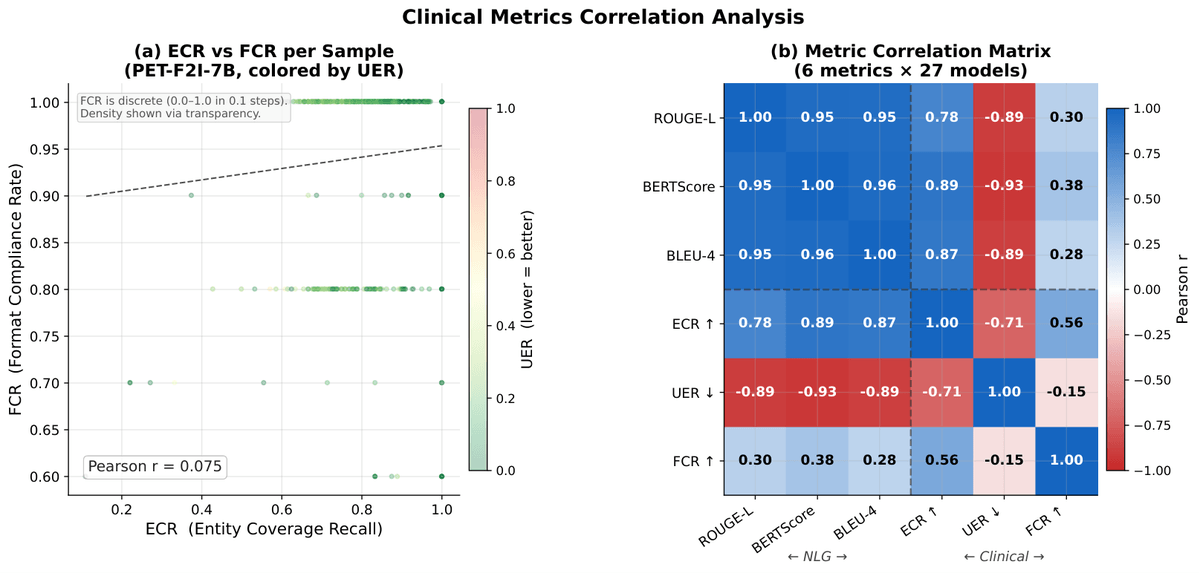
- Three new clinical metrics (ECR, UER, FCR) expose blind spots in BLEU and ROUGE.
- Medical-domain LLMs like Meditron and Med-PaLM 2 barely outperform generic baselines zero-shot.
- Runs locally on a single RTX 4090, avoiding cloud PHI transmission for hospital deployment.
Turning a PET/CT scan's raw findings into a concise diagnostic impression is one of the more thankless jobs in nuclear medicine. It is slow, requires subspecialty training, and small omissions can miss a tumor. A team from Fudan University, Shanghai Universal Medical Imaging Diagnostic Center, and the Shanghai Academy of Artificial Intelligence for Science built a benchmark to see whether current LLMs can help, and their answer is blunt: not out of the box, but a small fine-tuned model can.
Their paper introduces PET-F2I-41K, a benchmark of over 41,000 real-world PET/CT reports, and PET-F2I-7B, a LoRA-tuned Qwen2.5-7B-Instruct that beats every frontier model they tested. The results also show that standard NLG metrics like BLEU and ROUGE badly underrepresent clinical safety.
Why PET/CT breaks general-purpose LLMs
PET/CT reports are structurally unlike the chest X-ray reports most radiology NLP work targets. They demand strict formatting and specialized terminology, such as standardized uptake value (SUV) and tumor-node-metastasis (TNM) staging, and they integrate findings across multiple body regions and tracer types. On top of that, deploying proprietary frontier LLMs faces critical barriers: high latency, operational costs, and strict patient health information (PHI) privacy regulations render cloud-based solutions unviable for clinical workflows. Sending scans to a hosted API is often a non-starter for hospitals.
A critical impediment in this domain is the absence of clinically rigorous evaluation frameworks, which is what the benchmark is meant to fix.

The dataset and the 7B model
PET-F2I-41K comprises 41,191 real-world reports collected between 2013 and 2023, with a strict patient-level split of 40,691 training, 500 validation, and 500 test samples. While predominantly 18F-FDG, the dataset incorporates critical minority tracers for neurological and targeted molecular imaging such as dopamine, amyloid, and tau, which matters for out-of-distribution testing. Findings sections average 870 characters, impressions 240 characters.
The model itself is deliberately unglamorous. PET-F2I-7B is fine-tuned from Qwen2.5-7B-Instruct via LoRA, with r=64 and alpha=128 applied to all linear projections, optimized with AdamW at a peak learning rate of 1.0e-4 over 3 epochs with a 2048-token context on 2 RTX 4090 GPUs. This parameter-efficient approach enables seamless local inference on one RTX 4090, intrinsically securing patient health information by preventing external server transmissions.
Three metrics that actually measure clinical safety
The authors argue that BLEU and ROUGE score how a sentence looks, not whether it names the right tumor. They propose three complementary metrics computed with a greedy longest-match named-entity recognizer over a curated PET/CT lexicon:
- Entity Coverage Rate (ECR): fraction of reference clinical entities the generated impression actually reproduces. High ECR means the model did not miss findings.
- Unsupported Entity Rate (UER): fraction of generated entities absent from the source findings. This is the hallucination proxy.
- Format Compliance Rate (FCR): rule-based score over five formatting criteria including numerical sectioning, anatomical markers, and terminology density.
The correlation analysis is where things get interesting. ECR and FCR are essentially orthogonal (r=0.075), and BLEU-4 barely correlates with FCR (r=0.28). A model can hit high lexical overlap and still omit a malignancy, which is exactly the failure mode you cannot afford in a diagnostic pipeline.
How 27 models actually scored
The zero-shot results are unflattering for the frontier. GPT-5.1 and Claude Opus 4.5 yield ECRs of 0.46 and 0.53 respectively, showing that massive parameter counts cannot inherently resolve PET/CT's terminological complexities. Medical-domain LLMs like BioGPT, Meditron, Med-PaLM 2, and MedGemma-4B cluster around 0.35 to 0.39 ECR, roughly the same range as generic 7B baselines. Specialized medical LLMs perform comparably to generic baselines, proving that broad biomedical exposure fails to transfer to nuanced subspecialty reporting.
PET-F2I-7B lands in a different regime entirely:
| Model | BLEU-4 | ROUGE-L | ECR | UER (lower is better) |
|---|---|---|---|---|
| PET-F2I-7B | 0.7075 | 0.8673 | 0.8074 | 0.1649 |
| Qwen3-235B | 0.1480 | 0.2827 | 0.5612 | 0.6709 |
| Claude Opus 4.5 | 0.2532 | 0.3520 | 0.5268 | 0.5417 |
| GPT-5.1 | 0.1681 | 0.2963 | 0.4622 | 0.6250 |
| DeepSeek V3.2 | 0.2401 | 0.3822 | 0.5080 | 0.5704 |
| Med-PaLM 2 | 0.1563 | 0.3222 | 0.3544 | 0.5484 |
Beyond averages, PET-F2I-7B's lowest quartile for exact entity coverage strictly dominates the highest quartiles of all zero-shot baselines, meaning even its worst-case outputs are more complete than the best-case outputs of every other model tested. It also holds up on minority tracers like dopamine, amyloid, and tau imaging despite an FDG-dominated training corpus.

What is useful, and what is not
The takeaway for anyone considering a similar pipeline in another medical subspecialty:
- General medical instruction tuning is not a substitute for domain-specific fine-tuning on real reports.
- Lexical metrics are unsafe to optimize alone. Entity-level and format-level checks should be part of the evaluation loop.
- A LoRA adapter on a 7B backbone, trained on tens of thousands of paired findings/impressions, is enough to beat 200B+ frontier models on the narrow task, on hardware a single hospital can afford.
The limitations are worth naming. The corpus is single-center and Chinese-institution derived, so multilingual and multi-center generalization is unproven. The model is text-in, text-out; it does not look at the images themselves and inherits any error already present in the findings section. There is no radiologist preference alignment yet, and the paper flags RLHF and multimodal fusion with raw PET/CT images as future work. Neither the dataset nor the model weights are announced as public in the paper, which limits immediate reuse, though the methodology is straightforward enough to replicate if you have access to reports of your own.