
Fudan's NQS-DQME Cracks Quantum Memory Simulations With 54x Fewer Parameters
A new NQS-DQME framework uses neural networks to simulate quantum memory effects that were previously computationally intractable, matching exact methods with orders of magnitude fewer parameters.
 Pro
Takeaways
- Researchers combined neural quantum states (NQS) with the dissipaton-embedded quantum master equation (DQME) to simulate non-Markovian open quantum dynamics efficiently.
- The key idea: environmental memory is encoded in "dissipatons" (quasiparticles with lifetimes), which become explicit nodes in a restricted Boltzmann machine (RBM).
- NQS-DQME achieves under 1% error vs. exact HEOM benchmarks, while using up to 54x fewer parameters than competing tensor-network methods (MPS-HEOM).
- Parameter count scales quadratically with system size instead of exponentially, enabling previously intractable strongly-correlated systems to be simulated.
- The learned RBM weights are interpretable: they reveal which memory timescales drive long-time phenomena like the Kondo effect.
- Code is open-source at github.com/dumbimm/RBM-DQME; paper accepted in Physical Review B.
Simulating how quantum systems interact with their environments is one of the hardest problems in computational physics. The challenge is not just conceptual -- it is a brute-force computational wall. A team from the University of Science and Technology of China and Fudan University has now published a paper showing that neural networks can crack open a class of these problems that was previously considered the "ultimate toughness test" for simulation methods: non-Markovian open quantum dynamics.
The wall every simulator hits
An open quantum system (OQS) is any quantum system that is not perfectly isolated -- it exchanges energy and information with a surrounding environment, like a molecule in a solvent, an electron in a metal, or a qubit coupled to a noisy bath. Simulating these systems exactly requires tracking not just the system itself, but all the correlations it builds up with its environment over time.
The "non-Markovian" part is where things get especially hard. A Markovian process is memoryless: the future depends only on the present state. A non-Markovian process has memory -- past interactions with the environment continue to influence the system's future behavior. These systems exhibit non-Markovian behavior, meaning their evolution depends not only on the present state but also on their past history. Accurately capturing this memory effect requires sophisticated techniques, traditionally relying on hierarchical equations of motion (HEOM). However, standard HEOM suffers from exponential scaling with system size and environmental complexity, quickly becoming intractable for even moderately sized systems.
The gold standard solver, HEOM, works by introducing a hierarchy of auxiliary density operators (ADOs) that encode the system-environment memory. HEOM is a nonperturbative framework that replaces the memory-kernel evolution with a hierarchy of coupled first-order differential equations to simulate quantum dynamics. It employs auxiliary density operators to capture full system-bath correlations and non-Markovian memory effects critical for accurate modeling in complex environments. The problem: the number of these auxiliary objects grows exponentially with both system size and the complexity of environmental memory. You quickly run out of RAM and compute.
Tensor network methods (like matrix product states) have been used to compress this representation, but they struggle when quantum entanglement is high or when intermediate states during time evolution require large bond dimensions. Neural quantum states (NQSs) -- neural networks that represent quantum wavefunctions -- have shown more expressive power than tensor networks, but until this work, the NQS approach had been extended to represent the density matrix of mixed states, enabling the solution of Markovian Lindblad quantum master equations for open quantum systems. Despite these advancements, current works had primarily focused on systems coupled to Markovian environments.
Dissipatons: giving memory a shape
The key innovation is how the team encodes environmental memory into the neural network. Rather than trying to represent the full environment directly, they use a concept called dissipatons -- fictitious quasiparticles, each with a characteristic energy and lifetime, that collectively reproduce the exact influence the environment has on the system.
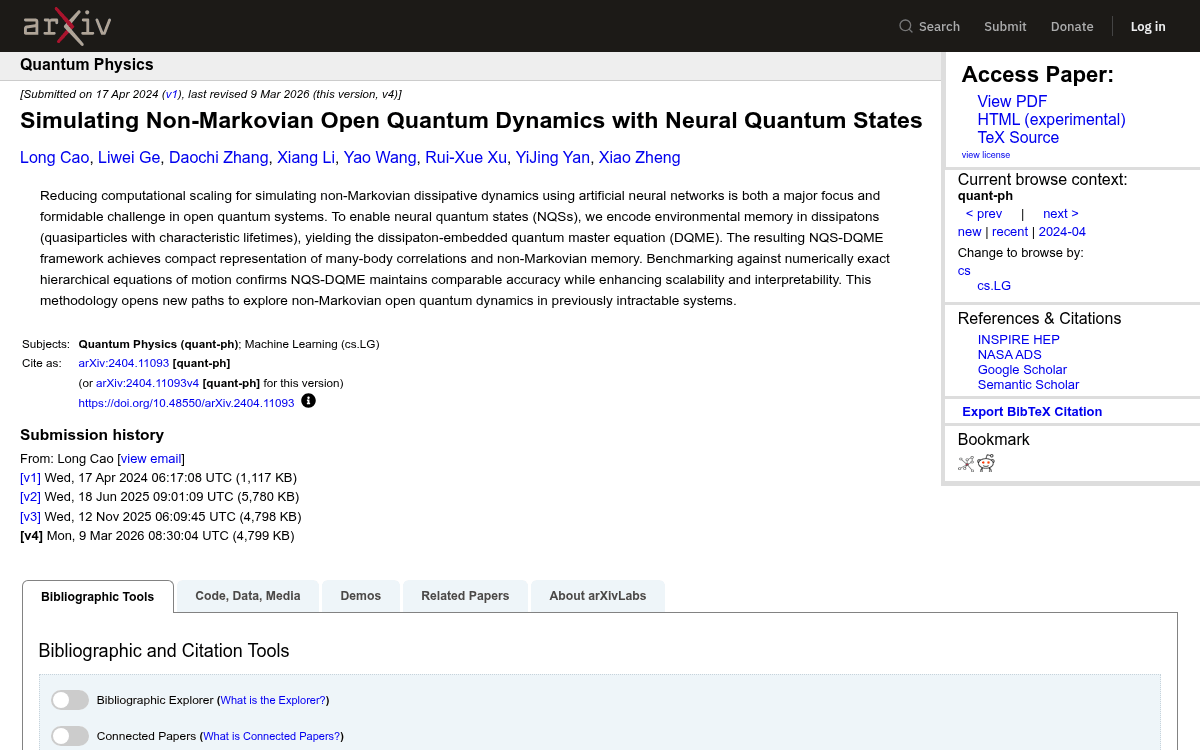
To enable neural quantum states (NQSs), the team encodes environmental memory in dissipatons (quasiparticles with characteristic lifetimes), yielding the dissipaton-embedded quantum master equation (DQME). The idea is that the environment's time-correlation function -- which captures how strongly the past influences the present -- can be decomposed into a sum of decaying exponentials. Each exponential term defines one dissipaton level. Slow-decaying dissipatons carry long-range memory; fast-decaying ones handle short-lived fluctuations.

This maps the original open quantum system onto an extended system that includes both the physical degrees of freedom and the dissipaton levels. The full state of this extended system is then represented by a restricted Boltzmann machine (RBM) -- a two-layer neural network where visible nodes encode system and dissipaton configurations, and hidden nodes capture correlations between them. The resulting framework is called NQS-DQME.
How it works, step by step
- Decompose the environment. The hybridization time-correlation function of the environment is expanded as a sum of exponentials using the Padé spectral decomposition scheme. Each exponential defines a dissipaton level with a complex decay rate encoding both energy and lifetime.
- Build the extended system. System fermion levels and dissipaton levels are combined into a single dissipaton-embedded system. The state of this system is the reduced density tensor (RDT), which contains both the physical density matrix and all the auxiliary memory information.
- Represent the RDT with an RBM. The RDT is parameterized by an RBM whose visible layer has nodes for system configurations and dissipaton configurations. Auxiliary nodes in the network handle the Markovian background responsible for dissipaton decay. Symmetry constraints and a sparsity filter are applied to reduce the number of non-zero elements by roughly an order of magnitude.
- Evolve in time. Using the time-dependent variational principle (TDVP), the exact DQME is projected onto the RBM parameter space. At each timestep, the network weights are updated by solving a linear equation for the parameter derivatives, then integrating with a 4th-order Runge-Kutta algorithm.
- Sample with MCMC. The sum over all visible states (which is exponentially large) is estimated using a customized Markov chain Monte Carlo algorithm that prioritizes low-dissipaton-occupancy states, which carry the most weight.
The total number of RBM parameters scales approximately quadratically with the dimension of the dissipaton-embedded system -- a dramatic improvement over the exponential scaling of HEOM, where the RDT dimension grows as 4^N_S * N_E^M_max.
Benchmarks that matter
The team tested NQS-DQME on two physically meaningful benchmark systems, both compared against numerically exact HEOM results from the HEOM-QUICK2 program.
Case 1: Single magnetic impurity coupled to two electron reservoirs. This is the single-impurity Anderson model -- a classic setup for studying electron transport through molecular junctions and the Kondo effect (a quantum phenomenon where conduction electrons collectively screen a localized magnetic spin, producing a sharp resonance in conductance at low temperatures). At low temperature (k_B T = 0.3 Γ), the system couples to 64 dissipaton levels. The NQS-DQME results exhibit excellent agreement with the reference data, with relative error below 1% across the entire temperature range.

Case 2: Two magnetic impurities coupled to a shared reservoir. This models recent experiments on coherent spin dynamics in surface molecules. When a ferromagnetic exchange interaction is suddenly switched on between the two impurities, their spins align into a high-spin state that cannot be fully screened by the reservoir -- progressively suppressing Kondo correlations over time. Maximum errors for spin correlations and hybridization energy both stayed below 1%.
The efficiency advantage is stark. In a direct comparison against matrix product state HEOM (MPS-HEOM), a competing compression approach:
| Method | Temperature | Parameters | Error (n↑) |
|---|---|---|---|
| MPS-HEOM | High (k_BT = 3.0 Γ) | 9,184 | 0.81% |
| NQS-DQME (RBM) | High (k_BT = 3.0 Γ) | 634 | 0.07% |
| MPS-HEOM | Low (k_BT = 0.3 Γ) | 299,120 | 0.97% |
| NQS-DQME (RBM) | Low (k_BT = 0.3 Γ) | 5,545 | 0.11% |
At low temperature -- where non-Markovian effects are strongest -- NQS-DQME achieves better accuracy with roughly 54x fewer parameters than MPS-HEOM.
Interpretability as a bonus
One unexpected benefit of the NQS-DQME framework is that the learned RBM weights are directly interpretable. Because each dissipaton level is explicitly represented as a node in the network, you can watch how the weight matrix connecting dissipaton nodes to auxiliary nodes evolves over time -- and read off which memory timescales are physically important.

At low temperatures, the heatmaps show that the slowest-decaying dissipaton level (the one carrying the longest-range memory) becomes dramatically more active during the long-time evolution -- directly linking non-Markovian memory to the formation of Kondo-correlated states. This kind of mechanistic transparency is essentially impossible with conventional HEOM, where the high-dimensional ADO space makes tracking individual memory contributions prohibitively difficult.
Where it falls short
The paper is candid about one significant bottleneck. The time-dependent variational principle requires solving a linear system at every timestep to update the network weights. This approach employs time-encoded neural networks within a time-domain decomposition strategy to represent the evolution governed by the dissipaton-embedded quantum master equation. This minimization of the loss function at each step is computationally demanding and currently represents the main performance ceiling. The authors note this can be addressed with advanced optimizers and more sophisticated architectures, but it remains an open problem.
Additionally, errors increase as temperature decreases and non-Markovian effects grow stronger. The relative error for current in Case 1 climbs from 0.02% at high temperature to ~1% at the lowest temperature studied. The method is still accurate, but harder problems cost more.
What this unlocks
The practical impact reaches across several domains where non-Markovian quantum dynamics governs real physics:
- Molecular electronics: Electron transport through single molecules on metal surfaces, where Kondo correlations and memory effects directly control conductance.
- Quantum biology: Energy transfer in photosynthetic complexes, where quantum coherence and environmental memory have been experimentally observed.
- Quantum computing: Noise modeling for qubits coupled to structured environments where the Markovian approximation breaks down.
- Surface science: Coherent spin dynamics of atoms and molecules on surfaces, directly relevant to recent scanning tunneling microscopy experiments.
- Strongly correlated materials: Any system where Kondo physics, underscreened spin states, or strong system-environment entanglement plays a role.
This methodology opens new paths to explore non-Markovian open quantum dynamics in previously intractable systems. The code is publicly available as the RBM-DQME repository on GitHub, giving the community a concrete starting point to extend the approach to larger systems and more complex environments.