
Fudan's LifeSim Catches GPT-5 Failing Real Personalization at 52% Accuracy
A new simulator built on the Belief-Desire-Intention model generates lifelike user trajectories, exposing where top LLMs fail at implicit intent and long-term memory.
 Pro
Takeaways
- LifeSim simulates coherent user lives using the Belief-Desire-Intention cognitive model grounded in real mobility data.
- LifeSim-Eval covers 1,200 scenarios across 8 life domains with 120 simulated users.
- Frontier LLMs drop 20+ points from explicit to implicit intent recognition tasks.
- Long-context implicit intent completion degrades sharply as history grows past 14K tokens.
- Simple profile memory helps inconsistently; robust personalization requires deeper preference reasoning.
- Code and data released at github.com/dfy37/lifesim for evaluating assistants.
Building a personal AI assistant that actually feels personal is harder than it looks. Ask GPT-5 or Claude to plan your evening, and you get a generic checklist. Ask a good friend, and they remember you hate crowds, know it's raining, and recall you've been dieting for a month. A new benchmark from Fudan University tries to close that gap by simulating entire lives, then watching where today's best models fall apart.
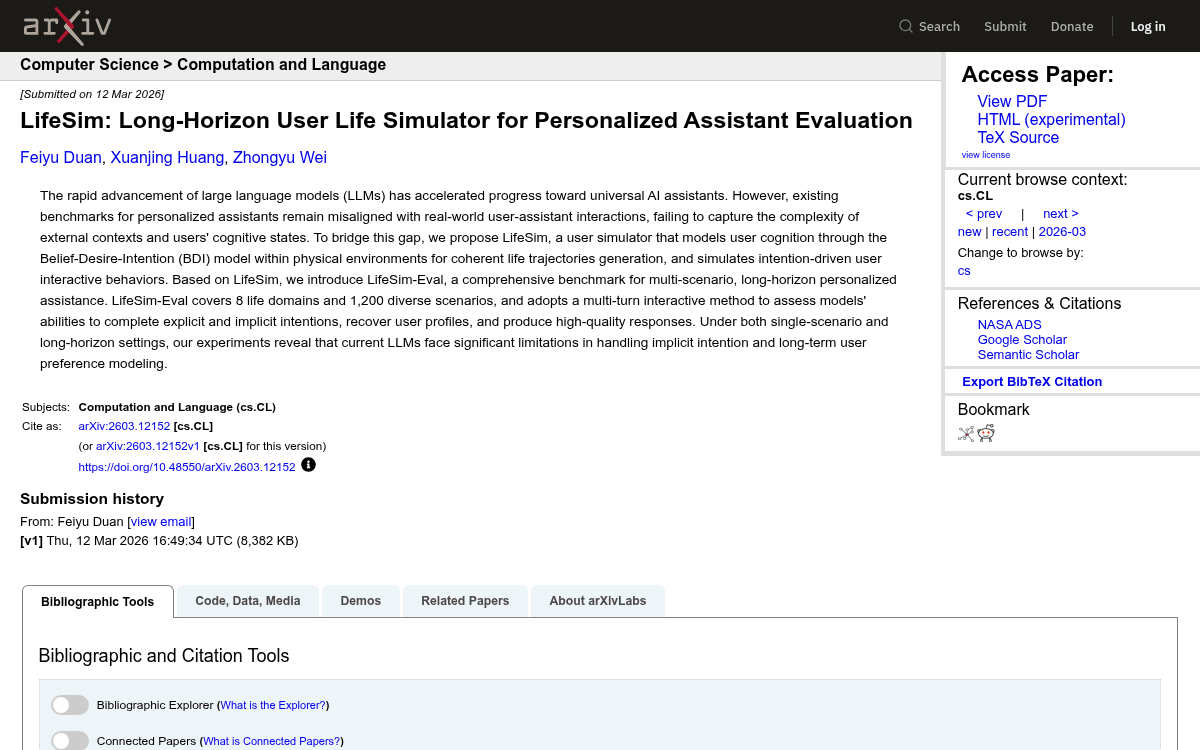
The system is called LifeSim, and it comes with an evaluation suite, LifeSim-Eval, that puts more than a dozen frontier LLMs through 1,200 scenarios spanning eight life domains. The core finding is blunt: current LLMs face significant limitations in handling implicit intention and long-term user preference modeling, even as they ace surface-level requests.
Why static benchmarks miss the point
Most personalization benchmarks treat each query as an island. But real user needs are shaped by two dimensions that isolated question answering ignores: complex external environment factors like time, location, weather, and ongoing life events; and dynamic cognitive states of users whose intentions arise from evolving experience alongside stable personalities and preferences.
The data problem is worse. Real-world user data are constrained by privacy and ethical considerations, and publicly available interaction logs spanning multiple years and diverse scenarios remain extremely scarce. That forces existing benchmarks to lean on short-context, static datasets that can't capture how preferences drift and contexts shift over months of use.

Simulating a life with Belief-Desire-Intention
LifeSim's answer is to generate synthetic but coherent life trajectories using a classical framework from cognitive science. For user cognitive modeling, the authors adopt the Belief-Desire-Intention (BDI) model to construct the user's internal reasoning process, a model originally developed by philosopher Michael Bratman in 1987 to describe how humans deliberate before acting.
The framework decomposes into four cooperating engines:
- BDI-Based Cognitive Engine , maintains long-term beliefs (the user profile) and short-term beliefs (situational hypotheses), then samples an intention from a ranked candidate pool using a softmin over reranked candidates.
- BDI-Grounded Event Engine , grounds behavior in a physical environment defined as Env(T, L, W) for time, location, and weather, driven by 3,374 real user mobility trajectories spanning 251 Points Of Interest from Foursquare.
- User Behavior Engine , generates each conversational turn through memory perception, emotion inference, action selection, and response generation.
- User Profile Pool , a million-user pool built from the SocioVerse dataset, filtered for bots, and annotated across demographics, Big Five personality traits, and long-term preferences.
A key mechanic is the event trigger. Users don't ask for help every minute, so LifeSim uses a logistic function over elapsed time since the last event to decide via Bernoulli sampling whether a new event fires. When one does, environmental context flows into the cognitive engine, which retrieves nine candidate intentions from a desire pool of over 113,000 event-intention pairs organized around WHO Quality of Life domains.

The benchmark: 1,200 scenarios, two settings
LifeSim-Eval includes 120 users, each associated with a sequence of 10 events, yielding 1,200 scenarios evenly distributed across eight life domains. The eight domains cover exercise, diet, mental health, parenting, elderly care, education, travel, and leisure.
The benchmark separates two crucial notions borrowed from linguistic pragmatics: explicit intentions (what the user directly asks) and implicit intentions (what they actually need but don't say). It runs in two modes:
- Single-scenario , up to 20 turns, no interaction history, tests whether the assistant can infer latent needs from profile and context alone.
- Long-horizon , preferences revealed in a first scenario, then the model is tested in a later scenario after a conversation history exceeding 14K tokens.
Where the models actually break
The results show a consistent, uncomfortable pattern. On explicit intent recognition, most models score in the 70s or higher. On implicit intent recognition, they drop by more than 20 points. GPT-5 hits 79.5 on explicit recognition but just 52.2 on implicit. Claude Sonnet 4.5 sits at 76.1 and 49.2. Even DeepSeek-V3.2 Thinking, the best open-source performer, only reaches 59.3 on implicit recognition.
Interestingly, DeepSeek-V3.2 achieves both a higher preference recovery score and the best persona alignment performance, and its Thinking variant shows clear gains on intention-related tasks, suggesting reasoning-style training helps recover latent user needs. Gemma models are a cautionary tale: strong on remembering preference facts but weak at translating those facts into personalized responses.

The long-horizon results are more damning. Explicit intent completion stays roughly flat as context grows from 1K to 16K tokens. Implicit intent completion collapses. Even a simple profile memory mechanism, where the model summarizes user preferences between scenarios, helps unevenly. A simple external memory mechanism alone is insufficient to guarantee robust long-term preference modeling; achieving reliable long-horizon user modeling requires stable preference reasoning throughout prolonged interactions.
The failure modes that matter
The case study section is where developers building assistant products should pay attention. Three recurring failure patterns emerged across every model tested:
- Rigid reasoning , models anchor on an initial suggestion and rephrase it after rejection instead of reformulating the problem. Llama 3.1 8B exhibited rigid reasoning in 64.2% of responses; GPT-5 in 11.2%.
- Insufficient proactive inquiry , models deliver default recommendations without asking clarifying questions. Only Claude Sonnet 4.5 asked follow-up questions in over half its turns (51.2%). GPT-oss variants sat below 2%.
- Weak persona utilization , even with detailed profiles in context, responses stayed generic. The model knew the user was emotionally unstable and needed reassurance but still produced textbook advice.
What this means for building assistants
The practical takeaway is that if you're wiring up a personalization layer on top of an LLM, retrieval and memory injection get you the easy 70%. The hard 30% comes from reasoning over that memory: connecting a stated preference from three weeks ago to an unstated need right now. Scaling helps modestly, reasoning-tuned models help more, but no tested system solves it.
The framework is open source, with code and data available on GitHub. For teams building consumer assistants, coaching apps, or long-running agents, LifeSim-Eval is a useful stress test before shipping. It's less useful for high-stakes domains, which the authors flag as a limitation: highly specialized and high-stakes domains such as healthcare, legal consultation, and financial decision-making are not yet included, and the current framework is text-only with no multimodal signals like voice tone or visual context.
For the research community, the more interesting question the paper raises is whether personalization is fundamentally a memory problem or a reasoning problem. The evidence here points firmly toward the latter.