
Fudan's KiRAS Teaches Robots Five Gaits Using Just One Pose Each
A new reinforcement learning framework teaches quadruped robots multiple gaits from single poses instead of full motion capture datasets, then adapts them to rough terrain.
 Pro
Takeaways
- KiRAS replaces motion capture datasets with single-pose keyframes for teaching quadrupeds multiple locomotion skills.
- Two-stage training: keyframe-guided self-imitation on flat ground, then terrain finetuning on the same network.
- Skill Initialization Technique adaptively oversamples weaker skills to prevent catastrophic forgetting between behaviors.
- Trains in 12 hours on one RTX 4090; deployed as sub-500KB ONNX model at 50Hz.
- Tested on Solo-8 and Unitree Go1 across walk, stilt, crawl, pitch, and biped skills.
- Project page with videos and details available at lainweigh.github.io/kiras.
Teaching a four-legged robot to walk is hard. Teaching it to walk, crawl, stilt-walk, tilt forward, tilt backward, and switch between all of these on stairs and grass and gravel, using a single neural network, is much harder. The standard trick is to collect large motion-capture datasets of each skill and let the robot imitate them, but those datasets almost always come from flat ground and break down the moment the terrain gets ugly.
A team from Fudan University proposes a way around that with KiRAS (Keyframe Guided Self-Imitation for Robust and Adaptive Skill Learning). Rather than full motion datasets, each skill is defined by a single pose, borrowed from the way animators use keyframes to describe an action with a few critical frames.
Why motion datasets keep failing on rough ground
Most current multi-skill methods for legged robots fall into two camps. Reward engineering hand-crafts a reward for each behavior, but balancing skill acquisition with terrain adaptation makes the design explode in complexity. Imitation methods like Adversarial Motion Prior (AMP) sidestep this by copying expert demonstrations, but those demos are typically collected on flat terrain and rarely include rough-terrain scenarios. Push a flat-ground gait onto stairs and the policy overfits to the reference motion instead of adapting to the obstacle.
Recent work has tried multi-stage distillation on large gait datasets or mixture-of-experts routing, but both approaches add architectural complexity and lose information between stages. What was missing was a skill representation compact enough that you don't need a dataset at all.
One pose to rule them all
KiRAS represents each skill by exactly one keyframe: a target base height, pitch angle, and joint configuration. For the Solo-8 robot the authors define five of these:
- Walk: 20 cm base height, 0 degrees pitch
- Crawl: 10 cm base height
- Stilt: 30 cm base height
- Pitch-up: -15 degrees
- Pitch-down: +15 degrees

A single static pose obviously can't specify a whole motion. If you just repeat the keyframe across timesteps, the policy overfits to the posture and produces temporally incoherent actions. KiRAS gets around this using self-imitation learning, a reinforcement learning technique where the policy imitates its own past high-return trajectories rather than a fixed expert dataset.
How the training actually works
Training runs in two stages, both on the same policy network. First comes skill learning on flat ground. For each skill the system keeps a premium buffer of trajectories, initialized with the keyframe repeated across timesteps. During rollouts, trajectories are scored on two criteria: their accumulated combined reward, and their Dynamic Time Warping distance to the keyframe trajectory (a measure of structural similarity between two sequences that allows for time stretching). Trajectories that beat the current best score enter the buffer, and a discriminator learns to distinguish premium transitions from current policy transitions, producing an imitation reward.
Then comes terrain finetuning. Self-imitation is switched off, and the same network continues training across five terrain types (flat, slopes, bars, discrete footholds, stairs) each with 10 progressive difficulty levels. A residual penalty keeps actions close to the flat-terrain versions so the skills don't drift.

Two other pieces make this work. A multi-critic architecture splits value estimation across a Task Critic (handling termination, regularization, and residual rewards) and an Imitation Critic (handling self-imitation), with mixing weights that linearly shift from imitation to task adaptation as training proceeds. An Environment Context Estimator is a conditional VAE that takes the last 5 proprioceptive observations plus the skill command and predicts body velocity and the next observation, giving the policy implicit terrain awareness without any external sensors.
Fighting catastrophic forgetting with skill initialization
The most interesting piece is the Skill Initialization Technique. Multi-skill policies tend to collapse toward whichever behavior is easiest to learn, forgetting harder ones. KiRAS uses the Task Critic to score each skill's reference keyframe, then sets sampling probability inversely to that score: behaviors that are already good get sampled less, and struggling ones get sampled more.
In practice, walk and crawl converge fastest because they have a low center of mass, while pitch-down gets the highest sampling probability on the Solo-8 because the robot is front-heavy and prone to slipping. A coverage check ensures no skill is ever fully abandoned.
Numbers that matter
The full policy trains in about 12 hours on a single RTX 4090 with 4,096 parallel Isaac Gym environments (6,000 iterations for skill learning, 30,000 for terrain finetuning). The deployed model is exported to ONNX at under 500 KB and runs at 50 Hz on a low-cost onboard computer.

Against baselines including Cassi (dataset-based), WTW (behavior-parameter modulation), DreamWaQ (VAE-based estimation), and CaT (constrained termination), KiRAS achieves the highest imitation similarity to keyframes and the highest success rates on steps and discrete footholds. It matches Cassi's imitation quality without any expert dataset. Removing the Skill Initialization Technique collapses all five skills into nearly identical gaits. Removing the multi-critic keeps the policy stuck in static poses and unable to lift its legs over obstacles.
On real Solo-8 hardware, success rates on 15 cm stairs and 45 degree slopes vary meaningfully by skill choice: pitch-up hits 88% success climbing upstairs and 94% descending, while pitch-down leads on slopes at 90%. That is the practical payoff of having a multi-skill policy: the robot can select the right posture for the obstacle.
Where it shines and where it stalls
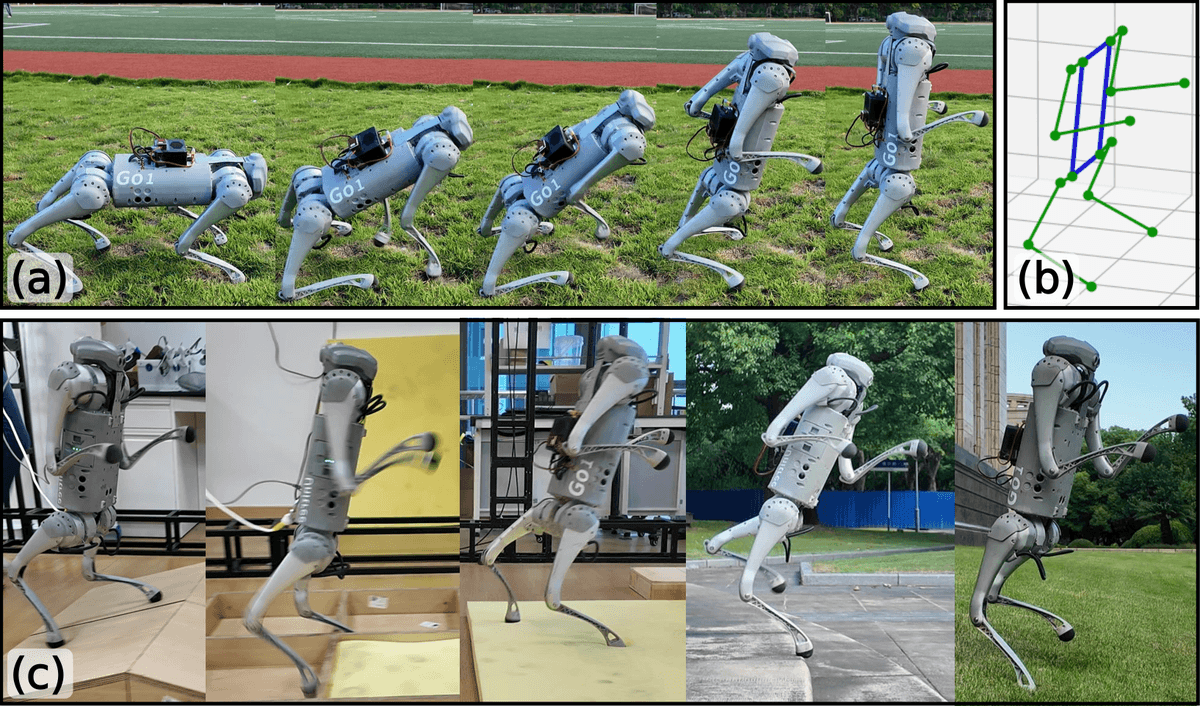
KiRAS targets legged locomotion research where you want diverse behaviors without collecting motion capture. The authors show it transferring to the larger Unitree Go1 by simply rescaling the keyframe joint positions, and extending to a bipedal stance skill by adding one new keyframe and continuing training. The bipedal Go1 traverses 10 cm stairs, discrete stepping stones, sponges, and gravel.
The limits are real too. Single keyframes cannot describe skills whose defining feature is timing rather than posture, such as a specific bounding gait pattern. Skill switching is triggered manually through joystick input rather than autonomously from environmental cues, which the authors flag as future work. The framework also still depends on carefully tuned regularization rewards for real-world safety.
Code and videos are hosted on the project website. For anyone building legged locomotion pipelines, the takeaway is that motion-capture datasets may not be the bottleneck they appear to be. A handful of well-chosen static poses, combined with self-imitation and terrain finetuning on the same network, can go a surprisingly long way.