
Fudan's InterveneBench Reveals GPT-5.1 Gets Policy Causation Right Only Half the Time
A new benchmark reveals that even GPT-5.1 struggles to design real policy studies, and a multi-agent framework closes much of the gap.
 Pro
Takeaways
- InterveneBench tests LLMs on 744 peer-reviewed social science studies requiring end-to-end causal study design.
- Even GPT-5.1 scores only 0.578 aggregate and 49.3% on picking the right identification strategy.
- STRIDES, a seven-agent framework, improves scores by up to 25.1% over vanilla LLMs.
- Best-of-6 sampling with similar compute yields only 7.5% gain, ruling out simple test-time scaling.
- Common failure modes include DiD-vs-IV confusion, under-selection of propensity score matching, and hallucinated causal mechanisms.
- Supervised fine-tuning helps direct inference but breaks the multi-agent setup through catastrophic forgetting.
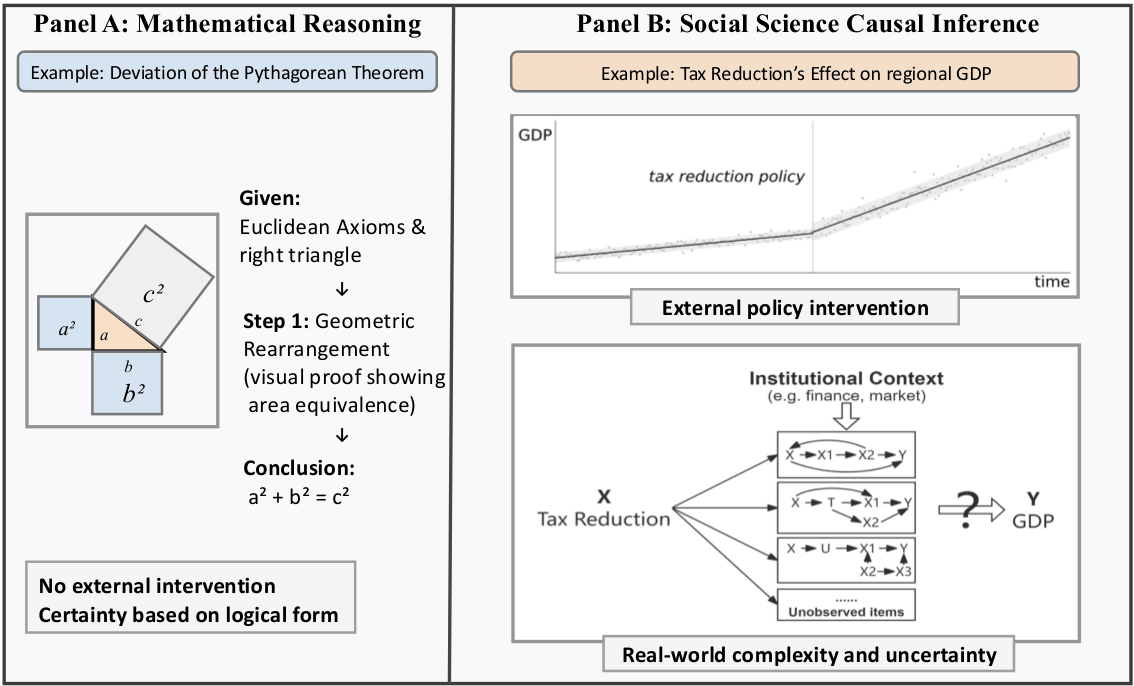
Causal inference in the social sciences is not a tidy math problem. When an economist wants to know whether a tax cut boosted regional GDP, there is no clean formula waiting to be solved. They have to pick an identification strategy, defend a set of assumptions, choose variables, and justify why any observed effect is actually caused by the policy. A new benchmark called InterveneBench tests whether large language models can do that kind of end-to-end reasoning, and the answer is mostly no.
The paper, from researchers at Fudan University and the Shanghai Innovation Institute, argues that existing causal reasoning benchmarks miss the point. Each instance in InterveneBench is derived from an empirical social science study and requires models to reason about policy interventions and identification assumptions without access to predefined causal graphs or structural equations. That structure-agnostic setup is what makes it hard, and it is where current frontier models fall over.
Why closed-form causal benchmarks aren't enough
Most prior work treats causality as a closed problem. Benchmarks like CLADDER or CausalBench give a model a defined graph or set of variables and ask it to compute an intervention. Real policy research does not work that way. The researcher does not know the true causal structure, cannot observe every confounder, and has to pick among methods like difference-in-differences (DiD), instrumental variables (IV), regression discontinuity (RD), synthetic control, or propensity score matching based on institutional context.
InterveneBench pushes on exactly this gap. InterveneBench comprises 744 peer-reviewed studies across diverse policy domains. The papers span nine domains including public health, education, macroeconomics, environmental policy, and housing. To avoid the obvious problem of models simply memorizing famous studies from pretraining, the authors carved out a time-restricted test set of 74 papers published in 2025, keeping the remaining 670 as a Legacy Set for supplementary analysis.

How the benchmark is built
Constructing a research-grade benchmark from unstructured PDFs is itself a hard problem, so the team used a human-in-the-loop pipeline of five agents:
- A Coordinator that schedules the workflow as a directed acyclic graph and handles errors.
- A Paper Interpreter that parses PDFs and extracts policy background, timelines, and data sources.
- A Causal Designer that reverse-engineers the identification strategy the original authors used.
- A Verifier that self-checks the extracted design against the source text and routes anything scoring below 0.9 to human expert review.
- A Formatter that maps approved designs into a standardized JSON schema.
Four domain experts with graduate training in economics and public policy reviewed every instance. Cross-model extraction consistency between GPT-5.1 and Gemini-3-Pro hit Cohen's kappa values between 0.663 and 0.928 across fields, suggesting the ground truth is genuinely stable.
Frontier models score surprisingly low
Here is the sobering part. Even the strongest model, GPT-5.1, achieves an aggregate score of 0.578, and only 49.3% accuracy on model selection. These results highlight persistent weaknesses in current LLMs' capacity to support end-to-end real-world study design and interventional reasoning. Model selection means picking the right identification strategy given the policy setup, which is arguably the most consequential decision in a study. Getting it right barely half the time is a serious problem.
Vanilla scores for other frontier models on the aggregate metric look like this:
| Model | Final Score | Model Type Accuracy |
|---|---|---|
| GPT-5.1 | 0.578 | 0.493 |
| Claude 3.7 Sonnet | 0.544 | 0.519 |
| Claude Sonnet 4 | 0.539 | 0.541 |
| GLM-4.6 | 0.531 | 0.535 |
| Gemini-2.5-Pro | 0.497 | 0.477 |
| Grok-4 | 0.464 | 0.424 |
| Kimi-K2 | 0.415 | 0.361 |
The authors describe the failure mode bluntly: LLMs act as sophisticated semantic extractors, not as causal study designers. They can pull out the relevant policy entities but frequently fail to synthesize them into a coherent identification strategy that is theoretically compatible with the data structure.
STRIDES: expert collaboration as a workflow
The second contribution is a multi-agent framework called STRIDES (Social Theory-guided Research for Intervention Design, Estimation, and Scrutiny). It decomposes the research workflow into three sequential modules powered by seven specialized agents:
- Strategic Research Design. A Theory Architect agent builds hypotheses from an embedded knowledge base of economics and sociology, then a Methodology agent translates them into a formal identification strategy with defined treatment and outcome variables.
- Data Environment Instantiation. A Data Retrieval agent maps abstract concepts to measurable indicators, while a Simulation agent generates synthetic mock data with plausible effects and noise so the design can actually be tested.
- Code-Based Adversarial Verification. A Code agent writes executable Python using tools like
statsmodels, runs it on the mock data, and passes results to a Critic agent that checks for statistical pitfalls (multicollinearity, failed parallel trends) and logical deviations (coefficient signs contradicting theory). If the Critic rejects, the pipeline iterates.
STRIDES is implemented on top of LangGraph, with reasoning agents pinned to temperature 0 and generative agents set to 0.7.
The gains are large and not just from more compute
Wrapping vanilla models in STRIDES delivers consistent double-digit gains. Relative to their baselines, improvements range from about 15% for GPT-5.1 and DeepSeek-v3.2 up to roughly 25% for Gemini-3-Flash, Grok-4, Kimi-K2, and GPT-OSS-120B. STRIDES-enhanced Claude family models score highest on model type selection.
The authors ran a critical control: is this just test-time compute scaling in disguise? They tried best-of-6 sampling on Kimi-K2 with a similar token budget (~20,160 tokens vs. ~19,000 for STRIDES). Best-of-6 delivered only a 7.5% gain compared to STRIDES's ~25%. Chain-of-thought plus self-refine landed around 6.1%. The multi-agent decomposition itself is doing the work, not raw sampling.
An ablation study confirms both the theory-and-methodology decomposition and the Critic agent contribute. The Critic matters more for GPT-5.1 and Claude Sonnet 4, while Gemini-2.5-Pro shows stronger intrinsic self-correction from code execution feedback.
Where it still breaks
STRIDES is not a fix-all. Two metrics do not consistently improve with the multi-agent setup: control variables and explanation coherence. The authors attribute this to simulation-induced selection bias, since the requirement to produce executable code pushes agents toward minimal, testable specifications with fewer covariates.
Error analysis on GPT-5.1 with STRIDES also reveals a stubborn DiD-versus-IV confusion. When a policy has both a temporal rollout (favoring DiD) and potential endogeneity (favoring IV), 8 of 42 DiD instances get misclassified as IV. Propensity score matching is the most under-selected method, and even when the model type is right, causal mechanisms can be plausible-sounding but factually wrong.
Fine-tuning barely helps either. The team tried supervised fine-tuning of Qwen3-32B on both the Legacy Set and CauSciBench, and results were essentially identical across sources. Direct inference improved by 7.6% after SFT, but performance under the multi-agent framework stayed flat, suggesting SFT induces catastrophic forgetting that undermines the specialized agent roles.
Why this matters
InterveneBench is the first benchmark to jointly evaluate end-to-end study design, real-world grounding, interventional reasoning, and structure-agnostic settings. That combination is what actual policy researchers need if they want to use LLMs as collaborators rather than as autocomplete for the methods section. The 744-study dataset, the STRIDES framework, and the evaluation rubric are all available in the linked GitHub repository, giving anyone building agentic systems for social science research a concrete target to beat.