
Fudan's FlashMotion Beats Slow Video AI Models at 47x Their Speed
FlashMotion cuts trajectory-controlled video generation to four denoising steps, delivering up to 47x speedup while beating multi-step baselines on quality and motion accuracy.
 Pro
Takeaways
- FlashMotion distills trajectory-controlled video generation to 4 denoising steps, reporting up to 47x speedup over prior SOTA.
- Three-stage recipe: train slow adapter on Wan2.2-TI2V-5B, distill generator via DMD, then realign adapter.
- Stage 3 uses a trajectory-aware DiT discriminator plus a scheduled diffusion loss to fight blur and drift.
- ResNet adapter denoises a video in 11 seconds on a single A100, ControlNet variant in 24 seconds.
- Ships training code, weights, and the FlashBench long-sequence benchmark on GitHub.
- Accepted to CVPR 2026; requires 42-50 GB GPU memory for inference on the two adapter variants.
Controllable video generation has a speed problem. Adapter-based methods that let you drag objects along a predefined path produce sharp, obedient motion, but they inherit the multi-step denoising cost of the underlying diffusion model. A new CVPR 2026 paper from Fudan University and Microsoft Research Asia, FlashMotion, cuts that cost dramatically and, surprisingly, ends up beating the slower models it was distilled from.
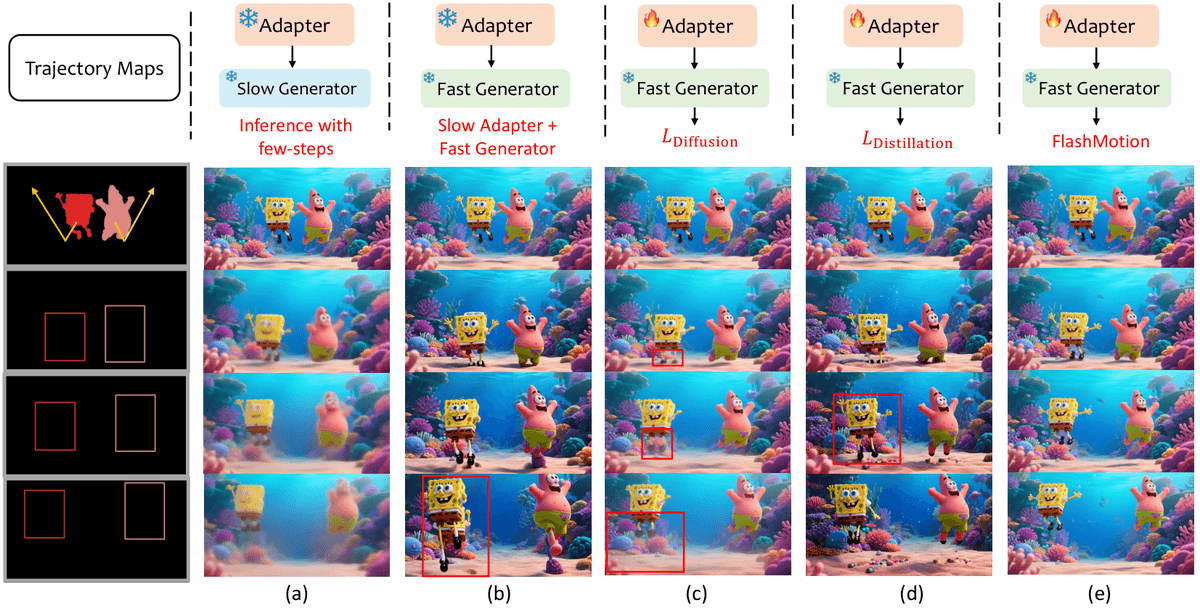
Previous methods mainly use adapter-based architectures for precise motion control along predefined trajectories, but all of them rely on a multi-step denoising process, leading to substantial time redundancy and computational overhead. The obvious fix, running one of the standard video distillation recipes on top of a trajectory adapter, breaks in an interesting way: directly applying these approaches to trajectory-controllable video generation results in noticeable degradation in both video quality and trajectory accuracy. The adapter was trained against the trajectory of a 40-step denoiser, and when you swap in a 4-step one, the guidance signal no longer lines up with what the generator is doing.
Three stages instead of one shortcut
FlashMotion is really a training recipe, not a new architecture. It splits the problem into three sequential stages that each fix what the previous one broke.

- Slow Adapter. A trajectory adapter is trained on top of a frozen multi-step generator, in this case Wan2.2-TI2V-5B, a DiT-based image-to-video model. Trajectory maps (segmentation masks or bounding boxes) are encoded by a pretrained 3D VAE and injected into the DiT blocks through zero-initialized convolutions. Training goes dense-to-sparse: start with per-pixel masks, then fine-tune with looser bounding boxes.
- Fast Generator. The base video model is distilled from many steps down to four using Distribution Matching Distillation (DMD). DMD trains the student by pushing its output distribution toward the teacher's using the difference between a real score model and a fake score model, rather than mimicking the teacher's per-step outputs directly.
- Fast Adapter. The Slow Adapter is fine-tuned to talk to the new 4-step generator. This is the stage where naive distillation fails, and it is where most of the paper's engineering sits.
Why the adapter needs its own adversarial trainer
Stage 3 is the interesting part. If you retrain the adapter with a plain diffusion loss on 4-step outputs, you get blur, because pixel-level MSE averages out the sharp textures a few-step generator would otherwise produce. If you use pure adversarial loss, trajectory accuracy drifts. FlashMotion combines both.
The discriminator is not a small CNN head. It is initialized from the SlowGenerator's own DiT backbone and reads the diffused latents through three attention paths: a semantic self-attention over the first frame and text prompt, a cross-attention over the trajectory maps, and a cross-attention over the video tokens. In other words, the discriminator is aware of the trajectory it is supposed to enforce, so it can penalize the adapter both for producing blurry frames and for straying off the path.
Because gradients from the GAN objective and the diffusion objective are on very different scales, the authors use a dynamic weighting schedule, λ = (1 / 4e-3) * step^0.1, that grows the diffusion loss weight slowly over training. The ablations show that removing any one of the diffusion loss, the GAN loss, the dynamic scaling, or the specialized discriminator all hurt the final result.

Numbers, hardware, and a new benchmark
The headline speedup: FlashMotion reaches up to a 47x speedup over the previous state-of-the-art while, according to the experiments, still coming out ahead of the multi-step models on both visual quality and trajectory consistency. On a single A100 the ResNet adapter denoises a video in about 11 seconds and the ControlNet adapter in about 24 seconds, using roughly 42 GB and 50 GB of GPU memory respectively.
The authors also release FlashBench, a benchmark aimed specifically at long-sequence trajectory videos. It stratifies test clips by the number of foreground objects and reports four metrics: FID and FVD for visual quality, and Mask_IoU and Box_IoU for how faithfully generated motion tracks the input trajectory. Existing controllable-video benchmarks mostly cover short clips, and the distribution in FlashBench is heavily weighted toward the 300+ frame range, which is where cheap adapters tend to fall apart.
What is actually open
The repository at quanhaol/FlashMotion ships more than a paper release usually does:
- Inference and training code for all three stages, plus configs for both the ResNet and ControlNet adapter variants.
- Model weights on Hugging Face for the FastGenerator and both Fast/Slow Adapters.
- The FlashBench evaluation set and the underlying MagicData training dataset, which contains video, per-frame masks, and per-frame bounding boxes.
- A trajectory construction pipeline for building your own box tracks from a source video, borrowed from the authors' earlier MagicMotion project.
Inference is a two-line invocation once weights are downloaded:
bash running_scripts/inference/i2v_control_fewstep_resnet.sh
bash running_scripts/inference/i2v_control_fewstep_controlnet.sh
When it is worth using, and when it is not
FlashMotion is a good fit if you want an image-to-video pipeline where a user or an upstream system draws a bounding-box path per object and expects the object to follow it faithfully, at interactive-ish latencies. Storyboarding tools, game cinematic previews, ad creative iteration, and dataset generation for embodied-AI training are the obvious targets. The 47x speedup matters most in exactly these iteration-heavy workflows, where 40-step diffusion turns every experiment into a coffee break.
The limits are also fairly clear. You still need a 40 to 50 GB GPU to run inference. The adapter is trained on box and mask trajectories, so freeform prompts like “the camera dollies left” are not the target use case, that is a different kind of control. And the method is tied to the Wan2.2-TI2V-5B backbone; porting to a newer base model means redoing all three training stages.
The real contribution here is subtler than another distillation paper. FlashMotion is a demonstration that when you distill a diffusion model, any adapters trained against the teacher are effectively broken, and that fixing them requires their own hybrid objective, in this case a trajectory-aware discriminator plus a scheduled diffusion loss. Anyone maintaining ControlNet-style modules on top of accelerated video models will run into the same problem, and this paper is a reasonable template for solving it.