
Fudan's FCMBench Stress-Tests 28 Vision Models on Fake Loan Documents
A new financial credit benchmark from Qifu Technology tests 28 vision-language models on real document workflows, with Gemini 3 Pro leading at 65.16 F1.
 Pro
Takeaways
- FCMBench is the first large-scale multimodal benchmark built specifically for financial credit review workflows (paper).
- 26 certificate types, 5,198 privacy-safe images, 13,806 VQA pairs, 7 tasks and 10 robustness challenges.
- All documents are synthetically designed, physically printed, then photographed to avoid privacy leaks entirely.
- Gemini 3 Pro tops the leaderboard at 65.16 F1; Kimi-K2.5 leads open-source models at 60.58.
- DeepSeek-OCR paired with DeepSeek V3.2 scores just 34.01, showing two-stage OCR pipelines lag end-to-end VLMs.
- Every model degrades under real-world photo artifacts like blur, crops and multi-document frames.
Automating loan approvals means reading messy phone photos of ID cards, bank statements, tax certificates and property documents, then reasoning across them to catch inconsistencies. It is exactly the kind of grungy, high-stakes work that vision-language models should be good at, but nobody has been able to benchmark it publicly because the source data is a privacy minefield. A team at Qifu Technology, Fudan University and South China University of Technology just released FCMBench, a credit-focused multimodal benchmark that sidesteps the privacy problem by fabricating every document from scratch and then photographing them under realistic conditions.
The dataset is not small. FCMBench covers 26 certificate types, with 5,198 privacy-compliant images and 13,806 paired VQA samples, spanning both Chinese and English documents. It evaluates models on Perception and Reasoning tasks under real-world Robustness interferences, including 3 foundational perception tasks, 4 credit-specific reasoning tasks demanding decision-oriented visual evidence interpretation, and 10 real-world challenges for rigorous robustness stress testing.
Why existing benchmarks miss the mark
Credit review is a specific workflow with its own failure modes. General-purpose benchmarks like MME assess broad perception and cognition but lack domain specificity; document understanding benchmarks such as OCRBench and ChartMuseum focus on OCR and chart reasoning but not credit-specific workflows; even financial-domain benchmarks prioritize financial knowledge and analysis over credit review, with limited and fragmentary credit-related images and tasks due to privacy constraints. Real loan review is less about knowing macroeconomics and more about verifying whether the address on a household register matches the ID card, whether an income certificate is plausible given the tax filing, and whether the photo is even in focus.
How they built a photorealistic dataset without leaking anyone's data
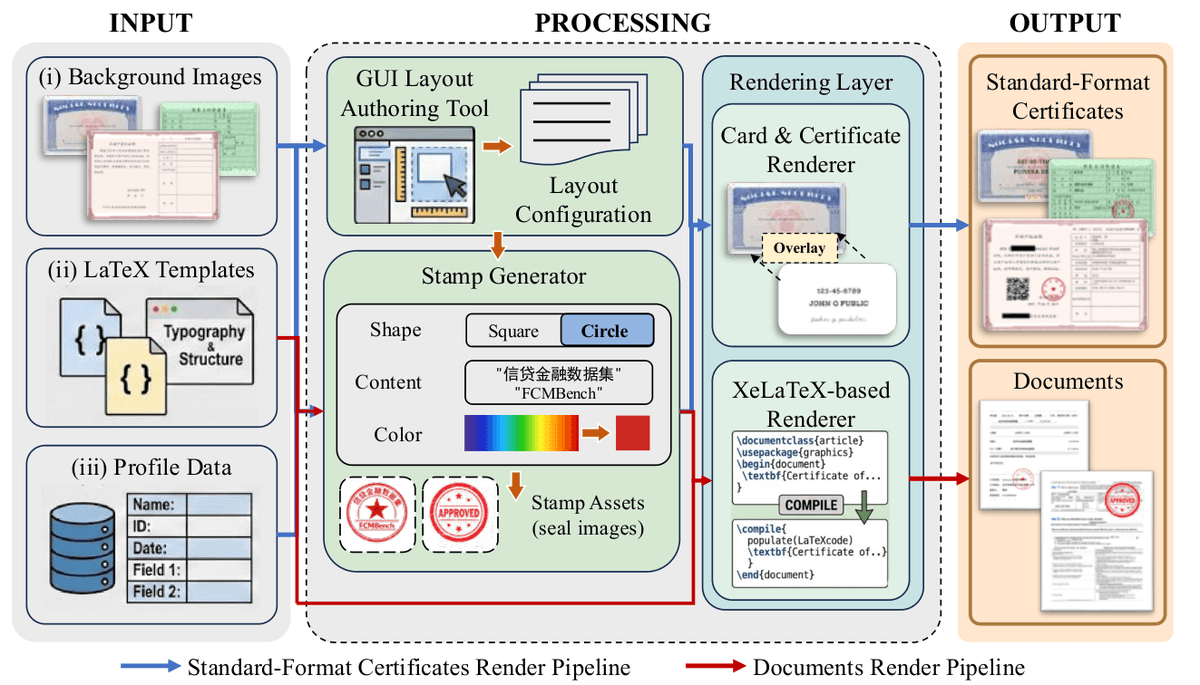
The construction pipeline is the most interesting engineering piece. All images are generated via a fully controlled synthetic-to-physical workflow. FCMBench is organized around a moderate-sized pool of fictional identities with diverse demographic and economic attributes. For each identity, they generate a full application profile spanning multiple documents so that names, IDs, addresses, and financial values match across certificates, then physically fabricate the paperwork.

Following the synthesis of electronic certificate templates, all certificates were physically fabricated: either as high-fidelity card replicas or printed on standard A4 paper, ensuring dimensional, layout, and material properties consistent with their real-world equivalents. A team of eleven photographers then shot the physical documents under different conditions to create the robustness splits.
The seven tasks map directly to real credit-review stages:
- Image Quality Evaluation (IQE) the desk-reject filter for blurry or reflective uploads.
- Document Type Recognition (DTR) completeness screening across single or multi-doc images.
- Key Information Extraction (KIE) pulling structured fields into the applicant profile.
- Consistency Checking (CC) verifying that documents describe the same person.
- Validity Checking (VC) policy and format compliance, expiry dates, ID formats.
- Numerical Calculation (NC) aggregating figures like average monthly income.
- Rationality Review (RR) plausibility checks across income, tax and bank statements.
The robustness axis layers ten realistic photo problems on top of every task, including off-axis angles, uneven lighting, specular reflections, defocus blur, small regions of interest, secondary captures (photos of a screen), cluttered backgrounds, watermarks, cropping and multi-document frames.

The scoring is deliberately strict
Credit fields are legally atomic, so the benchmark refuses to give partial credit for paraphrases. FCMBench adopts an exact-match oriented evaluation for atomic values. Semantic equivalence such as paraphrased addresses or reworded entities is not treated as correct, because such outputs are not actionable in downstream compliance checks and risk control workflows. Outputs are flattened into order-invariant key-value sets with tailored normalization for dicts, lists and primitives, then scored with set-based precision, recall and F1. Numerical calculation tasks tolerate differences under 2.
Who wins, and by how much
The team ran 28 vision-language models from 14 organizations across 2025 and 2026 releases. Gemini 3 Pro and Gemini 3 Flash achieve the highest overall averages (65.16 and 64.94, respectively). Among open-source models, Kimi-K2.5 and Qwen3.5-397B-A17B are the strongest baselines (overall averages are 60.58 and 53.38), which are comparable to other commercial models. The full field averages roughly 44.8 F1 with a standard deviation of 10.3, so the benchmark actually separates model tiers rather than saturating.
Two results stand out. First, the two-stage pipeline of DeepSeek-OCR feeding DeepSeek V3.2 lands at 34.01 overall, well below end-to-end VLMs. The OCR-dependent pipeline underperforms end-to-end VLMs in general, highlighting the fragility of two-stage approaches. Second, extraction has largely converged while reasoning has not. KIE performance is relatively clustered, with Gemini 3 Pro at 43.36, Gemini 3 Flash at 43.99 and Kimi-K2.5 at 45.28, suggesting that state-of-the-art VLMs have converged to a comparable level of key information extraction under these templates. The credit-specific reasoning tasks fan out much more widely.
Robustness is still an unsolved problem
Every model degrades when photos are blurry, cropped, or contain multiple documents in one frame. In the human study the authors ran, annotators also lose ground on the hardest artifacts, which suggests some fraction of the failures reflect real information loss rather than model weakness. Still, the practical takeaway for anyone deploying a VLM into a credit pipeline is that overall leaderboard scores hide systematic failure modes. The authors recommend capture-side guidelines like re-capture prompts, automated quality gates that detect blur or crops, and targeted finetuning on the dominant degradation modes.
Availability
FCMBench is open-sourced with dataset and evaluation code, and the paper links a companion Examples.html file that maps each task and subtask back to the credit-review workflow with prompt-image-answer cases. For teams building document AI for finance, insurance, or any domain where atomic field accuracy matters more than fluent paraphrase, this benchmark offers something rare: a hard, realistic test that does not depend on scraped private documents.