
Fudan's CCTU Benchmark Exposes AI Agents Failing Rules 80% of the Time
A new benchmark reveals that top LLMs including GPT-5.2 and Claude Opus 4.6 fail more than 80% of constrained tool-use tasks.
 Pro
Takeaways
- Fudan University released CCTU, a benchmark for LLM tool use under complex constraints.
- No frontier model exceeds 20% task completion when strict constraint adherence is required.
- 200 test cases average 7 constraints and 4,754 tokens across 12 constraint categories.
- GPT-5.2 leads on strict Perfect Solve Rate; Claude Opus 4.6 wins on Solve Rate via self-refinement.
- Models violate constraints in over 50% of cases, worst in resource and response dimensions.
- Data and code available on Hugging Face and GitHub.
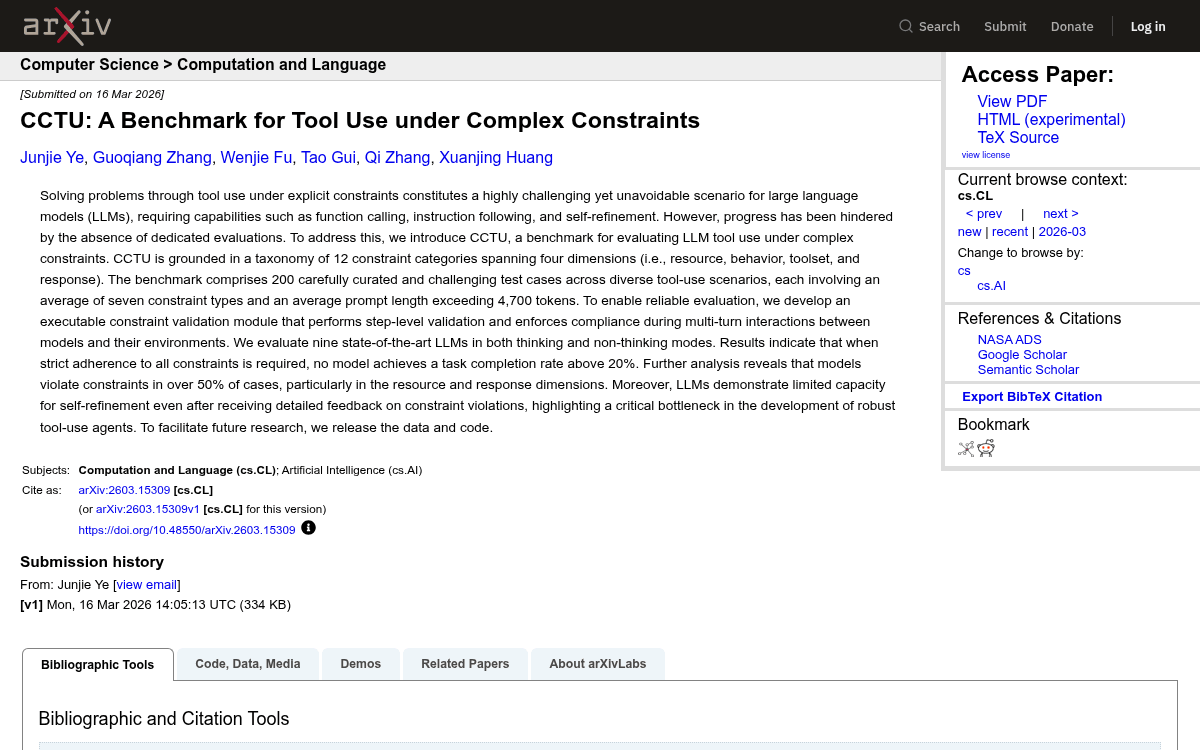
Tool-using agents look impressive in demos, but real deployments come with strings attached: latency budgets, rate limits, response formatting rules, and hard limits on how many times a given API can be hit. A new benchmark from Fudan University called CCTU puts nine frontier models through that gauntlet, and the results are brutal. No model achieves a task completion rate above 20% when strict adherence to all constraints is required, and most sit below 15%.
The gap between calling a tool and following the rules
Existing tool-use benchmarks tend to ask a narrow question: did the model eventually get the right answer? That misses the messier reality of production agents, where the path matters as much as the destination. A model that can correctly invoke different tools may still fail to consistently adhere to specified constraints, while a model with strong instruction-following ability may struggle to differentiate the functional roles of distinct tools.
The authors argue that three capabilities have to work together for constrained tool use: picking the right function, following instructions across long horizons, and self-correcting when the environment pushes back. Prior benchmarks like IFEval, BFCL, and τ-bench each cover one slice, but none stress all three at once.
Twelve constraints across four dimensions
CCTU is built around a taxonomy that groups real-world restrictions into four buckets, each with three concrete constraint types:
- Resource: interaction rounds limit the total exchanges between model and environment. Tool call count restricts the total number of tool invocations permitted during task execution. A third rule caps invocations of specific tools.
- Behavior: sequential dependencies (tool A before B), parallel dependencies (tools that must fire together), and limits on how many parallel calls are allowed per turn.
- Toolset: which tools and parameters are permitted, which parameters are required, and correct parameter types.
- Response: length bounds, format (JSON, tables, plain text), and required content elements.
The benchmark comprises 200 carefully curated test cases across diverse tool-use scenarios, each involving an average of seven constraint types and an average prompt length exceeding 4,700 tokens. Cases are built on top of the earlier FTRL dataset and span single-hop, parallel single-hop, multi-hop, and parallel multi-hop query structures across 28 domains.
Step-level validation instead of end-of-run grading
The interesting engineering piece is an executable validation module. After every model output, generated Python handlers inspect the accumulated interaction log to check each active constraint. If a rule is violated, the module injects detailed feedback as a tool or user message and asks the model to revise, without spawning a new role that would break the model's inference configuration.
That design also enables a stricter scoring metric. The authors report two numbers: Solve Rate (SR), which allows soft-satisfied constraints that were initially violated and then corrected, and Perfect Solve Rate (PSR), which requires zero violations throughout the trajectory.
Where the frontier actually lands
The evaluation covers Claude Opus 4.6, GPT-5.1, GPT-5.2, Gemini 3 Pro, DeepSeek-V3.2, Kimi K2.5, OpenAI o3, Qwen3.5-Plus, and Seed-2.0-Pro, each tested in thinking and non-thinking modes. In thinking mode, GPT-5.2 leads with 18.17% PSR and Claude Opus 4.6 tops SR at 34.17%. The divergence between those two winners is the most telling result in the paper.
GPT-5.2 demonstrates stronger instruction-following capabilities, violating fewer constraints during execution and thus achieving higher PSR. However, when it does encounter errors, it struggles to self-refine, which limits its overall SR. In contrast, Claude Opus 4.6 commits more constraint violations during task execution but compensates through strong self-refinement ability, using feedback to eventually complete more tasks.

Overthinking and stubborn failures
All models exhibit constraint violations in more than 50% of instances, with DeepSeek-V3.2 reaching as high as 86.83%. The worst offenders are resource limits (mostly blowing past tool call budgets) and response content rules (models summarize tool outputs and drop keywords the user explicitly required).
Thinking mode is not a free win. Claude Opus 4.6 and Kimi K2.5 actually regress when reasoning is enabled. Case studies show the models rewriting parameters that were already correct, or ignoring the plain wording of a query to search for locations that were never mentioned. On self-refinement, Claude Opus 4.6 achieves the highest correction rate at 65.36%, while the correction rates of other models remain below 60%, with OpenAI o3 reaching only 18.57%.
What is available
The data lives on Hugging Face and the code, including the constraint validation handlers, is on GitHub. Because the validation module is executable Python that inspects interaction logs, it can be plugged into your own agent framework as a compliance checker, not just as an offline evaluation. The construction pipeline is also documented in the paper, so the same taxonomy can be applied to expand coverage on top of other tool datasets.
The practical takeaway for anyone shipping agents: eventual task success and strict compliance are different problems, and current models are much better at the former. If your product involves rate-limited APIs, structured outputs, or ordered workflows, benchmark on constraints explicitly. The winner on your leaderboard may change.