
FSDAM Predicts Driver Gaze as Well as Models Trained on 658K Frames
A new framework predicts where drivers look and why using only 90 annotated examples, matching models trained on hundreds of thousands of frames.
 Pro
Takeaways
- FSDAM predicts driver gaze and generates structured reasoning from only 90 annotated examples.
- Dual-pathway design separates gaze prediction from caption generation to avoid task interference under low data.
- Training-only vision-language alignment via InfoNCE injects semantic priors without adding inference cost.
- Matches or beats fully-supervised baselines on BDD-A, DADA-2000, DR(eye)VE, and W3D benchmarks.
- Built on frozen LLaVA-Next Mistral-7B, trains only 13.6M parameters (0.2%) via LoRA.
- Code available at github.com/fsdam-vlc/fsdam; struggles with cluttered scenes and cross-modal grounding.
Predicting where a driver looks (and, more importantly, why they look there) has historically required massive eye-tracking datasets. A new paper called FSDAM (Few-Shot Driver Attention Modeling) flips that assumption on its head: it learns joint gaze prediction and structured natural-language reasoning from just 90 annotated frame pairs, and still holds up against baselines trained on hundreds of thousands of examples.
The authors argue that driver attention is not purely perceptual but semantically structured, which means attention shifts can be learned through minimal semantic supervision rather than dense large-scale annotation. That reframing is what makes the tiny training budget viable.
Why gaze prediction has been stuck
Most driver attention models treat the problem as visual saliency estimation, predicting heatmaps from dashcam frames. These methods depend heavily on densely annotated data collected under well-represented conditions, and large-scale gaze data collection is costly, privacy-sensitive, and often lacks diversity in safety-critical or rare scenarios. They also miss the point of human attention, which is forward-looking: drivers anticipate hazards based on rules and context rather than just fixating on bright pixels.
Recent vision-language approaches like LLada and GazeXplain tried to fix the interpretability gap by pairing gaze maps with text, but these approaches typically require tens of thousands of annotated samples to jointly align gaze and language representations. That is a wall for anyone without a labeling budget.
Decomposing attention into four sentences
FSDAM restructures the task. Instead of predicting a single heatmap, it outputs a spatial attention map plus a four-part textual reasoning trace: scene context, current focus, anticipated next focus, and a causal explanation of the shift. Supervision comes from frame pairs that capture clear attention transitions, mined from the BDD-A dataset using KL-divergence peaks between consecutive gaze maps.

The curation is deliberately small. The authors filter clips shorter than 50 frames and retain the top-K = 2 anchor-target pairs per video for temporal diversity, then generate structured captions via GPT-4o with human verification, yielding 90 training examples systematically sampled to evenly cover eight driving scenario categories. Categories include signalized and unsignalized intersections, lane changes, pedestrian crossings, construction zones, and imminent hazards.
The dual-pathway trick
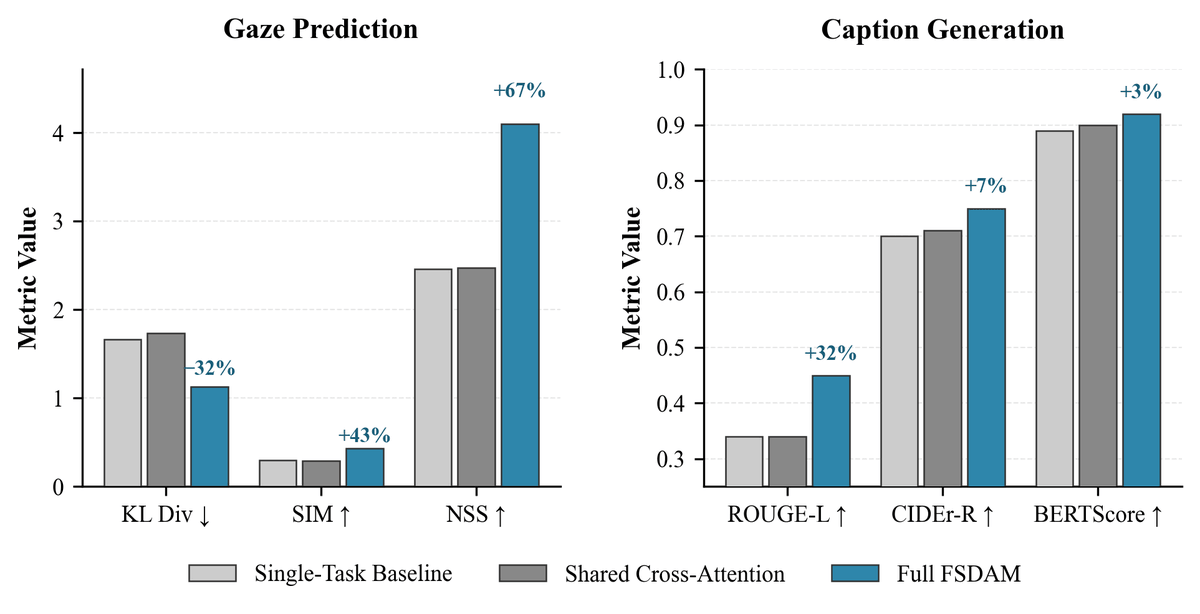
Trying to make one network do both spatial prediction and captioning tends to fail under low data because the tasks fight for capacity. A shared cross-attention module tends to overfit one task and underfit another. FSDAM keeps them separate.
- Backbone: A frozen LLaVA-Next with a CLIP-ViT-L/14 vision encoder and Mistral-7B language model.
- Gaze pathway: A convolutional decoder upsamples 24x24 features to a 64x64 attention grid, supervised with KL divergence plus a blur-gap regularizer that penalizes overly diffuse predictions.
- Caption pathway: Cross-attention over spatial features with prefix-tuning, generating the four structured sentences autoregressively.
- Alignment module (training only): An InfoNCE contrastive loss between gaze-weighted pooled visual features and text embeddings, injecting semantic priors into the gaze decoder without adding inference cost.
- Trainable footprint: 13.6M task-specific parameters, roughly 0.2% of the 7B backbone, updated via LoRA.

Numbers that punch above their weight
On BDD-A, FSDAM reaches CC 0.60 and KL 1.13 with 90 samples. Compared to the fully supervised MINet, FSDAM improves CC by 30% and reduces KL divergence by 89%. The really telling result is the few-shot baseline comparison: classical saliency models such as U2-Net degrade severely to CC=0.10, confirming that appearance-based features cannot generalize under extreme data scarcity, and LLada, despite sharing the same VLM backbone, also drops substantially to CC=0.37 and KL=1.86 when restricted to the same 90 samples.
Zero-shot transfer is where the paper gets interesting. With only 90 training samples, it reaches performance that aligns with or exceeds models trained on much larger datasets, including W3D with ~70K frames, DADA-2000 with 658K frames, and DR(eye)VE with 555K frames. On DR(eye)VE, FSDAM hits the lowest KL divergence at 0.77, a 26% improvement over LLada trained on the full BDD-A set.
For captioning on W3D, FSDAM lands close to fully-trained baselines: BLEU 0.42, METEOR 0.37, and CIDEr-R 0.83 on normal driving scenarios, closely approaching LLada (BLEU 0.44, METEOR 0.36, CIDEr-R 0.96) trained on ~70k samples.
How little data is actually enough
A support-set ablation shows the model saturates fast. The 5-shot model achieves performance that closely approaches the full-data baseline, recovering 96.7% of full-data CC performance and 99.8% of NSS performance with only five support samples. Most of the gain arrives between 1-shot and 3-shot, suggesting the vision-language alignment loss is doing heavy lifting as a semantic prior before spatial supervision even kicks in.
Where it still falls over
The failure analysis is candid. FSDAM stumbles in two recurring ways:
- Imperfect visual prioritization: In cluttered multi-agent scenes, the model captures the general context but distributes attention too broadly, or gets pulled toward visually salient but behaviorally irrelevant objects (including dashboard artifacts).
- Cross-modal inconsistency: The generated explanation can be plausible at the language level while the heatmap points somewhere else entirely, meaning textual coherence does not guarantee faithful visual grounding.
The authors also flag that generalization to extreme weather conditions such as heavy rain or fog remains an open direction for future validation.
Availability and practical fit
Code is published at the FSDAM GitHub repository. This work fits teams building driver monitoring, ADAS interpretability layers, or human-AI collaboration research where collecting eye-tracking data at scale is impractical. It is less suited as a drop-in for production autonomous stacks that need per-frame video reasoning, since inference operates on single frames and temporal modeling is listed as future work. The broader signal here is that structured semantic supervision (four short sentences per example) can substitute for orders of magnitude more annotated pixels, which is a useful pattern well beyond driving.