
FRIEND Catches 5G Eavesdroppers Without Ever Sharing Raw Signal Data
A federated learning framework called FRIEND detects eavesdroppers on cell-free mmWave networks using CSI, boosting secrecy rate by 30% versus non-RIS baselines.
 Pro
Takeaways
- FRIEND uses federated learning across access points to detect eavesdroppers in cell-free mmWave B5G networks.
- Combining FL with multi-RIS coordination lifts secrecy rate by roughly 30% versus non-RIS baselines.
- A DCNN ingests CSI images plus geolocation and transmit-power metadata, trained via FedAvg.
- An early-exit classifier cuts inference time by 35 to 45 percent while keeping accuracy above 0.83.
- Simulated with 500 UEs, 18 APs, 3 RIS units at 28 GHz using MATLAB and TensorFlow Federated.
- No code release; validation is simulation-only, with real-data testing flagged as future work.
Wireless networks headed toward Beyond 5G are getting harder to secure. Access points are spread out without traditional cell boundaries, signals bounce off programmable metasurfaces, and industrial IoT devices are too resource-constrained to run heavy cryptographic stacks. A team from the National Technical University of Athens and the University of Hertfordshire has proposed FRIEND, a federated learning framework that trains edge devices to spot eavesdroppers directly from radio channel data, without ever sharing that data with a central server.
Why physical-layer detection is the new frontier
Encryption sits high in the network stack, but attackers targeting industrial wireless deployments often work at the signal level. Physical Layer Security techniques play a vital role in safeguarding sensitive transmissions against eavesdropping threats in Beyond 5G environments, but traditional security mechanisms face scalability and privacy limitations, and centralized machine learning training is not feasible due to the huge amount of data generated by participating devices and privacy concerns.
The setup FRIEND targets is a mouthful but increasingly common: cell-free millimeter-wave networks assisted by Reconfigurable Intelligent Surfaces, or RIS. These are programmable panels of tiny reflectors that can be tuned to steer radio waves. In principle, a well-configured RIS can amplify signal quality for legitimate users while starving nearby eavesdroppers of usable signal. In practice, tuning them jointly with a security policy across dozens of distributed access points is a research problem.

How FRIEND works
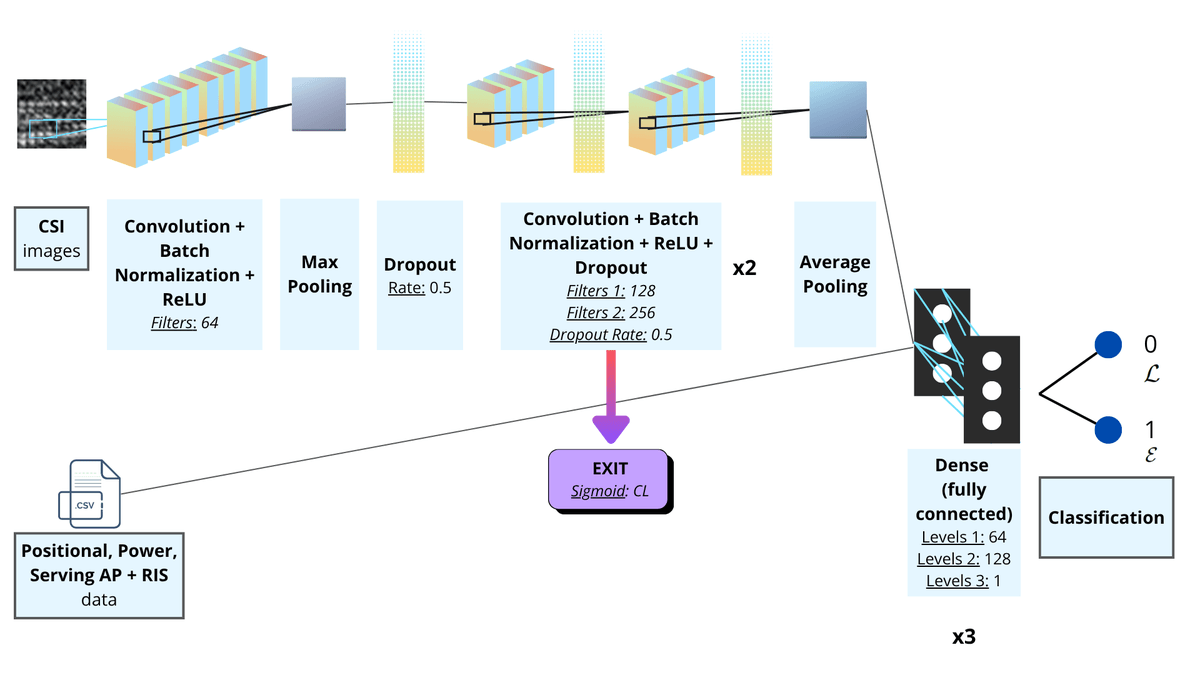
The framework treats eavesdropper detection as a binary classification task on Channel State Information (CSI), the fingerprint of how a signal traveled from a user to an access point. Edge devices collaboratively train a Deep Convolutional Neural Network on locally observed CSI, eliminating the need for raw data exchange. Each access point acts as a federated client, trains locally, and periodically ships weights (not data) to a central aggregator running the Federated Averaging algorithm.
A few design choices are worth calling out:
- Multi-modal input. The DCNN ingests CSI as image-like tensors, then fuses in six extra numerical features: user transmit power and the 3D coordinates of the user, its serving AP, and the RIS node.
- Association by signal, not distance. Users are attached to whichever AP and RIS give the best received SNR, which better reflects real mmWave deployments where blockage matters more than geometry.
- Early-exit head. An auxiliary classifier is inserted after the second convolutional block. If its confidence on a given sample exceeds a threshold, inference stops there. This is critical for resource-constrained APs that cannot afford full-model traversal for every packet.
- Loss. Standard binary crossentropy, built with the Keras Sequential API.
What the numbers say
The team simulated a dense industrial deployment at 28 GHz with 500 UEs (70% legitimate, 30% eavesdroppers), 18 APs, and 3 RIS units, following 3GPP TR 38.901 channel models. They ran 100 Monte Carlo simulations across different RIS phase configurations and evaluated the trained DCNN in TensorFlow Federated.
Detection performance sits in a solid but not superhuman range: accuracy between 0.71 and 0.93 with an interquartile median around 0.84, and recall reaching up to 0.95. That recall matters more than raw accuracy here, because a missed eavesdropper directly compromises secrecy.

The early-exit trick delivered the sharpest efficiency win. Inference time dropped by roughly 35% at a 70% confidence threshold and 45% at 55%, while accuracy stayed above 0.83. On the security side, the best RIS phase configuration produced roughly a 30% higher average secrecy rate compared to the authors' previous centralized non-RIS baseline in the same L-to-E ratio range, with the best configurations pushing past 20 bps/Hz.
The real breakthrough, and the caveats
Prior work has looked at physical-layer security, RIS, and federated learning in isolation. The novelty here lies in the unified treatment of active eavesdropper detection within a cell-free mmWave network enhanced by multiple RIS units, combining these technologies into a scalable simulation framework. Practically, this means an AP can classify malicious users while simultaneously benefiting from RIS-shaped propagation that favors legitimate links.
There are honest limitations. The evaluation is entirely simulation-based; the authors flag real-data validation as future work. Recall variability was traced to edge cases where eavesdroppers sit near RIS units with power profiles very similar to legitimate users. And some RIS phase settings inflate the apparent secrecy rate simply by biasing conditions in favor of legitimate users, which the paper carefully distinguishes from genuine detection quality by comparing against a non-ML label-based curve. There is also no code release announced; the simulator and models exist as MATLAB and Python assets described in the paper but not published.
When it is useful
FRIEND is most relevant if you are:
- Designing physical-layer security for industrial IoT deployments where devices cannot ship raw CSI to a cloud.
- Working with RIS-assisted cell-free architectures and need a joint story for beam configuration plus threat detection.
- Building latency-sensitive inference on edge radios where early-exit CNNs can preserve throughput.
It is less useful today for anyone hoping to drop in a working detector for a live 5G testbed. The framework is a reference blueprint validated in simulation, with the training pipeline, model shape, and RIS integration mapped out in enough detail to reproduce. Whether the numbers hold under real channel measurements is the next test.