
Freiburg's ProReFF Teaches Robots to Find Objects Like Humans Do
ProReFF learns where objects live in 3D space from raw RGB-D video alone, making robots 20% more efficient at finding objects than the best existing baselines
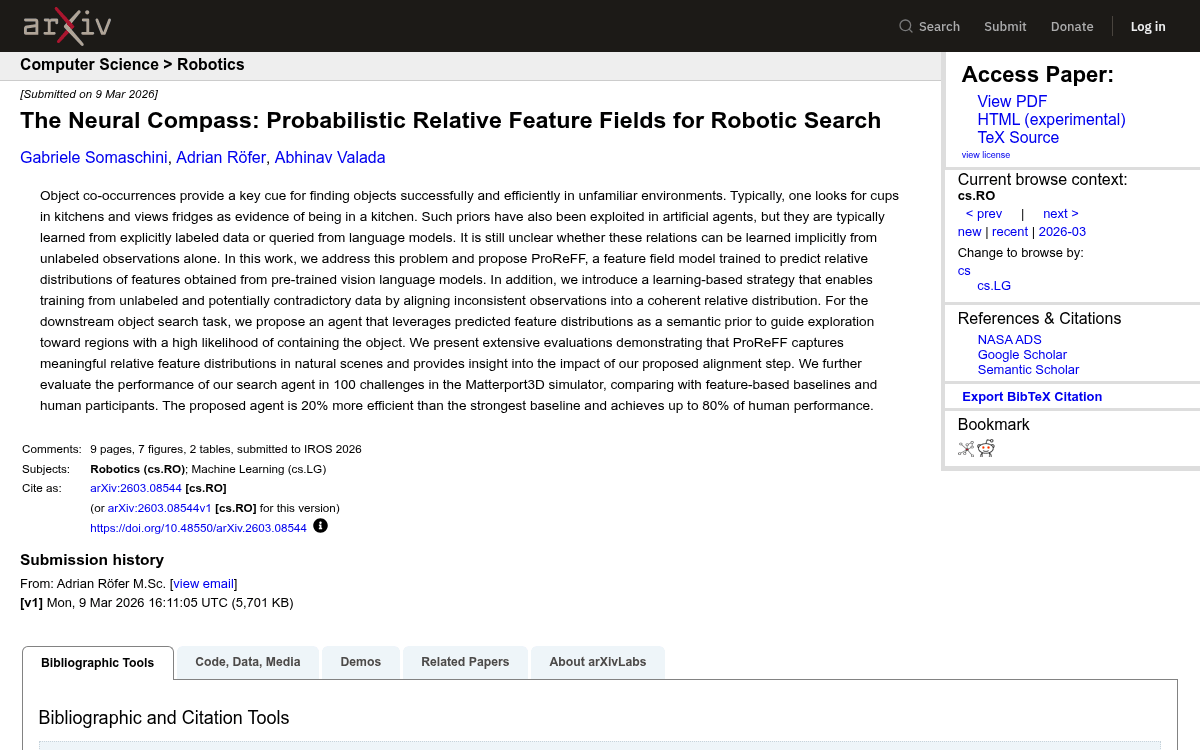 Pro
Takeaways
- ProReFF is a neural model that learns object co-occurrence priors from raw RGB-D video alone, with no object labels required.
- It predicts a probability distribution over what features (objects/surfaces) are likely to exist at any 3D offset from a given query location.
- A learned Alignment Network resolves contradictory training data caused by viewpoint ambiguity, preventing mode collapse during training.
- A search agent powered by ProReFF achieves 94% success rate and 0.53 SPL on 100 Matterport3D challenges, beating the best baseline by ~20% in efficiency.
- ProReFF is especially strong in multi-floor environments, where simpler feature-following agents fail to reason about staircases and distant rooms.
- Code and trained models will be released upon paper acceptance; preprint available on arXiv.
When you walk into an unfamiliar house looking for a coffee mug, you head to the kitchen. You don't check the bathroom first. This intuition, called object co-occurrence, is something humans develop effortlessly from experience. Teaching robots to do the same has historically required either hand-labeled datasets or querying large language models at runtime. A new paper from the University of Freiburg asks a more fundamental question: can a robot learn these spatial relationships on its own, just by looking at the world?
The answer, according to the paper, is yes. The team introduces ProReFF (Probabilistic Relative Feature Fields), a neural model that learns where things tend to appear relative to other things, trained entirely from unlabeled RGB-D video, with no object labels whatsoever.
The Problem with Existing Approaches
Most object-search agents today fall into one of two camps. The first uses explicitly labeled datasets or internet-mined co-occurrence statistics to build priors like "cups are near fridges." The second uses large language models to reason about object relationships on the fly. Both approaches have a shared weakness: they depend on named objects. If you can't detect or name the thing you're looking for, the whole system breaks down.
A newer class of methods sidesteps labels entirely by using vision-language models like CLIP or DINOv2 to produce rich, continuous feature embeddings for every pixel. These embeddings live in a shared space where semantically similar things cluster together, without any explicit labeling. But even these methods only score what the agent can currently see. They have no mechanism to reason about what's likely to be around the corner.
ProReFF fills that gap. Rather than asking "does this region look like a cup?", it asks: "given that I'm looking at a stove, what kinds of things are probably 2 meters to my left?"

How ProReFF Works
Rather than reconstructing a specific scene, ProReFF encodes the statistical co-occurrence structure across environments. Concretely, it is a neural field, a function that takes two inputs and returns a prediction:
- A query embedding
q: the DINOv2 feature vector of an observed object or surface patch (768-dimensional) - A displacement vector
v: a 3D offset in space relative to the query location
Given these two inputs, the model predicts a mean embedding and a variance representing what is likely to exist at that relative position. The architecture follows the NeRF MLP design (8 layers, 256 hidden units, skip connection at layer 5), but deliberately omits positional encoding. NeRF uses positional encoding to produce sharp, high-frequency reconstructions of specific scenes. ProReFF wants the opposite: smooth, general statistical trends across many scenes.
Training data comes from the Matterport3D dataset, a collection of 90 real indoor buildings captured with RGB-D cameras. For each panoramic viewpoint, the team encodes 18 RGB images with DINOv2, obtaining L2-normalized patch embeddings, then reconstructs a point cloud in the local coordinate frame, assigning each 3D point its corresponding embedding. From each viewpoint, 200 points are sampled, generating 40,000 training triplets per scene. No object labels are ever used.
The Alignment Problem (and Its Fix)
Training on raw observations immediately hits a nasty problem. Because displacement vectors are relative to the observer's viewpoint, the same scene observed from two different angles produces contradictory training data. If you're standing north of a stove, the fridge is "to your left." Standing south, it's "to your right." The same query embedding, the same offset direction, two completely different target embeddings. Feed that to a neural network and it collapses to predicting the mean of everything, which is useless.
The team proposes an alternative approach: learned dataset decomposition. During training, an auxiliary network g is introduced, which observes the full training triple and outputs a rotation vector, using the Rodrigues formula to rotate the displacement vector into a canonical frame before it is passed to the main model. This alignment network learns to resolve contradictions by rotating observations so that they agree, without filtering out any data. Crucially, the alignment network is only needed during training. At inference time, the main model can be queried with arbitrary spherical offsets.

The effect is dramatic. The base model (trained without the alignment network) exhibits severe mode collapse, whereas the aligned model retains substantially more of the semantic diversity around the query embedding. In plain terms: without alignment, the model learns to predict a blurry average of everything. With alignment, it learns to predict distinct, meaningful semantic neighborhoods.
The Search Agent
ProReFF is not just a representation, it also powers a search agent. The agent works as follows:
- At each step, it maintains a growing 3D semantic point cloud of everything it has seen so far, with DINOv2 embeddings attached to each point.
- It checks whether any observed point is already sufficiently similar to the target object embedding (above a threshold
τ = 0.3). If so, it heads there directly. - Otherwise, it queries ProReFF with the target embedding over a sphere of sampled offsets, getting a predicted distribution of what should be nearby.
- It clusters those predictions into K=10 semantic groups (the "field clustering") and compares them against the semantic clusters in each unexplored region of the scene (the "scene clustering").
- It navigates toward the unexplored region whose current observations best match the predicted neighborhood, using Angular Wasserstein distance as the matching score.
To handle cases where no sufficiently good match is found at the current scale, the agent performs an incremental expansion of spatial context, operating at multiple radii simultaneously and committing to the first level at which the current best match represents an improvement. This multi-scale design is what allows the agent to reason about both nearby context ("there's a countertop nearby") and broader room-level context ("this looks like a kitchen area").
Benchmarks and Results
The evaluation uses 20 buildings from Matterport3D not in the training set, with 24 target objects and 100 total challenges. Agents have a maximum of 100 navigation steps and access to perfect 6-DoF poses. The team also ran the same challenges with 15 human participants to establish an upper bound on performance.
| Method | Success Rate | SPL (Overall) | SPL (Multi-Floor) |
|---|---|---|---|
| Random | 0.45 | 0.05 | 0.03 |
| CoW (CLIP) | 0.78 | 0.30 | 0.24 |
| Query Follower (DINO) | 0.86 | 0.44 | 0.34 |
| ProReFF (Ours) | 0.94 | 0.53 | 0.42 |
| Human Participants | 0.95 | 0.66 | 0.62 |
SPL (Success weighted by Path Length) is the key metric here. It penalizes agents that succeed but take unnecessarily long routes, rewarding both finding the object and doing it efficiently. ProReFF achieves an SPL of 0.53 overall, compared to 0.44 for the best feature-based baseline, making it roughly 20% more efficient. Human participants scored 0.66 SPL, putting ProReFF at about 80% of human-level efficiency.
The multi-floor results are particularly telling. All agents show a decrease in SPL in the multi-floor scenario, but ProReFF remains the most robust. Having to pass a staircase creates a bottleneck for less context-aware agents, while ProReFF is able to use the semantic context provided by the learned field to consider the stairwell as a worthwhile exploration direction. The simpler query-following agents, which only reason about what they can currently see, struggle badly when the target is on a different floor.
What This Unlocks, and Where It Falls Short
The practical implications are significant for anyone building embodied AI systems. ProReFF is fully label-free, meaning it can be retrained on any new environment just by collecting RGB-D video. It is also open-vocabulary: because it operates in the continuous DINOv2 feature space (bridged to language via Talk2DINO), it can search for any object you can describe in text, not just a fixed category list.
The limitations are worth noting too. The threshold parameter τ, which controls when the agent switches from ProReFF-guided exploration to direct feature following, is sensitive and likely environment-specific. The ablation shows that performance varies noticeably across τ values, and further study is needed to determine the specificity of τ to the environment. The current evaluation also uses a discrete navigation graph with perfect pose information, which sidesteps the messy reality of continuous movement and localization error in real robots.
There is also an interesting open question the authors raise themselves: how much co-occurrence information is already contained in the feature spaces of VLMs such as DINOv2 and CLIP? The team suspects that the Vision Transformer's self-attention mechanism and VLMs trained on natural images yield features that already encode information about the typical local neighborhood of an object. If that's true, ProReFF's biggest advantage may be specifically in long-range, multi-floor reasoning, where local feature similarity alone is not enough.
Code and trained models are promised upon acceptance of the paper. For now, the full paper and architecture details are available on arXiv. The work points toward a future where robots can navigate unfamiliar homes with something closer to the intuitive spatial reasoning humans take for granted, learned entirely from observation, with no human annotation required.