
Fraunhofer Teaches POSEIDON to Solve Physics Problems From a Single Example
Fraunhofer researchers show that adding PDE residuals to the fine-tuning loss lets foundation models adapt to unseen physics with almost no labeled data.
 Pro
Takeaways
- Fraunhofer team introduces physics-informed fine-tuning for PDE foundation models, adding PDE residuals to the adaptation loss.
- Applied to POSEIDON-T (21M params) on 2D Poisson and Helmholtz downstream tasks.
- Hybrid variant matches data-driven fine-tuning using one labeled sample instead of 32.
- Physics-informed models beat FNO baselines on out-of-distribution source shapes like checkerboards and spirals.
- Data-only models look accurate but fail Laplacian residual checks; physics-informed ones actually satisfy the PDE.
- Fine-tuning takes 37 minutes on an H200 at roughly a quarter the FLOPs of FNO training.
Foundation models for partial differential equations are having their own scaling moment, with pre-trained surrogates like POSEIDON and WALRUS aiming to become the ImageNet of scientific simulation. But there is a snag: adapting them to a new physics problem still tends to require expensive numerical solvers to generate labeled ground truth. A team at Fraunhofer IISB has now shown that you can skip most of that labeling step by borrowing a trick from physics-informed neural networks and folding the PDE itself into the fine-tuning loss.
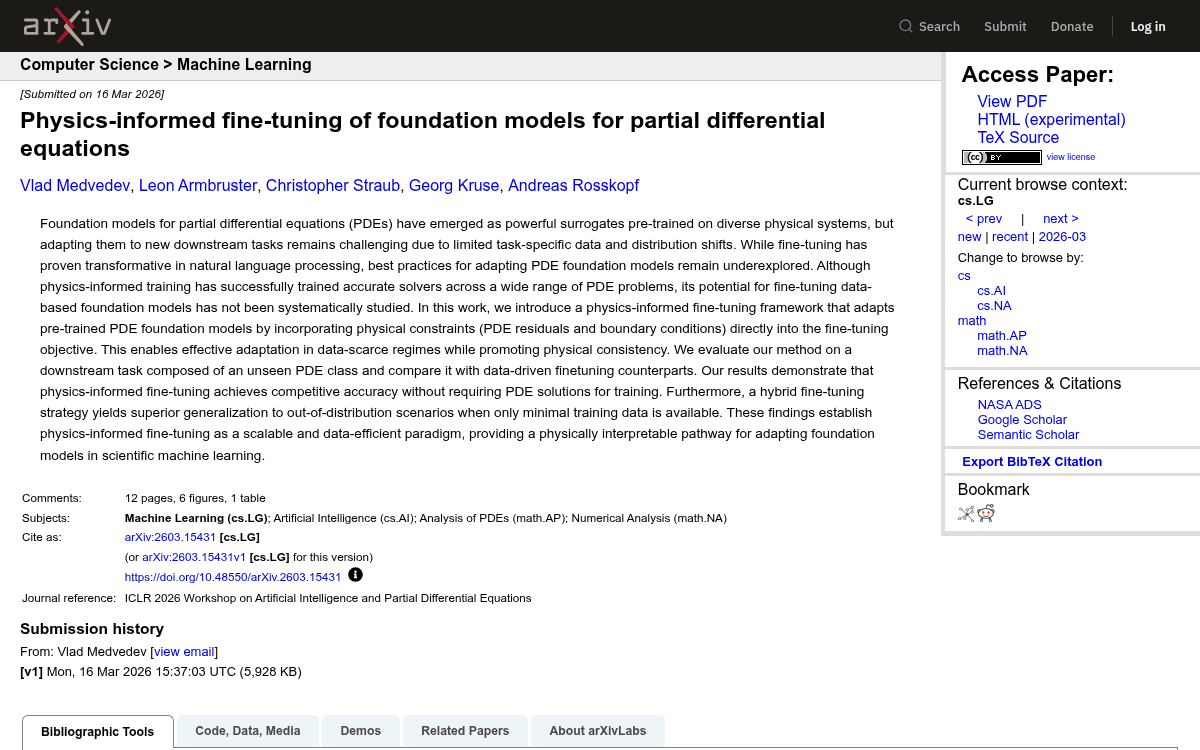
Their paper introduces what they describe as the first systematic study of physics-informed fine-tuning for data-based PDE foundation models, and the results suggest that a single labeled example plus the governing equation can match what data-only fine-tuning gets from dozens of solver-generated samples.
Why fine-tuning PDE models is harder than fine-tuning LLMs
Neural operators like the Fourier Neural Operator learn a mapping from input functions (source terms, boundary conditions) to PDE solutions. They work well, but they are narrow: change the governing equation or shift the input distribution and you usually retrain from scratch. Foundation models such as POSEIDON try to fix this by pre-training a Transformer backbone across many physical systems, then fine-tuning on a downstream task.
The problem is that fine-tuning still needs solver-generated labels, and when those labels are scarce or noisy the model tends to produce statistically plausible but physically wrong outputs. Physics-informed machine learning offers a workaround by adding PDE residuals to the loss, but nobody had systematically tried this on a data-trained foundation model.
Bolting the PDE onto the loss function
The setup is conceptually simple. Instead of only penalizing the mismatch between the model output and a solver-generated solution, the fine-tuning objective also penalizes the residual of the governing PDE, evaluated at collocation points inside the domain using finite-difference derivatives on the discretized output.

A few implementation details matter:
- The model output is zero-padded at the boundary, which enforces Dirichlet conditions exactly and removes the need for a soft boundary penalty term.
- Steady-state PDEs like Poisson are handled as the long-time limit of an evolutionary PDE, matching how POSEIDON was originally set up.
- The entire parameter set stays trainable during fine-tuning rather than freezing the latent backbone.
- A hybrid mode adds unlabeled source terms sampled on the fly, each supervised only by the physics loss, alongside the small labeled set.
The authors use POSEIDON-T (21M parameters) as the foundation model and compare against a parameter-matched FNO trained from scratch. Downstream tasks are the 2D Poisson equation with Gaussian-blob source terms and, in an appendix, the Helmholtz equation.
One labeled sample is enough
The headline result is a data-efficiency curve. In the low-data regime, POSEIDON hybrid can reach solid accuracy from a single labeled source-solution pair, while purely data-driven fine-tuning needs at least 32 labeled pairs to catch up. Purely physics-informed fine-tuning, which uses zero ground-truth solutions, remains competitive with the data-driven baseline in this regime.
Out-of-distribution behavior is where physics really pays off. When the team tested on extreme source shapes never seen during training (sinusoidal waves, checkerboards, Perlin-like noise, random polygons, spirals) the data-driven FNO fell apart, while the physics-informed variants held up because the PDE residual acts as a guardrail. The hybrid POSEIDON was the clear winner because its on-the-fly augmentation exposed it to a much broader distribution of source geometries than the labeled Gaussian-only set.

A subtler point: when they check the actual PDE residual of predictions (via a finite-difference Laplacian stencil), the data-driven model has low pixel error but high residual error. In other words, it has learned an image-to-image mapping that looks right but does not satisfy the equation. The physics-informed models produce solutions that respect the Laplacian much more faithfully, which matters if you plan to plug these surrogates into downstream inverse problems or control loops.
Cost, caveats, and where to be careful
Computationally, the physics loss is cheap. Derivative evaluations are the priciest part of the residual, but the whole thing stays small relative to the forward pass. POSEIDON-T fine-tunes in about 37 minutes on an H200 versus roughly an hour to train the FNO from scratch, at roughly a quarter the FLOPs.
The limitations are honest ones:
- The benchmarks are the steady-state Poisson and Helmholtz equations, which are relatively benign compared to time-dependent or multiphysics systems with sharp gradients.
- The hybrid model shows stagnation on extrapolation as labeled data grows, because those extra labels come from the narrow Gaussian distribution and dilute the diversity gain.
- All experiments reuse POSEIDON's original hyperparameters without physics-specific tuning, so the numbers are conservative rather than optimized.
- No code or checkpoints are released alongside the paper, though POSEIDON and FNO implementations are both publicly available.
The broader implication is that foundation models for physics do not have to inherit the labeled-data appetite of their language-model cousins. If you know the governing equation, and for most engineering problems you do, you can use it as free supervision during adaptation. That reframes PDE foundation models as something closer to a universal prior that gets specialized by physics rather than by yet another sweep of a finite-element solver.