
Fraunhofer's PrototypeNAS Beats MCUNet by 5% Training Only 5 Models
A zero-shot neural architecture search framework designs microcontroller-ready models in minutes by training only 3-5 candidates instead of hundreds.
 Pro
Takeaways
- PrototypeNAS designs microcontroller-ready networks by training only 3-5 candidates instead of hundreds.
- Three-step pipeline: prototype search, hypervolume subset selection, then train the survivors.
- Uses MeCo, ZiCo, NASWOT, and SNIP as competing objectives, not a linearized ensemble score.
- Beats MCUNet by up to 5% accuracy on CIFAR10 at similar FLOPs.
- Cuts search execution time and estimated emissions by 62% versus random sampling baselines.
- Pretrained weights released on Zenodo; targets iMXRT1062 Cortex-M7 with 480KB RAM.
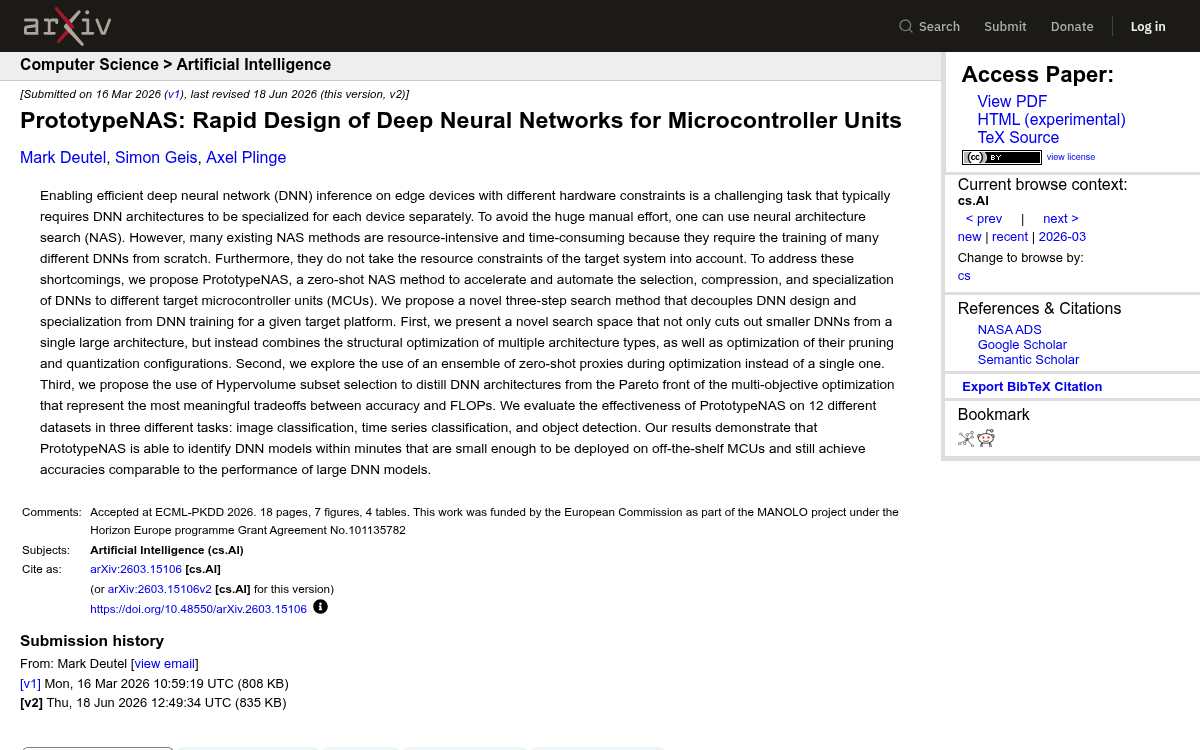
Fitting a modern neural network onto a microcontroller with 480KB of RAM is a design nightmare. You have to pick an architecture, shrink it, prune it, quantize it, and then hope it still learns something useful. A new zero-shot neural architecture search (NAS) method called PrototypeNAS collapses that whole loop into a few minutes of search plus training for only five candidate models.
The framework, from researchers at Fraunhofer IIS, targets ARM Cortex-M class microcontrollers and produces networks that beat MCUNet and NATS-Bench on CIFAR10 at roughly the same compute budget, while cutting search-time emissions by more than half.
The training bottleneck in hardware-aware NAS
Many existing NAS methods are resource-intensive and time-consuming because they require the training of many different DNNs from scratch, and they often ignore the resource constraints of the target system. For microcontroller deployment, that is a double bind: you cannot afford to train hundreds of candidates, and most of what you train will not fit on the chip anyway.
Zero-shot NAS tries to fix this by scoring untrained networks with a cheap proxy metric, but zero-shot proxies are known to be imprecise and biased toward certain architectures, often leading to poor correlation with actual training accuracy. Worse, most zero-shot methods sample subnetworks from a single pretrained super-net, so the search never leaves the neighborhood of one design.
A three-step pipeline that decouples design from training

PrototypeNAS restructures the search into three distinct stages:
- Architectural prototype exploration. A constrained multi-objective optimization searches a joint space of architectures, structural hyperparameters, width multipliers, and pruning sparsities.
- Hypervolume subset selection (HSS). An evolutionary algorithm distills the Pareto front down to 3-5 models that cover the most meaningful accuracy vs FLOPs tradeoffs.
- Dataset evaluator. Only the selected handful of prototypes are actually trained, pruned, and quantized on the target dataset.
The search space is the interesting part. Instead of carving subnetworks out of one supernet, each baseline architecture is abstracted as an initial layer pattern followed by repeatable superblocks and a classifier, with pruning and quantization defined to compress the model during training. The optimizer picks a baseline (MobileNetV2, ResNet18, SqueezeNet, MBedNet, InceptionTime, etc.), decides how many superblocks per group, tunes kernel and stride, scales width, and sets per-group pruning sparsity, all in one shot.
An ensemble of proxies that argue with each other
Rather than combining zero-shot metrics into a weighted score, PrototypeNAS treats four of them as competing objectives: MeCo, ZiCo, NASWOT, and SNIP, chosen because they evaluate different features of an untrained network. The Kendall's tau analysis in the paper shows why this matters: no single proxy correlates well with post-training accuracy across all 12 datasets, and several go negative on some tasks. By keeping them as separate MOO objectives, the search avoids being dragged into the bias of any one proxy.
Feasibility is enforced with hard constraints derived from the target chip. For the iMXRT1062 Cortex-M7 used in the paper, that meant 480KB RAM, 2MB ROM, and a 1 GFLOP ceiling. Candidates that violate any of these never enter the Pareto front.
Results across 12 datasets
The authors evaluated PrototypeNAS on eight image classification datasets (CIFAR10/100, GTSRB, Flowers, Birds, Cars, Pets, ArxPhotos314), three time-series datasets (Daliac, Mafaulda, BitBrain sleep staging), and person detection on a COCO subset using a YOLOv5 detector head on top of the searched backbone.
On CIFAR10, the five prototypes hit 90.0% to 93.7% test accuracy after post-training quantization, at 50-151 MFLOPs and 112-365KB of RAM. Latency on the Cortex-M7 ranged from 224ms to 753ms per inference, and energy from 78mJ to 255mJ measured with a Joulescope. The Pets dataset hit 99.9% and time-series accuracy landed above 96% on Mafaulda and Daliac.

Against MCUNet (TinyNAS), the PrototypeNAS models won by up to 5% accuracy at similar FLOPs. Against NATS-Bench, the searched models were competitive with the best entries in both the topology and size search spaces, despite NATS-Bench having trained 48,393 candidates for up to 200 epochs each while PrototypeNAS trained only five. On the sustainability side, disabling HSS, Bayesian optimization, and zero-shot proxies and falling back to random sampling produced a 62% increase in execution time and a corresponding jump in estimated carbon emissions measured with CodeCarbon.
When to reach for it, and where it breaks down
PrototypeNAS is designed for the case where you need to specialize a model for a specific MCU and dataset, quickly, and you already have a pool of reasonable baseline architectures. It is a good fit for:
- Deploying image, time-series, or lightweight detection models onto Cortex-M class devices with fixed RAM/ROM budgets.
- Iterating on the same task across multiple hardware targets without redoing training runs from scratch.
- Teams that want a small, human-interpretable Pareto set of 3-5 candidates rather than one opaque winner.
The limits are honest ones. The search stays in the neighborhood of its baseline architectures, so it will not invent a fundamentally new topology. RAM ends up dominated by the first few feature maps because of memory reuse during inference, which is why the paper treats memory as a constraint rather than an objective. And post-training quantization worked well for images but not for time series, where quantization-aware training with 15 extra epochs was needed to avoid accuracy loss.
Pretrained weights for the searched architectures are published on Zenodo, though the search framework itself is not linked as a public repository in the paper. For anyone building embedded ML pipelines, the more portable takeaway may be the recipe itself: use an ensemble of disagreeing zero-shot proxies as MOO objectives, constrain by real hardware limits, and let hypervolume selection do the final trimming before you spend any GPU time.