
Forward Correction Fails Even With a Perfect Noise Matrix, Paper Finds
A new paper shows Forward Correction collapses even with a perfect noise transition matrix, redirecting how researchers should approach noisy labels.
 Pro
Takeaways
- Providing Forward Correction with an oracle noise transition matrix still causes accuracy to collapse during training on CIFAR benchmarks.
- The failure is diagnosed at three levels: convergence states, gradient dynamics, and information-theoretic limits of noisy labels.
- Under memorization, FC provably collapses to a hard one-hot vector chosen by the largest entry in T's column.
- Softmax gradient saturation creates dead zones near simplex vertices, trapping SGD at the noisy label rather than the theoretical optimum.
- FEC and JEC, adding self-supervised pretraining and Mixup, push FC to 82.5 percent on CIFAR-10 with 90 percent noise.
- The paper argues LNL research should shift from refining T-estimation to jointly designing losses, optimizers, and richer supervision.
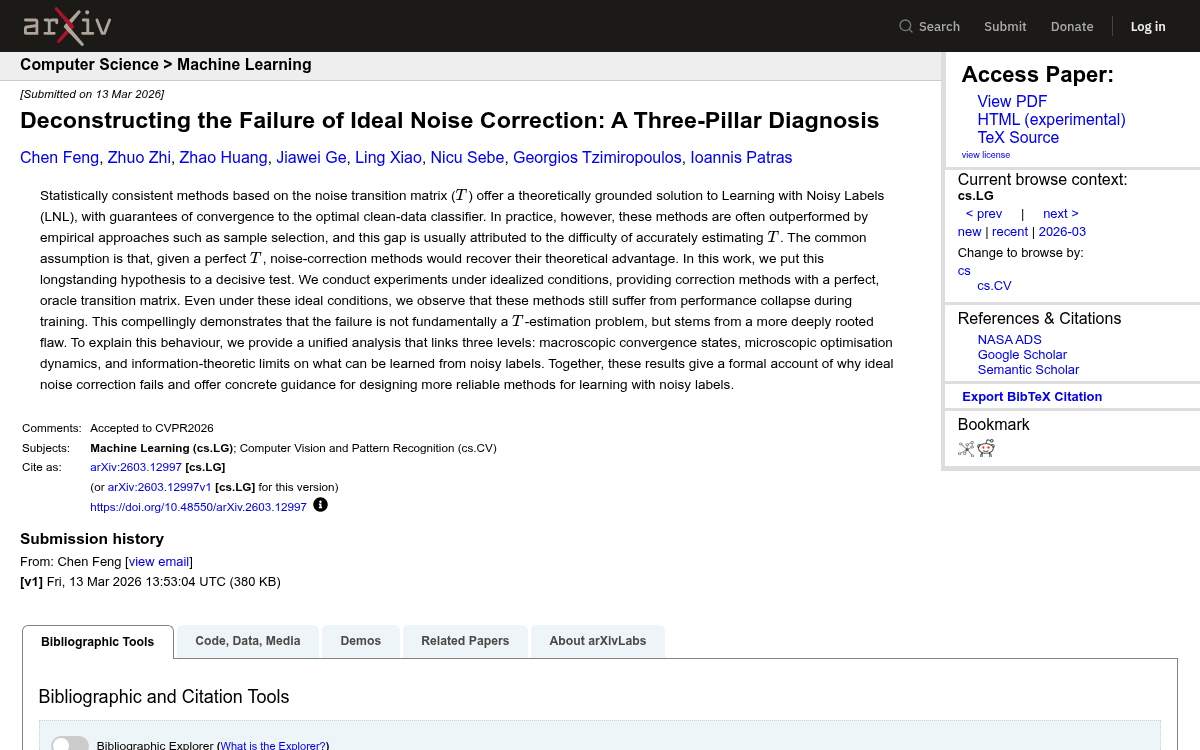
For years, the story around learning with noisy labels has had a convenient villain. Statistically consistent methods based on the noise transition matrix T come with proofs that they should recover the clean-data classifier, yet in practice they get outperformed by scrappier heuristics like sample selection. The community's explanation has been simple: we just cannot estimate T well enough. A new paper, Deconstructing the Failure of Ideal Noise Correction, puts that alibi under the microscope and finds it does not hold.
The authors run the experiment everyone assumed would settle the debate. They hand Forward Correction (FC) the ground-truth, oracle transition matrix and see whether the theoretical guarantees show up. Even when provided with the ground-truth transition matrix, the model's performance collapses after an initial peak, and prolonged training sees the correction method's efficacy degrade, ultimately offering no benefit over the uncorrected baseline. That single result reshapes the diagnosis: if a perfect T cannot save these methods, the problem lives somewhere deeper.
Why the standard story stopped working
The setup is a classifier trained on labels Y^n that were corrupted from clean labels Y according to a per-instance transition matrix T(x). Forward Correction rewrites the loss so that the model's predicted clean probabilities get pushed through T before being compared to the noisy label, and this is proven to be classifier-consistent with the clean risk, provided T(x) is known or accurately estimated. The theorem is real. The paradox is that it never translates to a well-trained deep network. The authors argue this is a finite-sample story: high-capacity models memorize the noisy set long before the asymptotic guarantees kick in.
Three pillars of the collapse
Rather than propose another heuristic, the paper builds a unified diagnosis at three levels. Each one explains a piece of the failure that the others cannot.
- Macroscopic analysis. They compare the ideal population minimizer against the empirical minimizer that a deep network actually finds. The clean solution and the memorized solution live at different points in parameter space, and the memorized one is where SGD ends up.
- Microscopic analysis. Looking at per-sample gradients, FC does temporarily soften the pull toward the noisy label, but this softening is a transient effect on the way to a different pathological attractor.
- Information-theoretic analysis. They prove that the noise channel strictly reduces the information a label carries about the underlying hypothesis, so no downstream correction can recover what the channel has already destroyed.
The key formal result at the memorization stage is uncompromising. When the empirical risk is driven to zero, the FC loss is minimized by collapsing predictions to a hard one-hot vector, and that vector is not the clean label. Specifically, the loss is minimized by collapsing the prediction to a hard vertex corresponding to the largest entry in the noisy label's column of T. In symmetric noise this vertex happens to coincide with the noisy label itself, which is why the FC accuracy curve mathematically collapses onto the uncorrected baseline at the end of training.
The gradient trap
The microscopic picture is where the paper gets pleasingly concrete. The FC gradient with respect to a logit is p_hat_k - q_k, where q_k is the model's estimated reverse posterior P(Y=k | Y^n, x). That softer target explains the well-known early peak in accuracy: FC really does behave better than plain cross-entropy during the memorization-avoidance phase. But the softmax parameterization has a catch. Near any vertex of the probability simplex, gradient magnitude vanishes, creating dead zones around every one-hot state. Once early learning drives predictions toward the noisy label vertex, the optimizer stalls there even though the loss landscape technically points elsewhere. The theoretical minimum and the actual convergence point are not the same object.
What the numbers show
The experiments span CIFAR-10, CIFAR-100 with symmetric noise from 20 percent up to 90 percent, plus asymmetric noise and the real-world Clothing1M benchmark. Two lightweight fixes, layered on top of Forward Correction, do most of the work of closing the gap:
- FEC (Feature-Enhanced Correction) trains a linear classifier on top of a frozen self-supervised encoder combined with Mixup and FC.
- JEC (Joint-Enhanced Correction) jointly fine-tunes the encoder with the classifier under the same recipe.
On CIFAR-10 at 90 percent symmetric noise, plain Forward achieves 42.9 percent accuracy, essentially indistinguishable from cross-entropy at 42.7. FEC reaches 82.5 and JEC reaches 68.5. On CIFAR-100 at 80 percent noise, Forward gets 19.9 while FEC reaches 52.7. On Clothing1M, JEC lands at 72.24 percent, competitive with DivideMix at 74.76 and clearly above vanilla Forward at 69.84.
What this changes for practitioners
The paper is not shipping a new state-of-the-art recipe, and there is no accompanying code repository advertised in the write-up. Its contribution is a redirection of research effort. If you are working on noisy labels, the useful takeaways are structural:
- Chasing better estimators of
Tis a diminishing return. Even a perfectThits the same wall. - Calibration matters as much as accuracy. Under memorization, the prediction confidence collapses to 1 everywhere, resulting in the ECE being perfectly coupled with accuracy. A model that is 60 percent accurate becomes 40 percent miscalibrated.
- Regularization strategies that keep predictions off the simplex vertices, like self-supervised pretraining and Mixup, matter more than fancier correction losses.
- Per-sample information content is a real bottleneck. Their scaling experiment shows that as you move from single-label to multi-label supervision, correction methods steadily close the gap with ideal sample selection, matching the information-theoretic prediction.
The most useful reframing is philosophical. Noise correction was treated as a statistical estimation problem. This three-pillar diagnosis reframes it as an optimization and information problem, where the finite-sample regime interacts pathologically with high-capacity networks regardless of how well you know the corruption process. That reframing is the actual breakthrough, and it points the next wave of work toward joint design of losses, optimizers, and data-side information rather than yet another estimator for T.