
Fordham and IBM's VAS-CFA Beats Single AI Alignment by 23%
A new framework fine-tunes five separate moral agents, then fuses their answers using combinatorial fusion to outperform single-agent alignment baselines.
 Pro
Takeaways
- VAS-CFA trains five moral agents (Authority, Care, Fairness, Loyalty, Sanctity) via DPO+QLoRA on Pythia-12B.
- Outputs are split into single-claim moral units, scored per value, then fused with combinatorial fusion analysis.
- Fine-tuning uses the Moral Integrity Corpus, 113.8K prompt-response pairs with human-revised answers.
- Best variant (WRCDS) hits 0.1692 ROUGE-L and 0.8849 BERTScore, beating single agents and prior aggregators.
- Rank-based fusion beats score-based fusion when agents show high cognitive diversity.
- No code released; pipeline is heavy but demonstrates pluralistic alignment as multi-objective aggregation.
Most alignment techniques treat human values as a single signal. RLHF collapses preferences into one reward model, DPO fits a single preference distribution, and constitutional methods rely on one written rulebook. That works, until the values themselves conflict, which they routinely do in real ethical scenarios. A new paper from Fordham University and IBM Research proposes a different route: train several moral agents with distinct value systems, then combine their outputs using a fusion method borrowed from information retrieval and drug discovery.
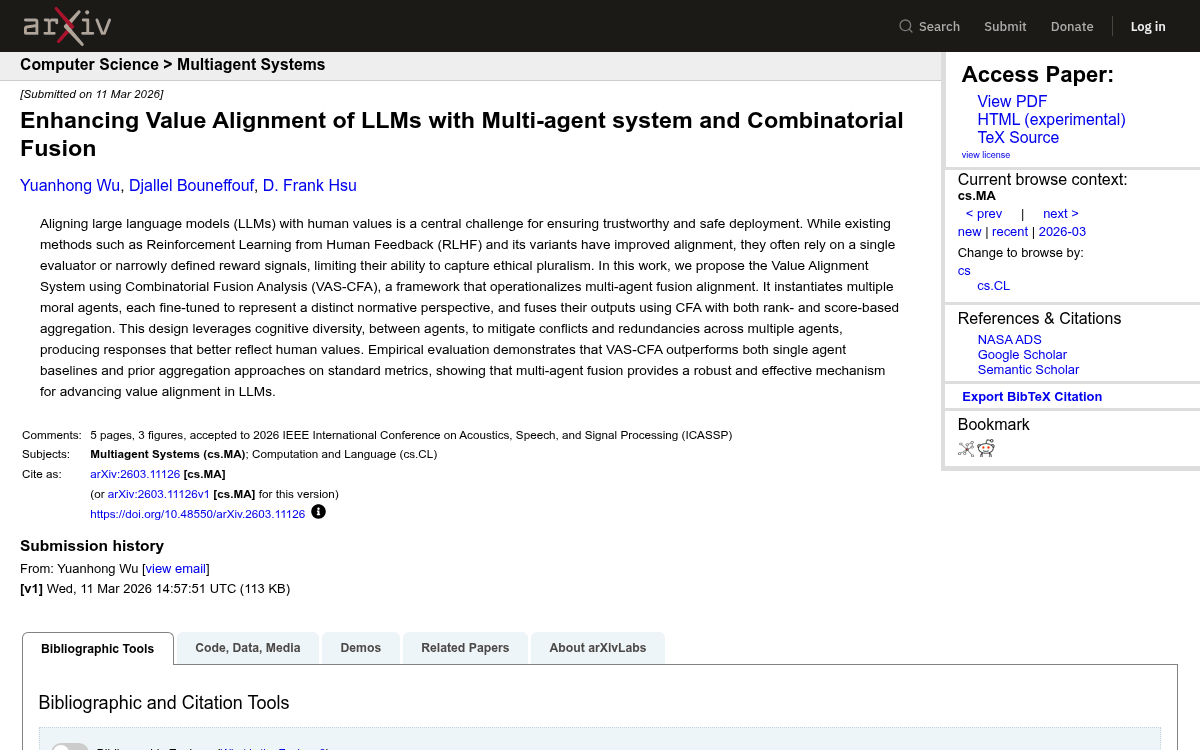
The framework is called VAS-CFA (Value Alignment System using Combinatorial Fusion Analysis). It instantiates multiple moral agents, each fine-tuned to represent a distinct normative perspective, and fuses their outputs using CFA with both rank- and score-based aggregation. The claim is that mixing perspectives beats any single evaluator on standard alignment metrics.
Why one evaluator is not enough
The motivation is straightforward. Models pretrained on broad web corpora can produce outputs that are untruthful, unsafe, or misaligned with user intentions. The canonical alignment approach is Reinforcement Learning from Human Feedback (RLHF), which involves supervised fine-tuning on demonstrations, followed by policy optimization using a reward model trained from human pairwise preferences. The trouble is that a single reward model implicitly picks one ethical stance. A growing literature warns that RLxF can result in narrow objectives and miss crucial ethical complexity.
VAS-CFA leans on moral foundations theory instead. It builds five agents, each aligned to one value: Authority, Care, Fairness, Loyalty, and Sanctity. Then it treats the disagreement between them as a feature, not a bug.
How the pipeline is stitched together

The workflow has four stages:
- Fine-tune five value-specific agents. All five start from the OpenAssistant/oasst-sft-4-pythia-12b-epoch-3.5 SFT checkpoint, using Direct Preference Optimization (DPO) with QLoRA on a single NVIDIA A100-40GB. The Moral Integrity Corpus (MIC) is used for fine-tuning the individual agents, providing 113.8K prompt-response pairs with human revised answers and rich ethical annotations, split 91.0K/11.4K/11.4K for train/validation/test.
- Decompose responses into moral units. Each agent generates a response to a prompt. Direct aggregation risks semantic conflict: different agents may express incompatible moral commitments, yielding diluted or incoherent answers and weakening value alignment. Instead, GPT-4.1 nano splits each response into single-claim units. A sentence like "promoting intelligence should be prioritized to ensure your child grows up healthy and prosperous" becomes three atomic claims.
- Score every unit across all five values. A moral classifier encodes the human-revised answer using SentenceTransformer (all-MiniLM-L6-v2) and fits a logistic regression model for multi-label prediction, returning five scores per unit, one per moral value. That produces a table of units by values, which is the input to CFA.
- Fuse with combinatorial fusion analysis. CFA generates every non-empty subset of the five scoring systems (31, but the paper uses 26 with two or more members) and applies four fusion strategies: average score, weighted score by diversity, average rank, and weighted rank by diversity.
The role of cognitive diversity
The interesting math is in how CFA weights each agent. For any two scoring systems, cognitive diversity is defined as the Euclidean distance between their rank-score functions. An agent's diversity strength is the mean distance from all other agents. Agents that disagree the most get higher weight in score fusion, and lower weight (i.e., 1/DS) in rank fusion. It was shown that rank combination tends to perform better with larger cognitive diversity.

What the numbers show
Evaluated on the MIC test set with ROUGE-L F1 and BERTScore F1 against human-revised answers, the fusion clearly beats the parts:
| Method | ROUGE-L F1 | BERTScore F1 |
|---|---|---|
| Best single agent (Loyalty) | 0.1376 | 0.8663 |
| Raw aggregation of 5 responses | 0.1318 | 0.8654 |
| CVA-GS-DYN (prior multi-agent baseline) | 0.1450 | 0.8754 |
| VAS-CFA: ARC (avg rank) | 0.1691 | 0.8847 |
| VAS-CFA: WRCDS (weighted rank) | 0.1692 | 0.8849 |
Rank combinations (ARC/WRCDS) consistently outperform score combinations (ASC/WSCDS) due to cognitive diversity between moral agents. Diversity strength as weight gives rise to desirable non-linear combination among individual agents. Roughly a 23 percent lift in ROUGE-L over the best single agent, and a meaningful jump over the previous contextual value alignment baseline from the same lab.
What it is good for, and where it stops
The framework is a research prototype, not a shipped library. The authors did not release code or model weights, and the pipeline is heavy: five fine-tuned 12B agents, a GPT-4.1 nano call to split responses, a logistic regression classifier, a 26-way fusion sweep, and a paraphraser to turn the winning moral unit back into an answer. For production alignment, that inference cost is hard to justify against a single well-tuned DPO model.
Where the idea earns its keep is as an argument. Pluralistic alignment is a live research question, and VAS-CFA is a concrete recipe showing that if you can enumerate the moral axes you care about, you can train specialists per axis and let a principled aggregator (rather than a hand-tuned ensemble prompt) pick the winning claim. The rank-based fusion result is the useful takeaway: when agents disagree meaningfully, ranking their outputs and combining ranks weighted by disagreement outperforms averaging their raw scores.
The limits are also plain. Only 5 moral foundations were modeled, evaluation leans on ROUGE and BERTScore against a single set of human-revised answers, and the CFA sweep grows combinatorially if you add more axes. Still, as a stepping stone toward alignment methods that treat ethics as a multi-objective optimization instead of a scalar reward, it is a clean, reproducible design worth reading. The full details are in the arXiv preprint, and the underlying Moral Integrity Corpus is publicly available for anyone who wants to try building similar per-value agents.