
FOMO25 Proves Self-Supervised Brain MRI Models Beat Supervised Training Across Continents
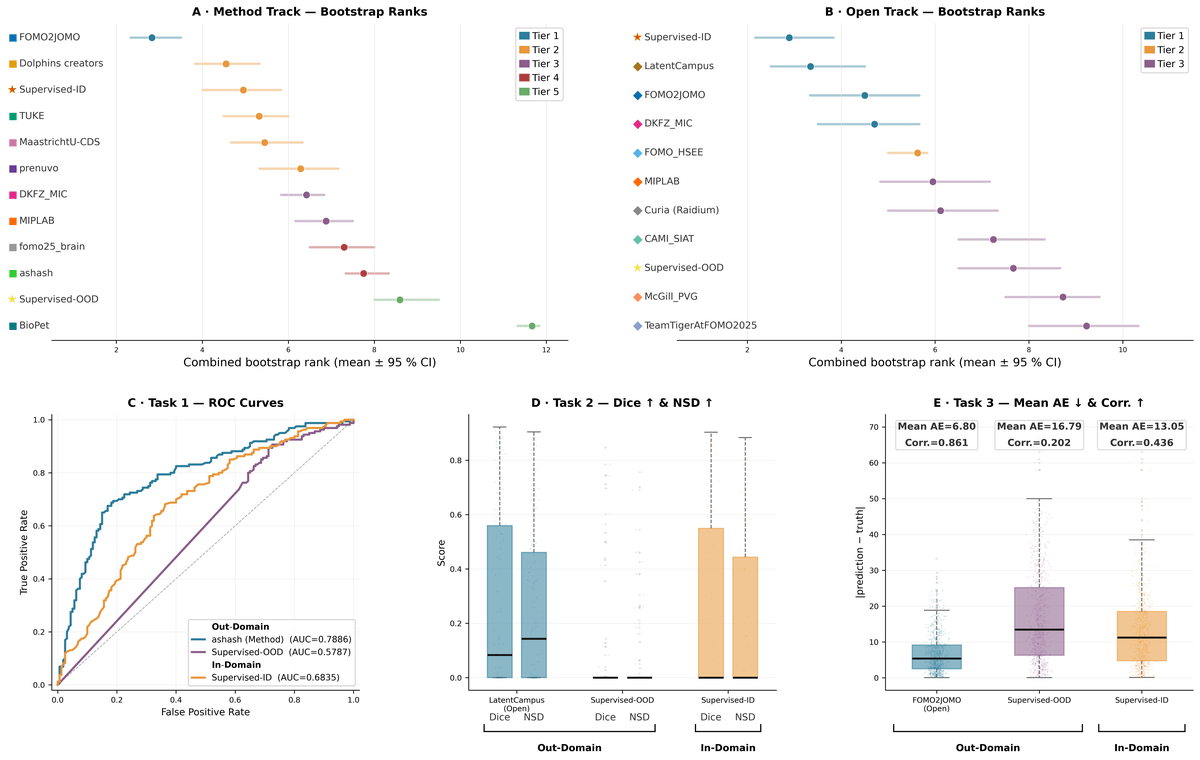
MICCAI 2025's FOMO25 challenge tested 19 brain MRI foundation models on real clinical data, revealing pretraining beats supervised baselines and scaling stalls.
 Pro
Takeaways
- FOMO25 at MICCAI 2025 evaluated 19 brain MRI foundation models from 16 teams on clinical out-of-domain data.
- Organizers released FOMO60K, a 60,529-scan pretraining dataset spanning T1, FLAIR, DWI, SWI and more sequences.
- Best pretrained models beat supervised baselines even when supervised training used more in-domain data.
- MAE objectives favored segmentation, hybrid MAE+contrastive favored classification and regression tasks.
- Scaling model size and training duration produced weak gains; small 6M-parameter encoders won classification.
- Baseline code and pretrained checkpoints are publicly available for the follow-up FOMO26 challenge.
Training a solid brain MRI model usually means paying radiologists to label thousands of scans. A new MICCAI 2025 satellite challenge just tested whether self-supervised foundation models can flip that equation, and the answer is a qualified yes. FOMO25 pitted 19 foundation models from 16 teams against clinical scans acquired at hospitals they had never seen, and the best pretrained entries beat supervised baselines trained directly on in-domain data.
Why brain MRI foundation models keep stalling
Evidence from general computer vision suggests that large-scale self-supervised pretraining offers vast yet underused possibilities for brain MRI analysis. The method of choice for deep-learning based analysis in this field is still fully supervised. A highly effective data augmentation pipeline lets that approach work even with limited labels, but out-of-domain robustness remains fragile, which limits broad clinical deployment.
Most prior brain MRI foundation model work has been evaluated on clean, research-grade datasets where supervised baselines are already near-perfect. FOMO25's organizers argue this is why pretraining has looked underwhelming: the benchmarks reward marginal improvements on already-solved problems rather than the messy generalization that clinical deployment actually demands.
Inside the challenge setup
Two things made FOMO25 different. The first is the pretraining corpus. FOMO-60K contains more than 60,000 brain MRI scans spanning both clinical and research-grade acquisitions, with sequences including T1, MPRAGE, T2, T2*, FLAIR, SWI, T1c, PD, DWI, and ADC. It's released on