
FlowAD Cuts Self-Driving Collision Rates 19% by Linking Car Motion to Scene
A new scene-flow framework called FlowAD models how the ego vehicle's own motion reshapes its view, cutting collisions 19% on nuScenes.
 Pro
Takeaways
- FlowAD introduces ego-scene interactive modeling by encoding scene flow relative to the ego vehicle in latent space.
- Uses ego-guided partition, spatial and temporal flow prediction, plus task-aware enhancement for downstream heads.
- Reduces collision rate by 19% over SparseDrive on nuScenes and hits 51.77 driving score on Bench2Drive.
- Proposes Frames before Correct Planning (FCP) metric, measuring how fast a planner reacts correctly.
- Works as a plug-in on SparseBEV, SparseDrive and Senna, learning from log-replay data without simulation.
- Code, models and configs released at github.com/AutoLab-SAI-SJTU/FlowAD (ICLR 2026).
A group of researchers has released FlowAD, a framework that rethinks how self-driving stacks perceive their surroundings by tying the scene representation directly to the ego vehicle's own motion. The paper, accepted to ICLR 2026, argues that most end-to-end driving systems ignore an obvious feedback loop: when the car turns or accelerates, the observed world changes in structured ways, and modeling that change explicitly makes planning noticeably better.
The headline numbers back it up. FlowAD reports a 19% collision rate reduction over SparseDrive on nuScenes, a 60% improvement (1.39 frames) on the newly proposed FCP metric, and a 51.77 driving score on the Bench2Drive closed-loop benchmark. Code and configs are available on the AutoLab-SAI-SJTU GitHub repo.
The blind spot in current driving stacks
Current paradigms often inadequately consider the feedback of ego motion to the observation, which leads to an incomplete understanding of the driving process and consequently limits the planning capability. In practice, vanilla and temporal architectures treat multi-view frames as inputs to be fused, but they don't explicitly encode the fact that a left turn command will pull the scene rightward in the next few frames. That mismatch shows up as late braking, missed cut-ins, and jittery planning.

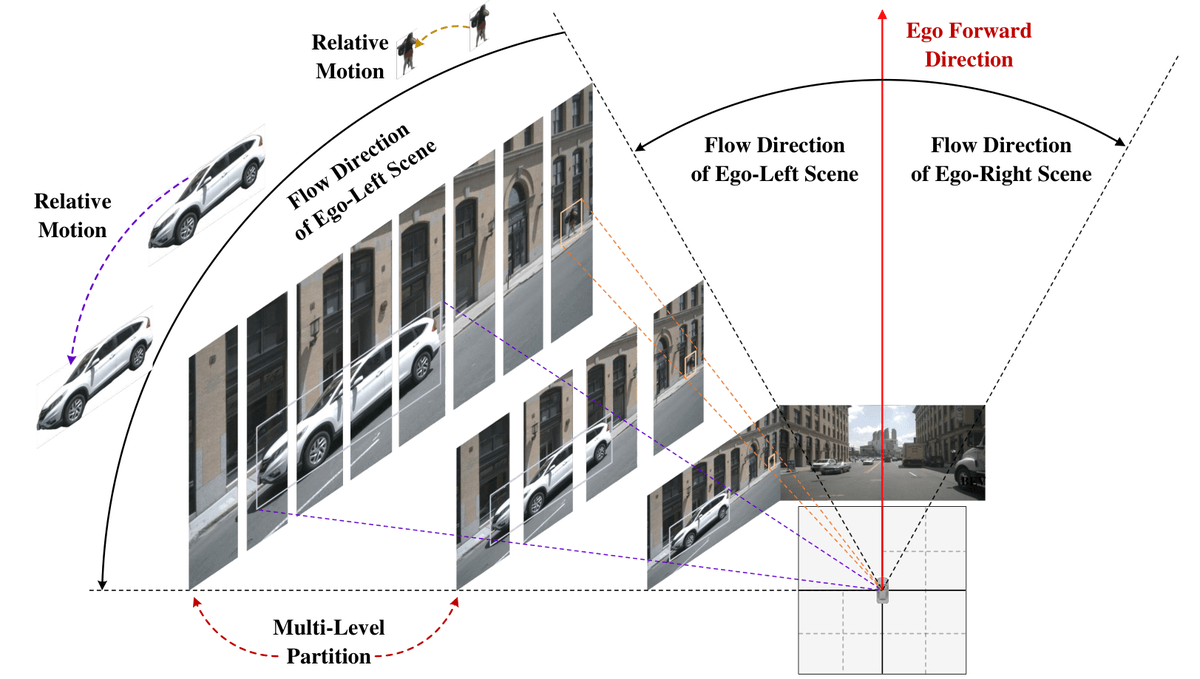
The authors frame their fix around how humans drive: we don't just watch the world go by, we anticipate how it will shift as we steer. Inspired by human perception, FlowAD represents ego-scene interaction as scene flow relative to the ego-vehicle, capturing relative motion as learnable scene flow within the latent feature space. This enables modeling ego-motion feedback using existing log-replay datasets without requiring complex scenario simulations. That last point matters, because it means no CARLA-style simulator is needed to learn the feedback signal.
How the framework is built
FlowAD is organized as three stages layered on top of a standard multi-view image backbone and FPN:
- Ego-guided scene partition. An ego-guided scene partition first constructs basic flow units to quantify scene flow. The ego-vehicle's forward direction and steering velocity directly shape the partition, which reflects ego motion. The forward direction sets where the partition starts, so the grid rotates with the car.
- Spatial and temporal flow prediction. Based on flow units, spatial and temporal flow predictions are performed to model dynamics of scene flow, encompassing both spatial displacement and temporal variation. Both modules use GRU-based predictors with cross-attention across views.
- Task-aware enhancement. The final task-aware enhancement exploits learned spatiotemporal flow dynamics to benefit diverse tasks through object and region-level strategies. Object-level features feed detection and tracking heads, while region-level features help occupancy and planning.

The team also borrows a trick from world models. They employ the mechanism of the world model to learn spatio-temporal dynamics of the scene in the latent space, which helps to understand the ego-scene interaction and improve the planning capability. Crucially, the prediction happens in the feature space rather than pixel space, so there is no expensive image reconstruction loss.
A new metric for scene understanding
Collision rate and L2 distance alone don't capture how quickly a planner realizes what it needs to do. To fill that gap, the authors introduce Frames before Correct Planning (FCP), which quantifies the frames elapsed until the planner initiates a rational action. Lower is better, and it directly measures reaction latency in tricky scenes like cut-ins and detours.
Results across perception, planning, and VLMs
FlowAD is positioned as a plug-in module rather than a monolithic stack. Applied to baselines SparseBEV, SparseDrive, and Senna, the framework yields consistent performance gains. On closed-loop testing, the Bench2Drive dataset covers 44 interactive scenes such as cut-ins, overtaking and detours, and 220 routes across diverse weather conditions, which is a much harsher setting than nuScenes open-loop evaluation.
Beyond raw numbers, the qualitative claims are interesting for anyone building a perception stack. FlowAD demonstrates superior detection of occluded objects, small targets, and dense scenes through learned scene flow dynamics. Those are exactly the failure modes where geometric BEV pipelines tend to break down, and where a motion-aware latent representation should help most.
When it is worth trying
The framework is best suited if you are already running a sparse query-based detector or an end-to-end planner and want a drop-in improvement on ego-motion-heavy scenarios such as turns, roundabouts, and lane changes. It relies on log-replay data with ego pose and steering, so any standard AV dataset works. It is less useful if your pipeline is dense-BEV and does not expose the ego forward vector or steering velocity, because those signals directly parameterize the partition. The OpenReview submission includes ablations for each component, and the reference implementation ships sub-projects for SparseBEV, SparseDrive, and Senna baselines so the gains can be reproduced independently.