
Florida Atlantic University Finds GPT-2's Hidden States Predict Human Reading Better Than Surprisal
A new metric derived from transformer hidden states predicts human reading times independently of surprisal, suggesting LLMs and humans share deeper processing dynamics than previously known
Takeaways
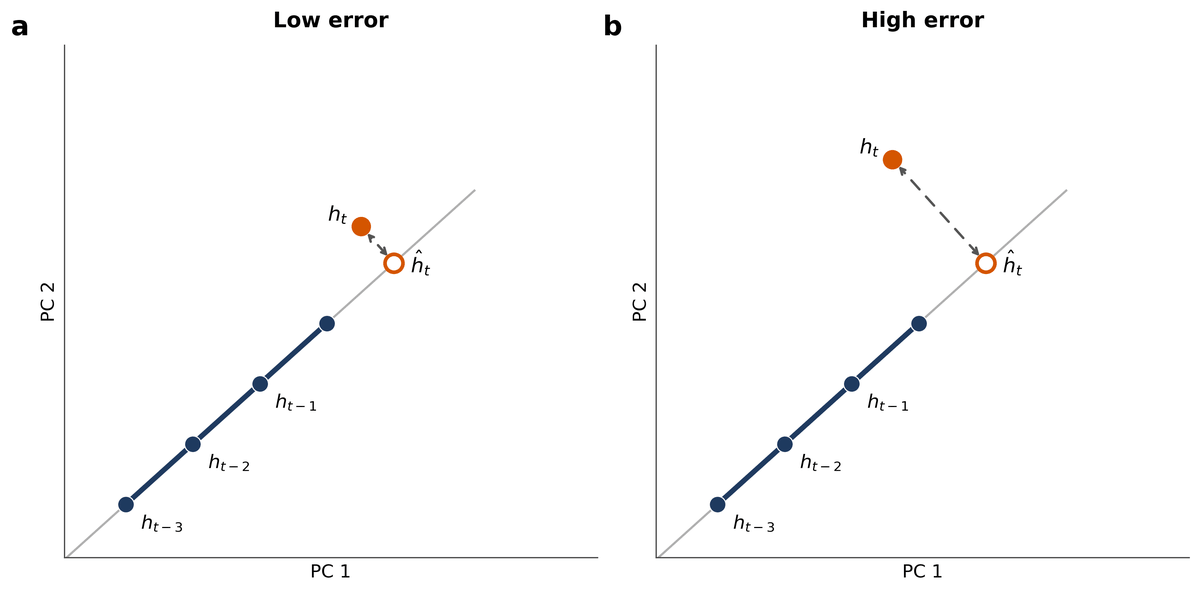
- New measure: Trajectory extrapolation error tracks how much a transformer's hidden states deviate from their recent directional trend at each word.
- Nearly orthogonal to surprisal: The two measures share almost no variance (r = .044), meaning they capture fundamentally different aspects of processing.
- Independently predicts reading times: Even words with low surprisal slow readers down if they break the representational trajectory (p = 3.0 × 10⁻⁶).
- Strongest on garden-path sentences: Trajectory error outperforms surprisal alone on syntactically ambiguous sentences across GPT-2 Small, Medium, and Large.
- Architecture-general: Results replicate on GPT-2 and Pythia (RoPE), ruling out positional encoding artifacts.
- Deeper human-LLM alignment: Humans appear sensitive to the internal geometry of model hidden states, not just output probabilities.
One of the most striking convergences in modern AI research is that language models seem to predict human reading behavior remarkably well. Feed a sentence through GPT-2, compute how surprised the model is at each word, and those surprise values correlate with how long humans take to read each word. This has been taken as evidence that humans and LLMs are doing something similar: both appear to run a version of next-token prediction. But a new paper from Florida Atlantic University argues that surprisal only tells half the story, and that looking inside the model reveals something even more interesting.
The Problem with Surprisal
Surprisal is defined as the negative log probability of a word given its context. It is a single number, computed once per word, that collapses everything the model knows about the preceding sentence into one scalar. Surprisal reduces rich sequential representations to a single scalar at each word, discarding information about the direction in which the interpretation has been evolving. Think of it like tracking someone walking through a city: surprisal tells you whether they ended up somewhere unexpected, but says nothing about the direction they were heading before they got there.
There is also a known paradox with surprisal: larger transformer-based pre-trained language models with more parameters and lower perplexity nonetheless yield surprisal estimates that are less predictive of human reading times. In other words, as models get smarter, their surprisal values diverge from human behavior. This is a red flag that surprisal is not capturing the full picture of what humans are doing.
A New Measure: Trajectory Extrapolation Error
The paper introduces a measure called trajectory extrapolation error. The idea is geometrically intuitive: as a transformer processes a sentence word by word, its hidden states (high-dimensional vectors representing the model's internal understanding) trace a path through representational space. At each new word, you can ask: given the direction the hidden states were moving over the last few words, where would we expect the next hidden state to land? And how far did it actually land from that predicted spot?
Here is the core computation:
import numpy as np
def trajectory_extrapolation_error(hidden_states, k=3):
    """
    hidden_states: list of vectors h[t-k], ..., h[t-1], h[t]
    Returns: Euclidean distance between predicted and actual h[t]
    """
    window = np.array(hidden_states[-(k+1):-1])  # k preceding states
    t_vals = np.arange(k).reshape(-1, 1)
    # Fit linear trajectory via OLS
    coeffs = np.linalg.lstsq(np.hstack([t_vals, np.ones_like(t_vals)]),
                              window, rcond=None)[0]
    predicted = coeffs[0] * k + coeffs[1]        # extrapolate one step
    actual = hidden_states[-1]
    return np.linalg.norm(actual - predicted)     # Euclidean distance