
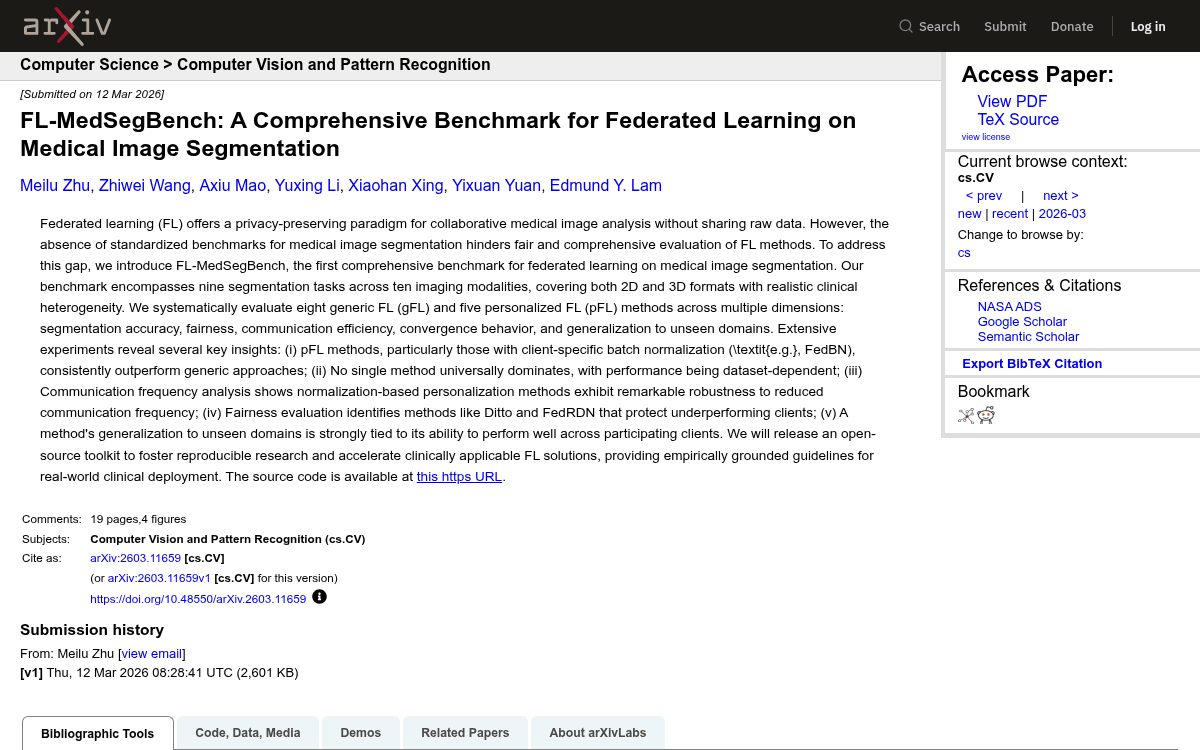
FL-MedSegBench Pits 13 AI Methods Against Each Other Across 27 Hospital Datasets
A new benchmark evaluates 13 federated learning methods across 27 medical imaging datasets, revealing which techniques actually hold up under real clinical heterogeneity.
 Pro
Takeaways
- FL-MedSegBench is the first comprehensive federated learning benchmark for medical image segmentation, spanning 27 datasets and 10 modalities.
- Evaluates 8 generic FL and 5 personalized FL methods across accuracy, fairness, communication, convergence, and generalization.
- FedBN and SioBN, which keep batch normalization local, dominate on 7 of 9 tasks.
- Ditto delivers the best fairness, protecting underperforming clients at slight cost to average accuracy.
- Generalization to unseen hospitals correlates strongly with in-federation performance across participating clients.
- Open-source toolkit released at github.com/meiluzhu/FL-MedSegBench with reproducible pipelines and standardized splits.
Training medical imaging models is stuck in a bind. Hospitals sit on huge, richly annotated datasets, but privacy laws like HIPAA and GDPR make it hard to pool them in one place. Federated learning (FL) is the standard workaround, letting institutions collaboratively train a model without sharing raw scans. The problem: there has been no agreed-upon way to test whether one FL algorithm actually beats another on real medical segmentation tasks, so published claims have been hard to compare.
A new benchmark called FL-MedSegBench aims to fix that. It's introduced as the first comprehensive benchmark for federated learning on medical image segmentation, with nine segmentation tasks across ten imaging modalities, covering both 2D and 3D formats with realistic clinical heterogeneity. The authors run 13 popular FL algorithms head to head and publish an open toolkit so anyone can reproduce or extend the results.

Why prior benchmarks fell short
Two earlier attempts existed, but they were narrow. FLamby covered only three 3D segmentation datasets and two modalities, and did not evaluate personalized FL at all. A separate brain-tumor benchmark focused on a single task. That left an obvious hole: no way to know how methods behave across the full mess of real clinical data, where fundus cameras, ultrasound probes, colonoscopes, and MRI scanners all produce wildly different distributions.
Data heterogeneity is the core reason FL is hard here. Two hospitals imaging the same organ can produce images with different intensity ranges, textures, and artifacts depending on scanner vendor, protocol, and patient population. Standard FedAvg, which just averages model weights across sites, tends to drift or plateau when local distributions diverge too much.
What the benchmark actually contains
FL-MedSegBench includes 27+ public medical datasets spanning a wide range of anatomical structures and diseases, enabling evaluation of FL methods under realistic data heterogeneity and cross-site distribution shifts. The nine tasks include retinal vessel segmentation on fundus images, prostate segmentation on MRI, adenocarcinoma detection in pathology slides, polyp segmentation from colonoscopy, breast lesion segmentation from ultrasound, meibomian gland segmentation from infrared, right-ventricle segmentation from cardiac MRI, pancreas from MRI-T1, and multi-modal brain tumor segmentation from the FeTS2022 challenge.
Each task is split so different clients correspond to different institutions or devices, mimicking how a real federation would look. The evaluation covers five axes rather than just accuracy:
- Segmentation accuracy (Dice score across clients)
- Fairness (worst-client Dice and variance across sites)
- Communication efficiency (performance as communication rounds decrease)
- Convergence behavior (Dice trajectory over epochs)
- Generalization to unseen client domains (out-of-distribution testing)
The 13 methods on the leaderboard
The paper splits federated methods into two families. Generic FL (gFL) trains one shared global model for everyone. Personalized FL (pFL) lets each client keep some local parameters so its model can adapt to its own data. The lineup includes eight gFL methods (FedAvg, FedProx, MOON, FedAWA, FedNova, FedRDN, PN, FedLWS) and five pFL methods (FedRoD, SioBN, FedBN, FedPer, Ditto). All are trained with U-Net backbones (2D U-Net for 2D tasks, 3D U-Net or SA-Net for volumetric tasks) using Adam, Dice + BCE loss, and standard augmentations.

What actually wins
The clearest finding: keeping batch normalization statistics local to each client is a small trick with outsized impact. FedBN, which shares convolutional weights globally but never averages BN parameters, ends up on top across seven of the nine datasets. SioBN, a close cousin, is often second. The intuition is simple: BN statistics encode a scanner's characteristic intensity distribution, so averaging them across hospitals blurs exactly the signal each site needs to work well on its own data.
A few other patterns stand out:
- No universal winner. Rankings shift dataset by dataset. FedLWS excels on retinal and prostate tasks; FedRDN, which injects global feature statistics as data augmentation, dominates on pathology and pancreas.
- Naive FedAvg often loses to just training locally. On several fundus and prostate clients, plain FedAvg actually degrades below the single-site baseline, a textbook symptom of client drift under non-IID data.
- Some methods collapse. PN, a proxy-normalization approach, and FedRoD, a dual-classifier design, repeatedly underperform on dense prediction tasks, with FedRoD sometimes dropping to 34% Dice on polyps.
- Ditto is the fairness champion. It doesn't top the accuracy charts, but it consistently produces the lowest variance across clients and the highest worst-client Dice, meaning underperforming hospitals aren't left behind.
Communication frequency and generalization
For teams with bandwidth constraints, the communication analysis is the most practical result. Normalization-based personalization methods, especially FedBN and SioBN, hold up well when communication rounds are reduced and local training is extended. That means fewer server round-trips without meaningful accuracy loss - useful in cross-institutional deployments where network coordination is expensive.
The generalization experiment is more surprising. When tested on five completely held-out datasets (ARIA, IOSTAR, MSD-prostate, Kvasir-SEG, BUS), methods that performed best on the participating clients also generalized best to unseen ones. FedLWS, for example, transferred well to fundus and prostate OOD data, though it collapsed to 20.69% Dice on Kvasir-SEG polyps - a warning that adaptive weighting can overfit to specific domain compositions. The takeaway: robust in-federation performance is a reasonable proxy for out-of-distribution robustness, which pushes back on the assumption that specialized domain-generalization tricks are always needed.
What you can do with it
The source code is available on GitHub, and FL-MedSegBench is a benchmark designed for federated learning in medical image segmentation. It provides a unified experimental framework to systematically evaluate both generic federated learning methods and personalized federated learning methods across diverse medical imaging scenarios, aiming to support fair, reproducible, and comprehensive evaluation for the medical federated segmentation community. The repository is modular, so plugging in a new aggregation method or a new dataset is straightforward.
If you're building a federated pipeline for a hospital consortium, the practical recommendations from the paper boil down to three choices. Start with FedBN or SioBN if you want the best accuracy-versus-communication tradeoff across heterogeneous scanners. Reach for Ditto when the political requirement is that every participating site clears a minimum performance floor. And if you're doing open-set deployment where new hospitals may join later, methods that already score well across current clients are your safest bet for future domains.