
Fine-Tuned GPT-4o Beats MFA Writers at Mimicking Authors for 99.7% Less
A preregistered study finds that when GPT-4o is fine-tuned on an author's complete works, both experts and general readers prefer its excerpts to those written by MFA-trained writers.
 Pro
Takeaways
- Fine-tuned GPT-4o beat MFA-trained writers on stylistic fidelity for 29 of 30 authors in blind pairwise evaluations.
- MFA readers went from OR=0.16 (favoring humans) to OR=8.16 (favoring AI) after author-specific fine-tuning.
- General readers favored fine-tuned AI even more strongly, with fidelity OR=16.65 and quality OR=5.42.
- Pangram detected 97% of in-context AI excerpts but only 3% of fine-tuned ones; cliché density largely disappeared.
- Median cost to fine-tune and generate 100,000 words was $81 per author, a 99.7% cut versus paying a writer.
- Data and R analysis code are on GitHub; the paper argues against fair use for author-specific fine-tuning.
A new preregistered study puts a hard number on something the publishing industry has been anxiously debating: when large language models are fine-tuned on an individual author's complete body of work, readers, including trained literary experts, prefer the machine's imitations to excerpts written by MFA-trained human writers emulating the same author. The cost of producing that text is roughly 0.3% of what you would pay a professional novelist.
The paper, Readers Prefer Outputs of AI Trained on Copyrighted Books over Expert Human Writers, comes from Tuhin Chakrabarty (Stony Brook), Jane C. Ginsburg (Columbia Law), and Paramveer Dhillon (Michigan / MIT). Its methodology is unusually rigorous for creative-writing evaluation, and the findings land directly on top of the fair-use lawsuits currently being filed against OpenAI, Anthropic, Meta, and Google.
50 acclaimed authors, blind pairwise judgments
The researchers recruited 28 expert writers affiliated with top MFA programs in the United States, including the Iowa Writers Workshop, Michigan's Helen Zell program, NYU, Columbia, and Boston University, paying them $75 for each excerpt. Both humans and models received the same brief: write an up-to-450-word passage in the style of one of 50 award-winning authors, including Nobel laureates (Han Kang, Annie Ernaux), Booker winners (Salman Rushdie, George Saunders), and Pulitzer winners (Junot Díaz, Marilynne Robinson).
Prompts were built by five English Literature PhD students and contained three ingredients: 20 sample excerpts from the target author, a written description of that author's stylistic tics, and content specifications describing the scene to emulate.

Two AI conditions were tested:
- In-context prompting: GPT-4o, Claude 3.5 Sonnet, and Gemini 1.5 Pro received the same prompt as the MFA writers.
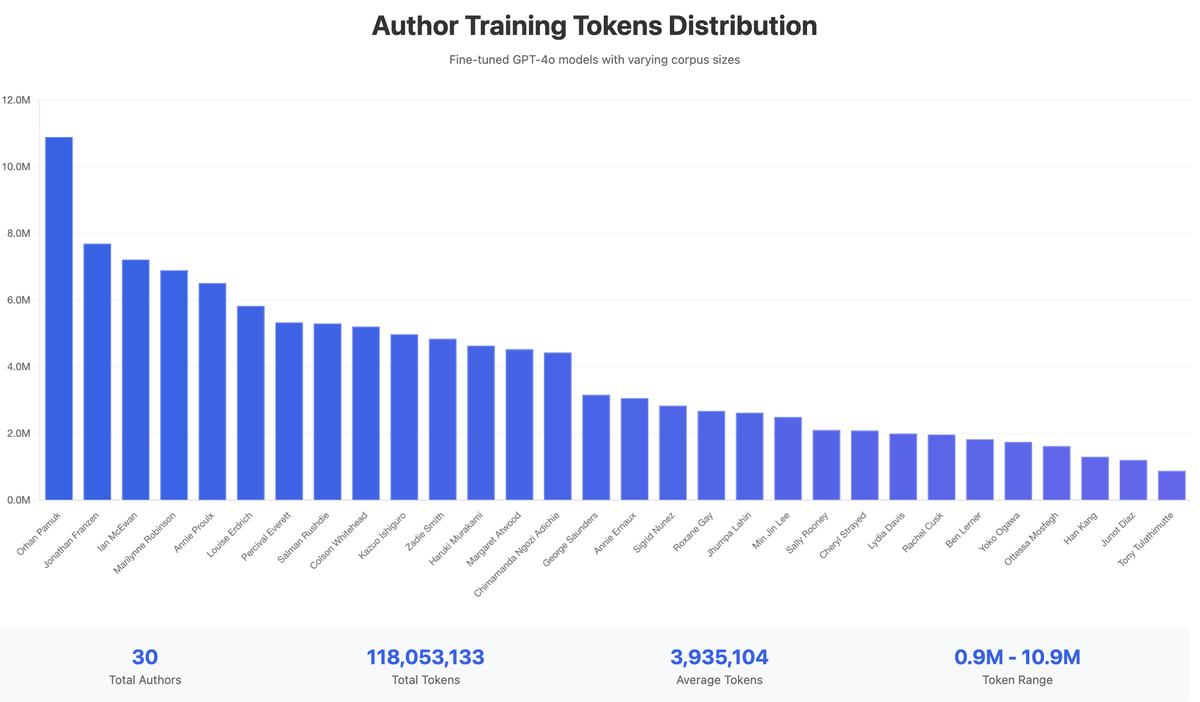
- Fine-tuning: GPT-4o was fine-tuned separately for 30 living authors on their complete published works, purchased as ePubs and segmented into 250-650 word chunks.