
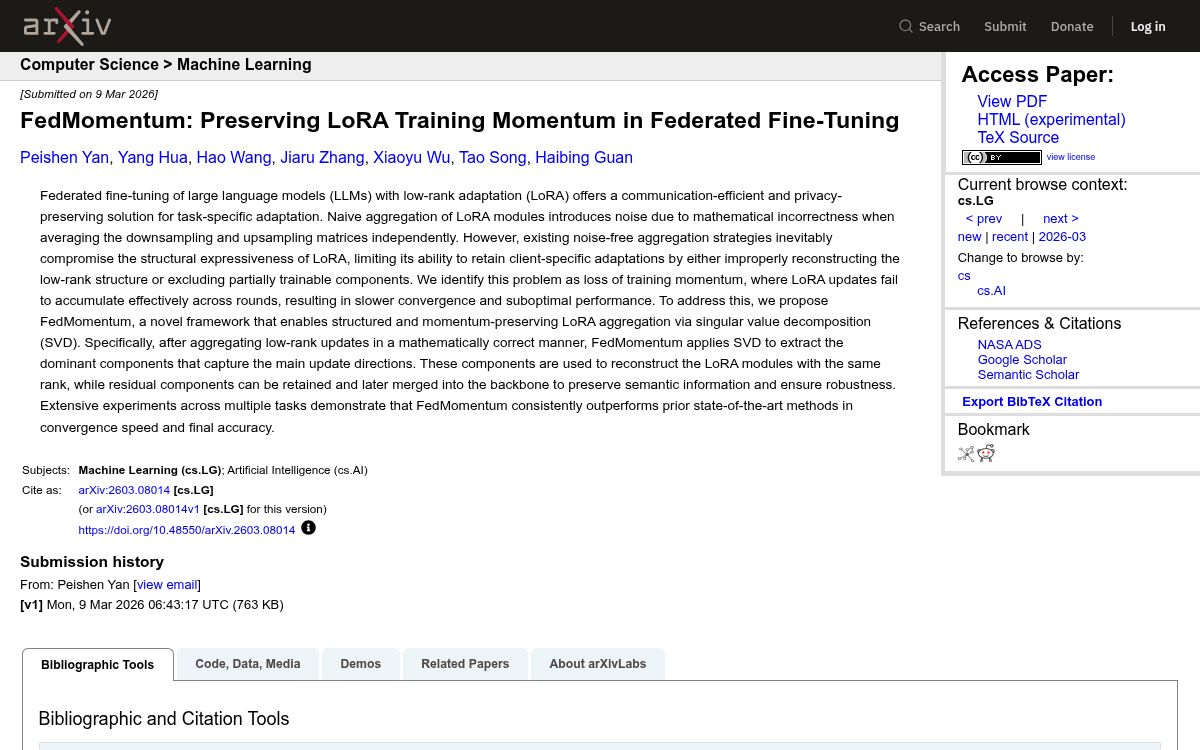
FedMomentum Fixes a Silent Math Flaw Corrupting Federated AI Training
FedMomentum uses SVD to fix a hidden flaw in federated LoRA fine-tuning, achieving up to 219% better accuracy on math reasoning tasks
 Pro
Takeaways
- Core finding: FedMomentum fixes a mathematical flaw in federated LoRA aggregation by using SVD to preserve training momentum across rounds.
- Key result: Achieves 34.22% on GSM8K math reasoning, a 219% improvement over FedIT and 18% over the previous best method.
- Novel concept: Identifies "loss of training momentum" -- the hidden cost of reinitializing or freezing LoRA structures during federated aggregation.
- Method: Aggregates full LoRA products (BᵢAᵢ) before SVD decomposition, then reconstructs LoRA with balanced singular value splitting and merges residuals into the backbone.
- Efficiency: Uses randomized SVD to keep aggregation at 0.60s/round vs. 1000+ seconds for exact SVD; communication cost is between FedIT and FLoRA.
- Limitation: Only tested on LLaMA2-7B; does not support heterogeneous LoRA ranks across clients; paper available on arXiv.
Fine-tuning large language models across distributed, private datasets is one of the hardest unsolved problems in production ML. Federated learning lets multiple parties collaboratively train a shared model without ever sharing raw data, but combining it with LoRA -- the dominant parameter-efficient fine-tuning technique -- introduces a subtle mathematical flaw that has been quietly degrading model quality for years. A new paper from researchers at Shanghai Jiao Tong University, Queen's University Belfast, Stevens Institute of Technology, Purdue, and Rice University proposes FedMomentum, a framework that finally fixes it.
The Flaw Nobody Was Talking About
LoRA works by freezing a model's original weights and injecting two small trainable matrices, B and A, whose product approximates the weight update. The actual update is ΔW = B × A. The problem: in federated settings, the standard approach (FedIT) averages B and A independently across clients. But averaging the parts is not the same as averaging the product. Mathematically, mean(B) × mean(A) ≠ mean(B × A).
This approach introduces aggregation noise because the matrix multiplication required to reconstruct the update is non-linear -- the product of the averaged matrices is simply not equal to the sum of the individual products.
Prior work tried to fix this. FLoRA attempts to achieve noise-free aggregation by stacking the local LoRA matrices and updating the local models with BA -- essentially merging all local updates back into the backbone and then reinitializing the low-rank matrices in subsequent rounds. But reinitializing LoRA each round throws away everything the model learned about its update direction. FFA-LoRA aggregates and updates only the matrix B, but freezing A restricts the representation space of the update, affecting its performance. Every existing fix traded one problem for another.
Loss of Training Momentum
The FedMomentum paper names this underlying issue precisely: loss of training momentum. The concept is borrowed from gradient-based optimization. When you train a neural network, the gradient signal builds up over iterations -- the model develops a sense of direction. In federated LoRA, every time you reinitialize or freeze part of the LoRA structure, you reset that directional memory. Since the value of the LoRA parameters directly determines the gradient direction, improper merging of LoRA-induced weight updates into the backbone or freezing partial LoRA parameters results in information loss within the LoRA space, which leads to both directional drift and diminished step sizes, disrupting the optimization trajectory.
The authors validated this with pilot experiments. In centralized settings, they compared vanilla LoRA training against two strategies used by federated methods: reinitializing LoRA each round, and freezing the A matrix. Both alternatives not only converged slower but also reached a worse final loss. The problem isn't just noise -- it's the destruction of accumulated learning signal.

SVD to the Rescue
FedMomentum's core insight is that you can aggregate correctly and preserve LoRA structure at the same time, using singular value decomposition (SVD). SVD is a standard matrix factorization that decomposes any matrix into a set of ranked components ordered by how much of the matrix's "energy" they capture -- think of it as finding the most important directions in the update space.
Here is the four-stage loop FedMomentum runs each communication round:
- Local fine-tuning: Each client trains its LoRA modules on private data for a fixed number of steps.
- Correct aggregation: Instead of averaging
AandBseparately, the server first computes each client's full updateΔWᵢ = Bᵢ × Aᵢ, then sums them:ΔW = Σ BᵢAᵢ. This is mathematically exact. - SVD decomposition: The server applies randomized SVD to
ΔW, splitting it into three parts: major components (top-r singular vectors capturing the dominant update directions), residual components (lower-energy directions above a 99.99% energy threshold), and negligible components (discarded). - Reconstruction and distribution: New LoRA matrices are built from the major components. The residual is sent to clients to be merged into their local backbone. This preserves semantic information without polluting the LoRA structure.
A key engineering detail: exact SVD on large weight matrices costs O(d³) -- completely infeasible. FedMomentum uses randomized SVD, which sketches the matrix with a random Gaussian projection first. This reduces aggregation time to 0.60 seconds per round, versus over 1,000 seconds with exact SVD.
There is also a subtle trick in how the singular values are split between the reconstructed B and A matrices. Rather than assigning all singular values to one side, FedMomentum distributes them evenly via √Σ: B = U_r × √Σ_r, A = √Σ_r × V_rᵀ.
This balanced allocation of singular values mitigates gradient imbalance in the following training iteration, which arises from the skewed singular spectrum and leads to instability or slow convergence in federated training.
The ablation study shows this single design choice accounts for a 7-point drop in average math accuracy when removed.
What the Numbers Show
The paper benchmarks FedMomentum against five baselines -- FedIT, FLoRA, FFA-LoRA, RoLoRA, and FedEx-LoRA -- using LLaMA2-7B across three task categories with 10 federated clients in a non-IID data split.
| Method | GSM8K | MATH | Avg. | HumanEval | CS Reasoning Avg. |
|---|---|---|---|---|---|
| FedIT | 10.72% | 3.84% | 7.28% | 15.24% | 67.93% |
| FLoRA | 29.06% | 3.86% | 16.53% | 13.41% | 63.60% |
| FFA-LoRA | 25.40% | 4.18% | 14.91% | 15.85% | 67.49% |
| FedEx-LoRA | 26.18% | 3.97% | 9.15% | 16.46% | 66.20% |
| FedMomentum | 34.22% | 4.44% | 19.99% | 17.07% | 69.02% |
On GSM8K, FedMomentum achieves 34.22% accuracy, representing a relative improvement of 18.0% over the second-best method FLoRA (29.06%), and a remarkable 219.3% improvement over FedIT (10.72%). Notably, FedIT actually performs worse than the pre-trained model on GSM8K -- a sign of how badly naive aggregation can corrupt training in non-IID settings. FedMomentum achieves the highest average accuracy of 69.02% on commonsense reasoning, outperforming the best baseline by 1.09 points across eight standard benchmarks.
The Only Method That Checks All Three Boxes
What makes FedMomentum stand out in the taxonomy of federated LoRA methods is that it is the first to simultaneously satisfy all three desiderata:
- Communication efficiency: Only LoRA parameters (plus a small residual) are transmitted -- no full-weight matrices.
- Aggregation correctness: Updates are summed as products
BᵢAᵢbefore decomposition, not averaged independently. - Training momentum preservation: SVD reconstruction keeps the LoRA subspace consistent across rounds, so gradient direction is never reset.
FedMomentum's communication cost falls between FedIT (the cheapest) and FLoRA (the most expensive), depending on how large the residual rank s is. When the residual is zero, it matches FedIT's overhead; when residual rank is maximal, it matches FLoRA's.
In practice, the residual rank shrinks as training converges, so the overhead decreases over time.
Where It Falls Short
FedMomentum is not a silver bullet. A few limitations are worth noting:
- The SVD aggregation step adds latency on the server side (0.60s vs. 0.05-0.15s for baselines). For very large deployments with tight round-trip budgets, this matters.
- The paper only tests on LLaMA2-7B. Behavior on larger models or different architectures (e.g., mixture-of-experts) is unknown.
- The framework assumes a standard federated setup with homogeneous LoRA ranks. Heterogeneous-rank scenarios (different clients using different LoRA ranks) are not addressed.
- The non-IID split uses Dirichlet distribution with a fixed concentration parameter. Real-world data heterogeneity can be more extreme.
Who Should Care
FedMomentum is directly relevant to anyone building or deploying LLMs in privacy-sensitive, multi-party settings. High-quality public datasets are projected to become increasingly scarce, making federated fine-tuning especially critical in privacy-sensitive domains such as healthcare and finance, where data sharing is highly constrained due to legal and ethical concerns. If you are fine-tuning on distributed hospital records, financial transaction logs, or enterprise documents across organizational boundaries, this framework offers a principled drop-in improvement over FedIT or FLoRA.
No code repository was linked in the paper at time of writing, but the method is straightforward to implement on top of any standard federated LoRA pipeline. The core aggregation logic reduces to: compute ΔW = Σ BᵢAᵢ, run randomized SVD, split singular values evenly between the reconstructed B and A, and ship the residual back to clients. The conceptual clarity is itself part of the contribution.