
FastDSAC Beats FastTD3 by 350% on the Hardest Humanoid Robot Tasks
A new framework called FastDSAC brings stochastic maximum entropy reinforcement learning back into the humanoid control conversation, matching or beating deterministic baselines on 35 tasks.
 Pro
Takeaways
- FastDSAC scales maximum entropy RL to 61-DoF humanoid control, beating deterministic baselines like FastTD3.
- Dimension-wise Entropy Modulation redistributes exploration variance across joints under a fixed budget constraint.
- Continuous Gaussian critic replaces C51 discrete bins, removing per-task value-support tuning.
- Achieves 180% and 350% return gains on HumanoidBench Basketball and Balance Hard tasks respectively.
- Policies transfer zero-shot to a physical Unitree G1 humanoid, robust to moderate physical pushes.
- Anonymous code implementation released with unified hyperparameters across all tasks.
For the past couple of years, humanoid robot training has quietly settled into a consensus: if you want to scale reinforcement learning to a 61-joint humanoid running on thousands of parallel simulators, use a deterministic policy gradient method like FastTD3. Stochastic maximum entropy methods like SAC, celebrated for exploration, tend to fall apart when the action space explodes. A new framework called FastDSAC pushes back on that assumption, and it does so with some striking numbers on the hardest tasks in HumanoidBench.
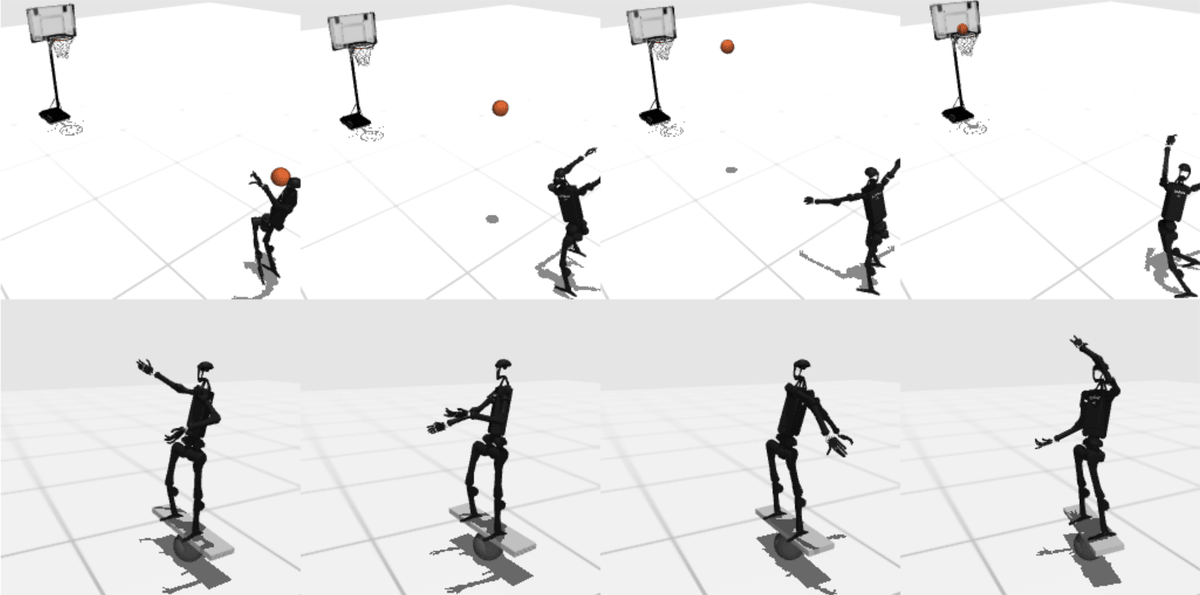
FastDSAC establishes state-of-the-art performance for high-dimensional stochastic policies on the evaluated benchmarks, and on two of the most brutal whole-body control tasks in the suite, it delivers gains of 180% and 350% over FastTD3 on the challenging Basketball and Balance Hard tasks respectively. The authors also managed to deploy the resulting policies zero-shot on a physical Unitree G1 humanoid.
Why stochastic policies keep breaking in high dimensions
The problem starts with what the paper calls vanishing exploration. A standard SAC policy uses a diagonal Gaussian, which means every joint gets its own independent noise. Because standard diagonal Gaussian policies lack structural prioritization, they distribute independent exploration noise uniformly across the expanded action volume, and as the action dimension pushes past 20 or 60, all those tiny independent perturbations cancel out into ineffective, jittery movement.
The second issue is the critic. In high-dimensional action spaces, the Q-function gets queried on out-of-distribution actions constantly, and neural nets extrapolate wildly there. Standard mitigation strategies, such as clipped double Q-learning, are often insufficient to suppress this overestimation bias in complex dynamics. Even recent parallelized approaches, utilizing either standard architectures or discrete distributional critics, struggle to resolve this instability, leading to suboptimal convergence. FastTD3 uses a C51-style categorical critic with fixed value support bins, which introduces another problem: you have to hand-tune the min and max return range per task.
Redistributing the exploration budget
The first core contribution is Dimension-wise Entropy Modulation (DEM). Instead of letting every joint explore independently, DEM learns a per-dimension scaling weight that redistributes a fixed exploration budget across joints. The weights come out of a temperature-scaled softmax over learned logits, then get multiplied by the number of action dimensions so they average to exactly 1.
The effect is a zero-sum trade-off: to explore aggressively on some joints, the policy has to become nearly deterministic on others. By dynamically adjusting w_i, the agent gains the autonomy to selectively suppress noise on specific dimensions while concentrating exploration variance on task-irrelevant dimensions, effectively rendering critical actions near-deterministic to ensure the precise control for optimal convergence.
Here's a rough sketch of what the modulation looks like in code:
logits = actor_logits_head(features)      # per-dim importance
w = softmax(logits / tau) * N              # mean of w is 1
base_log_std = actor_std_head(features)
sigma = w * torch.exp(base_log_std)        # modulated per-dim std
action = mu + sigma * torch.randn_like(mu) # reparameterized sample
The visualization on the Basketball task is where this gets interesting. The heatmap below shows the learned exploration weights across joints over the course of an episode.

We observed a prominent high-weight band corresponding to task-irrelevant joints, such as the left thumb and wrist, which act as entropy sinks. During the critical interaction phase, as the robot impacts the ball, weights for the legs, torso, and right arm are suppressed to near-zero. The agent basically dumps its required exploration noise into fingers that don't matter, so the legs and core can stay precise. Even better, it discovers a non-human strategy: The agent autonomously discovers an unconventional "body-rebound" strategy, using the torso rather than the hands to redirect the ball.
A continuous critic instead of fixed bins
The second piece swaps out FastTD3's categorical C51 critic for a continuous Gaussian critic borrowed from DSAC-T. Instead of predicting probabilities over a fixed grid of return values, the critic outputs a mean and a standard deviation for the return distribution. This kills two annoyances at once: no hand-tuned support range per task, and no quantization error from finite atoms.
The team also streamlined DSAC-T's gradient estimator. While original DSAC-T employs complex variance-based gradient adjustments for low-data regimes, we find these constraints restrict accurate variance modeling in our settings. Because the massively parallel training regime uses batches of 32,768, they could drop the variance clipping and shrink the numerical stabilizer from 0.1 down to 1e-6, which lets the critic model low-variance states with much finer resolution.
Results across 35 tasks
The evaluation spans HumanoidBench (25 tasks, 61-DoF), MuJoCo Playground, and IsaacLab. A few things stood out:
- Precision-heavy tasks: FastDSAC dominates on Basketball, Balance Hard, Insert Normal, Sit Hard, and Window, where deterministic policies converge prematurely.
- Locomotion: On Run and Slide, FastDSAC rises more slowly than FastTD3 but converges to higher final returns, consistent with entropy-driven exploration finding better gaits.
- Compute overhead: Only about 10% slower wall-clock time than FastTD3 on the same RTX 4090 hardware.
- Sim-to-real: Policies transferred zero-shot to a Unitree G1 running on the robot's onboard compute, holding up under physical pushes.
One important implementation note: the authors set the target entropy to zero across all tasks, rather than the standard heuristic of negative-action-dimension. Unlike the standard heuristic which forces premature variance decay, H=0 sustains a generous exploration budget, which DEM structurally manages by safely offloading excess entropy to redundant joints.
Where it falls short
DEM assumes independent noise per dimension (a diagonal covariance), so it can't model correlated exploration between coupled joints. The continuous critic also adds a small compute cost compared to purely deterministic baselines. And in a head-to-head with concurrent work FastSAC-ERA and FlashSAC on the 61-DoF tasks, both alternatives struggled: FlashSAC struggles to scale to the 61-DoF regime despite extended training budgets, highlighting the necessity of algorithmic exploration mechanisms.
Is it useful right now
If you're training whole-body humanoid controllers in Isaac Lab, MuJoCo Playground, or HumanoidBench and you've been defaulting to FastTD3 because SAC keeps blowing up, this is the first framework that makes the maximum-entropy path competitive at 60+ DoF. An anonymous implementation is available, and the training protocol is a drop-in match with FastTD3's, so migration cost is low. The team also released their full paper with appendices covering hyperparameters, sim-to-real recipe, and ablations for target entropy and LayerNorm.
The bigger takeaway is conceptual: the stochastic-versus-deterministic debate for high-dimensional control isn't actually about the policy class, it's about how you allocate variance. Once you give the agent a structured way to decide which joints get to be noisy, maximum entropy RL stops being a liability and starts being an advantage, discovering coordination strategies that human intuition wouldn't design.