
FAST Beats Every Traffic AI by Splitting Time and Space
A new spatiotemporal forecasting framework pairs attention with Mamba in a Temporal-Spatial-Temporal design, cutting RMSE by up to 4.3% on standard traffic benchmarks.
Takeaways
- FAST combines attention for temporal modeling with Mamba for spatial propagation in a Temporal-Spatial-Temporal architecture. Paper
- Achieves up to 4.3% lower RMSE and 2.8% lower MAE than the strongest baseline on PeMS08.
- Best MAE on all three PeMS benchmarks; best RMSE on PeMS04 and PeMS08.
- Uses learnable multi-source embeddings for traffic flow, day-of-week, time-of-day, and node identity.
- Mamba spatial module keeps complexity linear in the number of sensors, avoiding quadratic attention costs.
- No public code released; evaluated only on PeMS-family California highway datasets.
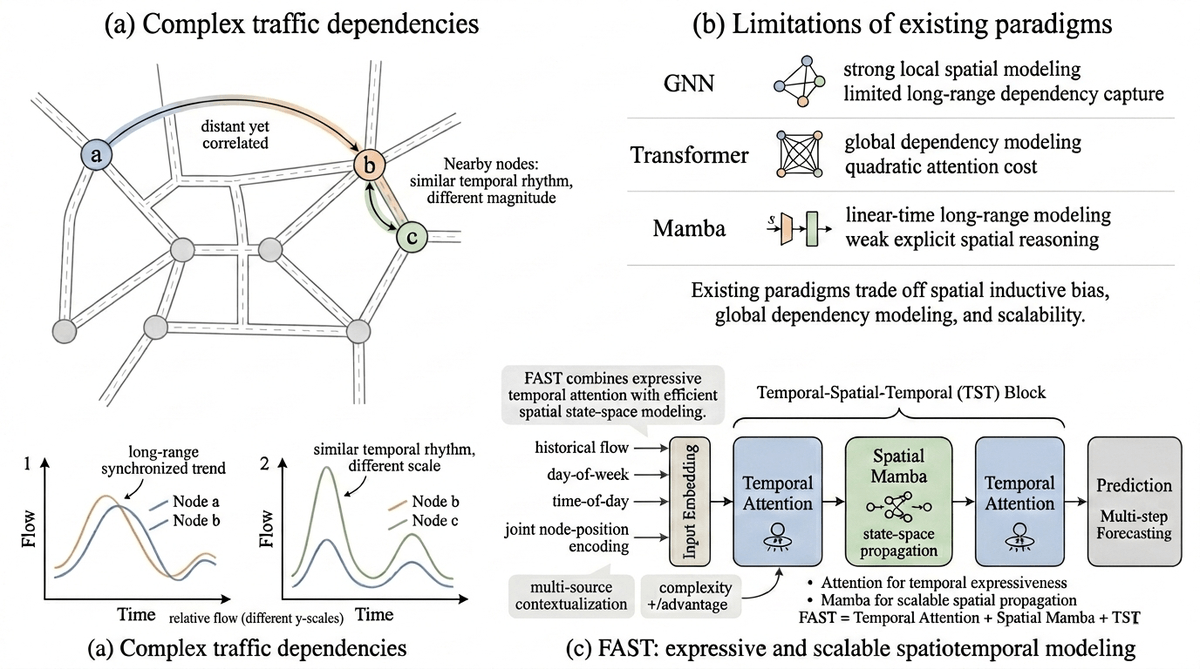
Traffic forecasting has been stuck in an awkward tradeoff for years. Graph neural networks handle local road structure well but miss long-range patterns. Transformers capture global dependencies but scale quadratically. Selective state-space models like Mamba are fast but weren't designed for graph-shaped sensor networks. A new paper called FAST proposes a clean division of labor: use attention where it shines (time) and Mamba where it shines (space), then interleave them.
The result consistently outperforms strong baselines from Transformer-, GNN-, attention-, and Mamba-based families, achieving the best MAE and RMSE on all three benchmarks, with up to 4.3% lower RMSE and 2.8% lower MAE than the strongest competitor. A modest but pointed win, and the architectural idea behind it is worth understanding.
Why traffic forecasting is harder than it looks
Traffic sensors don't behave like tokens in a sentence or pixels in an image. Geographically distant loops on a highway can be tightly synchronized (rush-hour arteries feeding the same downtown), while nearby sensors on different roads can diverge wildly.
Existing methods typically face a tradeoff between expressiveness and efficiency. Transformer-based models capture global dependencies well but suffer from quadratic complexity. Selective state-space models are computationally cheap yet less effective at modeling spatial interactions in graph-structured data. GNNs keep the road-network prior but stay stuck in local message-passing neighborhoods.