
FAKTUAL Beats Full Robot Training Datasets by Measuring Diversity Mathematically
A signature-kernel entropy metric quantifies robot demonstration diversity, letting a model-free curator pick subsets that often beat training on the full dataset.
 Pro
Takeaways
- New paper introduces FAKTUAL, a model-free curation method for robot imitation learning datasets.
- Extends Shannon and von Neumann entropy to trajectories via the signature kernel's Gram matrix.
- Signature entropy correlates strongly with policy success rate (Pearson r = 0.74 to 1.00).
- Beats random selection on RoboMimic, MetaWorld, and four real SO-ARM101 tasks; sometimes beats full dataset.
- Needs no auxiliary model, no rollouts, and negligible overhead beyond policy training.
- Weaker than rollout/quality-based baselines like CUPID when data quality varies.
Robot imitation learning has been riding the same wave as the rest of deep learning: bigger datasets, bigger models, better results. But nobody has had a good answer to a basic question: what does it actually mean for a demonstration dataset to be diverse? A new paper called Diversity You Can Actually Measure proposes a concrete metric, and then uses it to build a curation algorithm that consistently outperforms random subsampling, often matching or beating training on the full dataset.
Why counting demos is not enough
Robotics datasets for imitation learning typically consist of long-horizon trajectories of different lengths over states, actions, and high-dimensional observations (e.g., RGB video), making it non-trivial to quantify diversity in a way that respects the underlying trajectory structure and geometry. Two demos of a pick-and-place can look nearly identical in state space while being very different geometrically, or vice versa. Pointwise distances between states or between video frames miss what actually varies from one demonstration to the next.
The authors also point out a practical problem with existing curation pipelines. A limitation of several curation approaches is that they typically rely on training an auxiliary model to compute heuristic scores, often incurring large upfront costs comparable to training the target policy itself. Methods like CUPID or Demo-SCORE need policy rollouts or a learned scoring network before you can even start filtering, which is fine for a small fine-tuning set and painful for a large pretraining corpus.
Borrowing from rough path theory
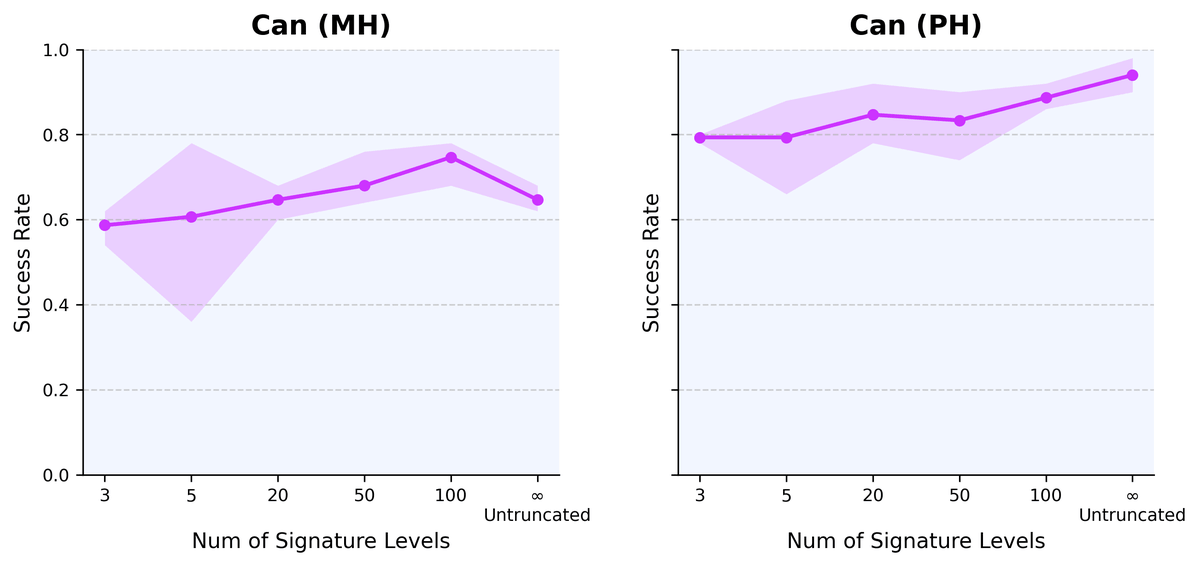
The core mathematical object here is the signature transform, a construction from rough path theory that turns a variable-length trajectory into a canonical, infinite sequence of iterated integrals. Informally, it plays a role similar to a Fourier series: low levels capture coarse trajectory shape, higher levels capture increasingly fine geometric detail. Two useful properties make it a good fit for robotics: it is invariant to how fast a path is traversed, and its induced kernel gives a meaningful similarity between paths of different lengths.
Building on this, the authors define a diversity score by computing entropy on the eigenvalues of the signature kernel's Gram matrix over demonstrations. Remarkably, it turns out that the signature Shannon entropy equals the signature von Neumann entropy, and exponentiating it gives the effective rank of the kernel matrix, which is the Vendi score adapted to trajectories. In plain terms: if all your demos look alike under the signature kernel, entropy is low; if they cover many distinct trajectory modes, entropy is high.
How FAKTUAL builds a subset
The curation algorithm, FAKTUAL (FAst trajectory Kernel enTropy cUration for imitation Learning), is refreshingly simple. Given a budget of m demonstrations, it greedily selects the subset that maximizes signature entropy. To convert each demonstration into a path, images are embedded with a ViT (or replaced with low-dimensional object representations like point clouds), then concatenated with per-timestep states and actions. Only then does the signature kernel come into play.
The pipeline has a small twist: pure entropy maximization can miss extreme but useful outliers, so FAKTUAL splits the budget with a mixing parameter p:
- Fix
pbetween roughly 0.5 and 0.9. - Pick the entropy-maximizing subset of size
m*p. - From the remainder, pick a determinant-maximizing subset of size
m*(1-p)(this favors extreme, volume-expanding demos). - Return the union.
Because the underlying objective is submodular, standard greedy or stochastic-greedy algorithms give a (1-1/e) approximation guarantee, and the whole thing runs without ever training an auxiliary model or rolling out a policy.

Diversity actually predicts success
The most striking empirical finding is how tightly the entropy score tracks downstream policy performance. Across tasks, higher-entropy sets consistently achieve higher success rates (Pearson r=0.74 to 1.00 for both random selection and FAKTUAL). That correlation holds whether the subsets were picked randomly or by FAKTUAL itself, which is strong evidence that signature entropy is measuring something real about the data rather than just tracking its own optimizer.
The team evaluated on image and state-based RoboMimic (Can, Square, Transport in both proficient-human and multi-human variants), three MetaWorld tasks (Door Open, Stick Push, Shelf Place), and four real-world SO-ARM101 manipulation tasks (Drawer Open, Mug Drag, Pick-and-Place Marker, Organize Objects). Policies included BC-RNN, diffusion policy, and fine-tuned SmolVLA.

Some concrete numbers from the RoboMimic experiments give a sense of the gap:
- Can (PH) with 120 demos: FAKTUAL 95% vs random 86% vs full 180-demo dataset 90%.
- Can (MH) with 240 demos: FAKTUAL 83% vs random 72% vs full 280-demo dataset 79%.
- Square (PH) with 90 demos: FAKTUAL 67% vs random 61%.
On two of the four real-world tasks the curated subset actually outperformed the full dataset, which the authors interpret as evidence that additional demonstrations can be redundant and adding noise rather than being strictly beneficial.
Where it wins and where it stumbles
Against stronger baselines, the tradeoff is honest. Relative to random pruning, FAKTUAL is generally better, and it can get you near the "All demos" reference, but it is still below most of the stronger rollout-/quality-informed baselines. The selling point is not raw performance but the cost profile: no auxiliary model, no environment rollouts, negligible overhead relative to policy training.
Several failure modes are worth knowing about:
- Low-demo regime on hard tasks. Diversity-maximizing curation can underperform random selection when the budget is small on difficult tasks like Transport, where every demo carries useful density.
- No quality filter. FAKTUAL assumes demos are all successful. If the dataset mixes good and bad trajectories, quality-based methods like CUPID or DemInf will do better.
- Invariances can miss things. On the Drawer Open real-world task, the method did not successfully distinguish between lighting conditions, primarily because it operates on ViT-based image embeddings or low-dimensional observations, which may not capture global illumination differences sufficiently.
- Weak policies hurt. If the imitation model cannot represent multimodal behavior, promoting diversity can actively degrade performance.
What this changes
The real breakthrough here is not a bigger success number, it is turning "diversity" into a scalar you can compute directly from the dataset in a few seconds and use as a signal. That opens the door to combining it with quality-based curation, using it as an auditing tool before training a large VLA model, or as a stopping criterion for data collection when the entropy curve saturates. Given that recent work like SmolVLA and pi0.5 depends heavily on the composition of massive manipulation datasets, having a cheap, model-free dataset-level metric that correlates with downstream policy success is a practically useful addition to the imitation learning toolkit.