
FACET Builds Personalized Dyslexia-Ready Worksheets for 30 Students in 30 Seconds
A four-agent architecture built on GPT-OSS 120B generates differentiated worksheets while keeping teachers in control of profiles, review, and export.
 Pro
Takeaways
- FACET is a teacher-facing four-agent LLM framework generating differentiated worksheets for diverse learners. Paper
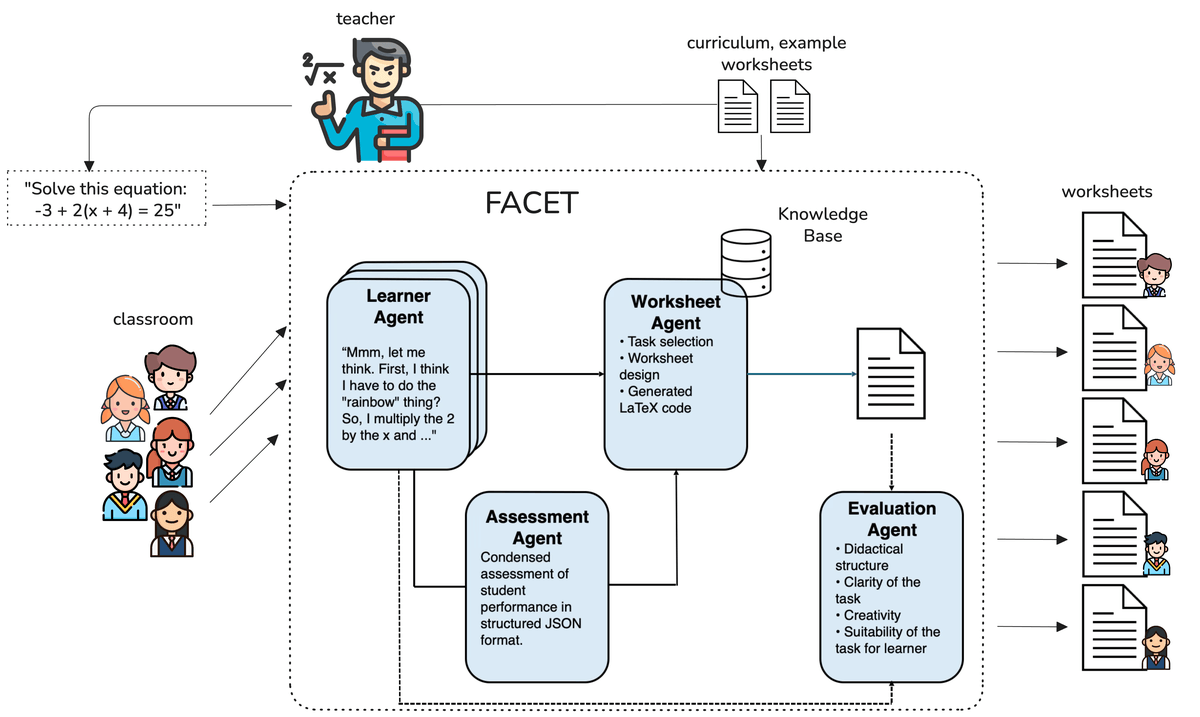
- Agents handle learner simulation, diagnostic assessment, material generation, and pedagogical evaluation with strict JSON handoffs.
- Runs on locally hosted GPT-OSS 120B via Ollama, producing one full worksheet in about 30 seconds.
- Generator emits LaTeX with dyslexia-aware typography, exports to PDF or .docx for teacher editing.
- 70 K-12 teachers rated scaffolded worksheets highly (structure ~4.5/6); enrichment for advanced learners scored lowest.
- Longitudinal deployment planned with 10 German schools to validate simulated behavior against real student responses.
Differentiated instruction is one of those ideas everyone in education agrees with and almost no one can actually pull off. A single teacher with 30 students spanning wildly different reading levels, motivation, and neurodivergent profiles cannot hand-craft a separate worksheet for each learner every week. Researchers from Zuse Institute Berlin, TU Berlin, Humboldt University, and the Weizenbaum Institute have built and tested a system that tries to close that gap using a multi-agent LLM architecture aimed at teachers rather than students.
The system, called FACET, coordinates four specialized agents to produce classroom-ready worksheets tailored to individual learner profiles that include motivation and learning differences like dyslexia and ADHD, not just performance scores. Evaluation involved 30 school principals in participatory workshops and 70 in-service K-12 teachers who rated the generated materials.
Why performance-only personalization keeps missing the point
Most existing AI tutoring products, from Khanmigo to Squirrel AI, are student-facing and adapt based on how many questions a learner gets right. That framing ignores the motivational and processing dimensions that educational research says actually drive outcomes. Roughly 5 to 17 percent of schoolchildren have dyslexia, and 11.4 percent of U.S. children aged 3 to 17 received an ADHD diagnosis in 2022. Those learners need adaptations to structure, cognitive load, and instructional clarity that a raw performance signal cannot capture.
Teachers who reach for ChatGPT to generate materials hit a different wall. Single LLMs show instability in learner simulation and high prompt sensitivity, they often fail to align with specific curricula, and chatbots lack the scalability required for complex workflows across multiple learning groups. Re-prompting from scratch every week for every subgroup is not a workflow, it is a second job.