
FA-MAPF Cuts Warehouse Robot Conflicts With Humans by 55%
A new MAPF planner uses learned pedestrian traffic patterns to route robot fleets around humans, cutting conflicts by up to 55%.
 Pro
Takeaways
- FA-MAPF integrates learned human motion patterns into centralized multi-agent path finding planners.
- Uses CLiFF-maps: per-cell Gaussian mixture distributions over velocity built from trajectory data.
- Applies a Mahalanobis-based flow cost as edge weights in a guidance graph, then runs EECBS or RHCR.
- Cuts conflicts with humans by up to 55% on benchmarks and real ATC shopping mall data without hurting throughput.
- Wins on room-like maps and one-way corridors; ineffective on mazes and unconstrained warehouse layouts.
- Preserves completeness and bounded-suboptimality of the base solver; trades higher planning runtime for fewer conflicts.
Warehouse robots plan their routes assuming the world is a well-behaved grid. Real warehouses have people in them, and people do not follow schedules. A new paper from Örebro University, Bosch Research, TU Munich and UC Irvine tries to fix that by teaching centralized multi-robot planners about the actual traffic patterns of the humans they share space with.
The method, called Flow-Aware Multi-Agent Path Finding (FA-MAPF), plugs learned motion patterns of uncontrollable agents directly into the cost function of a standard MAPF solver. The experimental results show that FA-MAPF can consistently reduce conflicts with uncontrollable agents, up to 55%, without compromising task efficiency.
Why fleet planners keep tripping over people
Multi-Agent Path Finding (MAPF) is the problem of computing collision-free paths for a team of robots on a shared graph. It is the backbone of warehouse automation, but classical MAPF assumes every moving thing on the map is one of your robots. In such environments, individual robot operations can be delayed due to unforeseen conflicts with uncontrollable agents.
The existing response has been what the field calls robust MAPF: build schedules that survive delays, freeze precedence constraints, or replan aggressively when something goes wrong. The authors point out that almost no one has tried to prevent the conflicts in the first place by exploiting the fact that humans in a mall or warehouse are not actually moving randomly. They follow corridors, prefer certain doors, and respect flow norms.
That structure is what FA-MAPF exploits. It leans on a concept called Maps of Dynamics (MoDs), which encode where things typically move and in what direction as a property of the environment itself, not of any individual person.
Turning human traffic into edge weights
The specific representation used is the CLiFF-map (Circular-Linear Flow Field). For every spatial cell in the environment, it stores a probability distribution over velocity, where velocity is the pair (direction, speed). Because human traffic is often multimodal (people going both directions down a corridor), the distribution is a Semi-Wrapped Gaussian Mixture Model, where the angular dimension is wrapped around the unit circle and the speed dimension is linear. Think of it as a per-location weather map of pedestrian wind.
Once you have that, FA-MAPF asks a simple question at every grid cell: how well does each of my possible actions (right, up, left, down, wait) align with the local flow? Actions that fight the flow get a higher cost, actions that ride with it get a lower cost. Formally, the paper uses the Mahalanobis distance between the action vector and each mixture component, weighted by how often people were actually observed there:

These per-edge costs feed a guidance graph, a formalism from Zhang et al. where each edge in the original MAPF graph carries an extra weight. Crucially, FA-MAPF does not touch the search algorithm itself. It sits on top of solvers like EECBS (Explicit Estimation Conflict-Based Search) for one-shot problems and RHCR (Rolling-Horizon Collision Resolution) for lifelong problems where new tasks stream in.
Two properties fall out of the design. First, because the flow cost is finite and positive, the underlying MAPF algorithm remains complete and its bounded-suboptimality guarantees carry over to the modified cost function. Second, the guidance graph and all-pairs heuristics can be pre-computed offline from historical trajectory data, so planning time is not spent detecting or predicting individual humans. There is no ad-hoc replanning and no reliance on real-time perception of uncontrollable agents.
What the numbers actually say
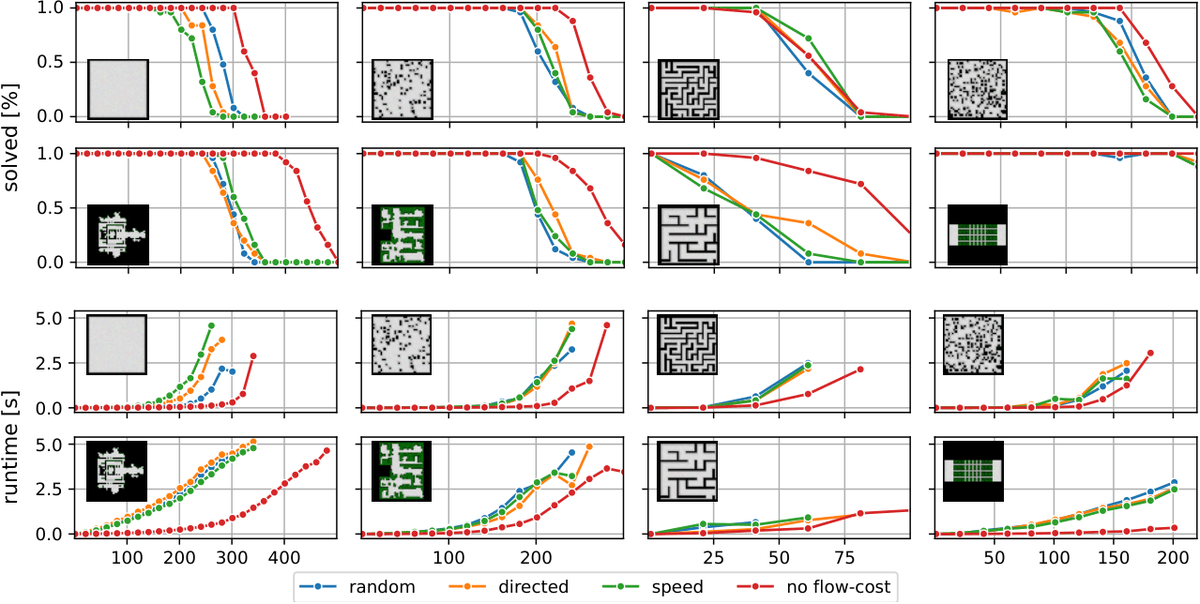
The team ran two experiments: one-shot EECBS on standard MAPF benchmarks with 100 simulated pedestrians, and lifelong RHCR with a fresh pedestrian appearing every timestep. They also tested on the ATC shopping mall dataset, replaying real human trajectories against 40 robots for 33,000 timesteps (roughly 9 hours).

The headline result on lifelong MAPF: FA-MAPF reduces UA conflicts by up to 55% compared to the baseline, in exchange for an increase in runtime. Throughput, the number of tasks completed per timestep, is essentially unchanged. On the ATC map with real human data, the reduction was consistent across the full 9-hour replay.
Where FA-MAPF wins depends heavily on the map:
- Room-like layouts (den312d, ht_chantry): big gains. Flow patterns are clear and there is room for robots to detour.
- Open maps (empty-32-32): solid gains, since the robots can freely reroute around observed streams.
- Maze-like maps (maze-32-32-2, maze-32-32-4): minimal gains. Corridors are too narrow for robots to adjust to human motion patterns.
- Warehouses with unrestricted human paths: no gain, because corridors get traversed in both directions and no flow pattern emerges.
- Warehouses with highway-style one-way rules: large gains, because the MoD picks up the enforced pattern.
The cost side is runtime. Because edge weights are no longer uniform, the low-level search expands more nodes. On the harder benchmarks EECBS starts hitting the 5-second cutoff at lower agent counts than the baseline, and per-iteration RHCR runtime grows several-fold in the worst cases. Throughput mostly holds steady, and interestingly at high agent counts flow awareness seems to dampen throughput drop-off, hinting that it produces more feasible partial solutions when the solver runs out of time.
Where it fits and what it does not do
FA-MAPF is complementary to robust MAPF, not a replacement. Robust methods handle the delays you cannot avoid; FA-MAPF tries to have fewer of those delays to begin with. It is a good fit for shared spaces where human traffic has structure that can be learned from historical data, and where the environment gives robots room to route around it. It is not the right tool for tight mazes, or for warehouses where nothing constrains where humans walk.
The paper does not release code, and the authors were unable to compare against the closest prior method (TP-CA from Bonalumi et al.) because that implementation was unavailable. Open follow-ups the team flags include integrating flow awareness into large-scale planners like LaCAM and PIBT, and extending the maps of dynamics to time-dependent CLiFF-maps that capture rush-hour effects.
The broader shift is philosophical. Centralized MAPF has spent years assuming the environment is sterile. This work is a concrete step toward planners that treat the messy dynamics of shared spaces as a first-class input, encoded as a static feature of the environment rather than a stream of real-time detections.