
ExpertGen Teaches Robots Real-World Tasks With Just 200 Imperfect Demos
A three-stage pipeline from RAI Institute turns messy LLM-scripted demos into robust real-robot policies without a single hand-tuned reward.
 Pro
Takeaways
- ExpertGen combines diffusion behavior priors with FastTD3 RL that steers only the initial noise of a frozen diffusion policy.
- Achieves 90.5% success on AutoMate industrial assembly and 85% on long-horizon manipulation using only sparse rewards.
- Requires no reward engineering; a binary task-success signal is enough to train dexterous expert policies.
- State-based experts distilled into RGB or point-cloud policies via DAgger transfer zero-shot to a real Franka arm.
- Roughly 200 imperfect demonstrations from LLM-scripted skills or human teleop suffice to bootstrap the prior.
- Limitation: cannot invent skills outside the demonstration distribution, such as recovering a fully knocked-over object.
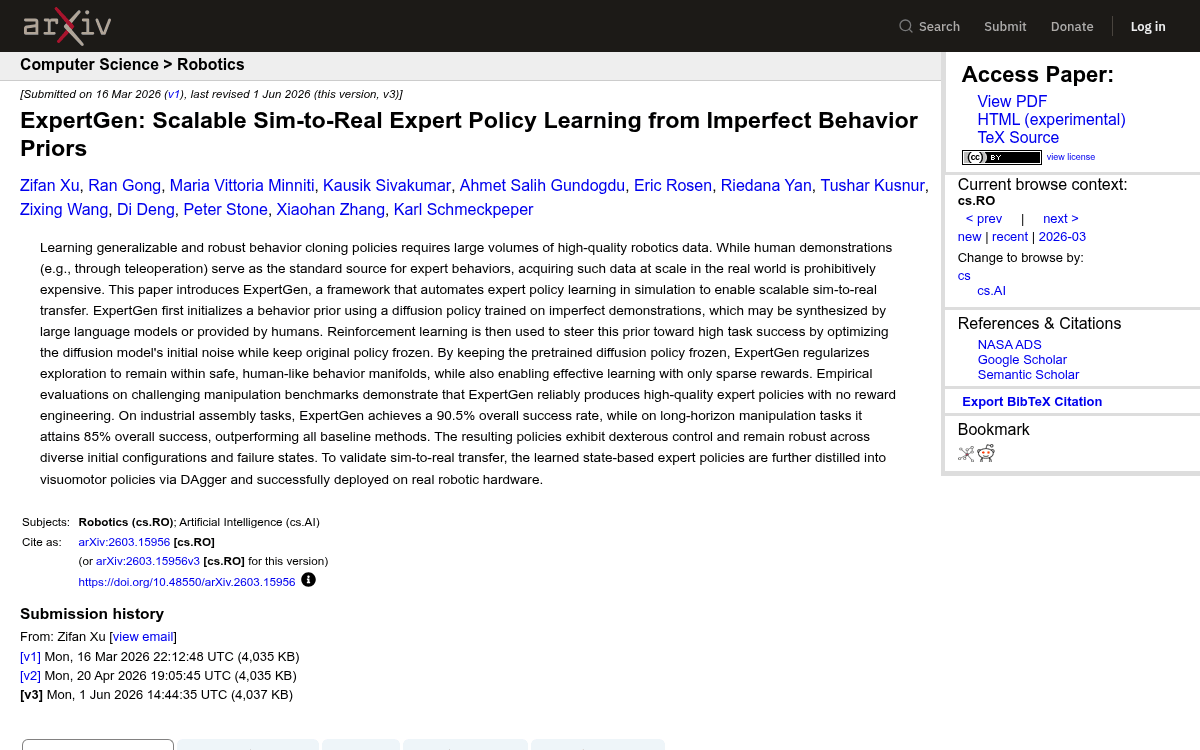
Training a robot to reliably pick up a banana or slot a peg into a socket sounds simple until you try to collect enough demonstrations to make it work in the real world. Teleoperation is expensive, scripted policies are brittle, and pure reinforcement learning demands reward functions that take PhD-level effort to shape. A new paper from the Robotics and AI Institute, called ExpertGen, sidesteps all three problems by turning a handful of imperfect demonstrations into high-performing sim-to-real policies using only a binary success signal.
The core trick is deceptively simple. Instead of fine-tuning a diffusion policy with RL (which tends to break its smooth motion prior) or bolting a residual correction on top (which needs careful action-scale tuning), ExpertGen freezes the diffusion model entirely and learns to steer its initial noise. That single design choice lets the system scale to massively parallel GPU simulation, learn from sparse rewards, and transfer cleanly to physical hardware.

The data bottleneck that keeps breaking robotics
Modern vision-language-action models inherit strong semantic reasoning from internet-scale pretraining, but translating semantic competence into reliable physical execution remains a major challenge because closed-loop, temporally-aligned robot data is scarce. The field has tried three workarounds, all with sharp edges:
- Teleoperation: High quality, but expensive and slow.
- LLM-scripted policies: Cheap and scalable, but they cover few states and cannot recover from failures.
- Pure RL: Powerful, but training high-performing expert policies typically depends on carefully engineered reward functions, which does not generalize across tasks.
ExpertGen's authors frame the goal as satisfying four properties at once: spatial generalization beyond the demo distribution, failure recovery, real-world transferability, and learning from sparse task-level rewards without any shaping.
How diffusion steering actually works
The system runs in three phases. First, a lightweight state-based diffusion policy is trained on roughly 200 to 1000 imperfect demonstrations, which can come from either LLM-generated scripted trajectories or a few human teleop sessions augmented with SkillMimicGen. This gives the system a behavior prior that knows what feasible, human-like motion looks like, even if it fails at the actual task most of the time.
Second comes the interesting part. Rather than updating the diffusion weights, ExpertGen uses Diffusion Steering RL (DSRL) to learn a small policy that picks the initial Gaussian noise fed into the denoiser. The frozen diffusion model then deterministically unrolls that noise into an action chunk. Because the noise is the only thing being optimized, exploration is automatically constrained to the manifold of behaviors the diffusion model already knows how to produce. As the authors put it, DSRL optimizes task performance while preserving the structure of behaviors captured by the diffusion prior, and unlike residual or policy fine-tuning approaches, DSRL does not modify the diffusion model parameters nor reduce the dimensionality of the action space.
The RL algorithm doing the steering is FastTD3, a scalable off-policy TD3 variant designed for high-throughput simulation with distributional critics and mixed exploration noise. It runs in IsaacLab with batch sizes over 8000 across thousands of parallel environments. The reward is just a binary indicator of task success. No shaping, no dense signals.
Third, the resulting state-based expert (which uses privileged simulator info like exact object poses) is distilled into a visuomotor student that consumes RGB images or point clouds. This distillation uses DAgger with heavy visual domain randomization on textures, lighting, camera extrinsics, and object appearances, so the student learns to imitate the expert under realistic visual noise.
The numbers
On the AutoMate industrial assembly benchmark, which focuses on tight-tolerance peg insertion, ExpertGen hits 90.5% average success across eight tasks, outperforming prior state-of-the-art by roughly 38 points. On the ANYTASK benchmark of eight tabletop manipulation tasks, it wins on every single task compared to residual RL, SMP, pure FastTD3, and vanilla diffusion policies.
A few results are worth highlighting:
- Failure recovery: Under random external forces applied to the end-effector, the base diffusion policy on Lift Banana drops from 82% to 1.9% success. ExpertGen only drops from 99.7% to 56.6%.
- Demo efficiency: Performance is stable down to 200 demonstrations. It only degrades noticeably at 50 demos.
- Motion quality: ExpertGen's jerk cost averages 5.97 across ANYTASK tasks, compared to 35.3 for residual RL with a large action scale, meaning the motions stay smooth enough for real hardware.
- Sparse-reward RL alone fails: FastTD3 without the diffusion prior scores essentially 0% on all eight ANYTASK tasks. The prior is what makes sparse-reward learning tractable.
Zero-shot to a real Franka
The team deployed the distilled visuomotor policies on a single-arm Franka with a Robotiq gripper and three RealSense D435i cameras. On four real-world tasks, ExpertGen-distilled policies substantially outperformed policies trained directly on the LLM-scripted demonstrations, especially on tasks with articulation and complex contact. For pixel-based control, the RGB student hit 80% on Lift Banana even in a cluttered scene with visual distractors, while the scripted-policy BC baseline achieved zero successful trials.
A subtle but important finding: for real-world DAgger distillation, keeping a small non-zero teacher-rollout ratio (around 0.2) worked better than fully switching to pure student rollouts. Retaining a bit of teacher correction stabilizes the policy against real-world sensor noise.
When to reach for this, and when not to
ExpertGen is a strong fit if you have a simulator with privileged state, a task where you can define a binary success check, and some way to generate imperfect demonstrations (LLM-scripted skills, a small teleop batch, or motion capture). It shines on contact-rich and long-horizon tasks where reward shaping would be a nightmare.
The main limitation is honest and important. The learned policies are constrained by the coverage of the provided demonstrations, so if your prior never demonstrates a recovery skill, like flipping a knocked-over can back upright, the RL step cannot invent it from scratch. The diffusion prior is a safety rail and a scaffold, but it is also a ceiling on what novel behaviors can emerge.
Code and a model release are not yet public, but the team has a project page with videos and further details, and the full method is documented in the arXiv paper. For anyone building sim-to-real pipelines, the takeaway is that noise-space RL on a frozen diffusion prior may be a more scalable recipe than either residual learning or full policy fine-tuning.