
EvoClaw Exposes How Frontier Coding Agents Silently Destroy Real Codebases
A new benchmark called EvoClaw tests AI coding agents on multi-step software evolution and finds performance collapses from over 80% to under 38%.
 Pro
Takeaways
- New benchmark: EvoClaw evaluates AI agents on continuous software evolution across dependency-linked milestones.
- Performance collapse: Frontier models drop from over 80% on isolated tasks to at most 38% continuous.
- Snowball effect: Recall grows linearly but Precision saturates as regressions accumulate across milestones.
- DeepCommit pipeline: Reconstructs verifiable Milestone DAGs from noisy git commit histories using LLM agents.
- Scale: 98 milestones across 7 repositories in Go, Rust, Java, TypeScript, and Python.
- Open resources: Code on GitHub, dataset on Hugging Face, leaderboard at evo-claw.com.
Most coding benchmarks treat software engineering as a series of unrelated puzzles. An agent fixes one bug, gets scored, and the environment resets. Real repositories do not work that way, and a new benchmark called EvoClaw shows that when you force frontier agents to evolve a codebase across dozens of dependent tasks, they fall apart in ways that isolated benchmarks completely miss.
EvoClaw comes with a companion pipeline, DeepCommit, that turns messy git histories into structured evaluation sequences. Together they expose what the authors call a snowball effect: agents keep implementing new features fine, but silently break existing behavior until the codebase becomes unworkable.
The gap between one-off tasks and living codebases
Benchmarks like SWE-bench, Multi-SWE-bench, and Commit0 have pushed agent evaluation from single-function completion to whole-repository generation. But they predominantly treat development as independent, one-off tasks, ignoring the temporal structure of software evolution. In production, early implementation decisions constrain everything that comes after. Agents that pass isolated tests can still be piling up technical debt that only shows up milestones later.
The team behind EvoClaw argues that the right granularity for measuring this is neither the individual commit (too noisy, full of typo fixes and squash merges) nor the release (too coarse, collapsing hundreds of interdependent changes into one blob). Instead they define a milestone as a coherent functional unit, and organize milestones into a directed acyclic graph where edges encode genuine prerequisite constraints.
DeepCommit: turning git logs into executable evolution
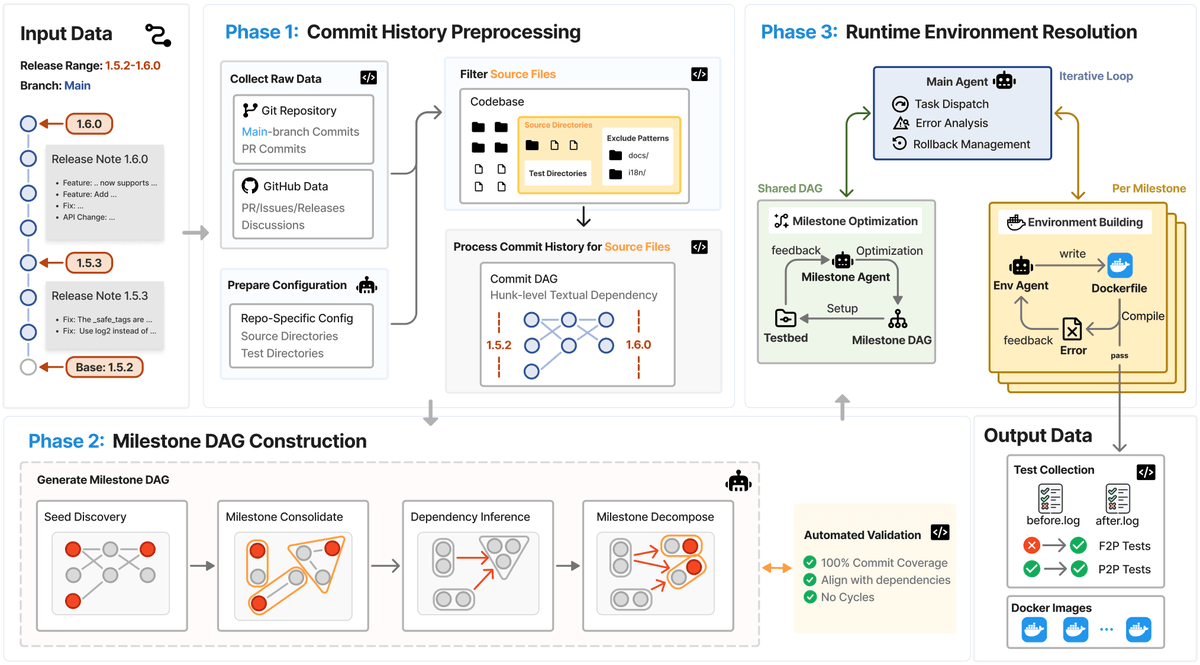
Reconstructing milestone DAGs from raw commit history is the hard part. Commits vary widely in granularity, semantic clarity, and dependency structure, while parallel branches, squash merges, and non-functional changes obscure true developmental relationships. DeepCommit is an agentic pipeline that handles this in three phases.

- Commit preprocessing. Static analysis builds a commit-level DAG using
git blame, extracts symbol-level modifications in classes and functions, and computes file co-change statistics. - Milestone DAG construction. An LLM agent runs four stages: seed discovery (finding foundational anchors via topology), milestone consolidation (parallel sub-agents group related commits), dependency inference, and granularity refinement.
- Runtime resolution. A MilestoneAgent cherry-picks commits in topological order, an EnvAgent generates Dockerfiles, and tests are categorized as Fail-to-Pass (validating new functionality) or Pass-to-Pass (guarding against regressions).
Powered by Claude Opus 4.5, DeepCommit achieves an average test collection success rate of >85%. The full benchmark contains 98 human-verified milestones across 7 high-impact open-source repositories, spanning Go, Rust, Java, TypeScript, and Python, with 124 inter-milestone dependencies.
How the continuous evaluation actually works
EvoClaw decouples planning from implementation. An external scheduler unlocks a new milestone only when its prerequisites are complete, and the agent works in a persistent stateful environment where every prior modification carries forward. When a milestone is submitted, the codebase is snapshotted and shipped to an isolated container for scoring, so evaluation never contaminates the ongoing development loop.
Scoring uses two complementary metrics rather than a binary pass/fail:
- Recall: fraction of required Fail-to-Pass tests the agent gets working (feature completeness).
- Precision: fraction of test status changes that are improvements rather than regressions, measured against Pass-to-Pass tests (safety of edits).
The final Score is the harmonic mean, so an agent that ships features while breaking existing ones is penalized just as heavily as one that avoids regressions by doing nothing.
The results are grim
The team evaluated 12 frontier models across four agent frameworks: Claude Code, Codex CLI, Gemini CLI, and OpenHands. The headline finding is a collapse. Scores drop from over ∼80% on isolated tasks to at most 38.03% (Claude Opus 4.6) in continuous environments, with a mere 13.37% Resolve Rate (Gemini 3 Pro).
A few concrete data points from the leaderboard:
- Claude Opus 4.6 in OpenHands tops out at 38.03% Score, 8.46% Resolve Rate.
- GPT 5.3-Codex hits 28.88% at roughly $25 per evolution range.
- Gemini 3 Flash sits on the Pareto frontier at $12 and 24.22%.
- A full evaluation costs about $500 with frontier models like Claude Opus 4.5.
Interestingly, GPT 5.2-Codex reveals that Codex-specific optimization may be counterproductive for long-horizon development, where sustained codebase maintenance demands broader analytical capabilities beyond isolated task solving. And throwing more compute at the problem does not automatically help: OpenHands with GPT 5.3-Codex ran for 18.49 hours per repository without beating Claude Code in a fraction of the time.
Recall scales, Precision saturates
The most interesting finding is mechanistic. When the researchers decomposed cumulative scores over the evolution timeline, Recall continues to grow near-linearly across all models, indicating that agents retain the ability to solve newly assigned tasks. Precision, however, saturates rapidly across all evaluated configurations.
The ceiling is not about forgetting how to code. It is about failing to prevent regressions from piling up. Each new milestone operates on an increasingly degraded codebase until the agent's own damage overwhelms its productivity.

To trace how failures cascade, the authors introduced error chains, which follow each broken test forward across all remaining milestones. They classify propagation events as P0 root causes, P0 induced (cross-chain contamination), P1 inherited (through dependency), PX missing (skipped execution), or PH healed. Logic errors dominate the root causes, and buggy implementations frequently prevent downstream tests from running at all.
Behavioral tells: exploration and verification matter
Instrumenting tool calls surfaced patterns that predict success or failure. Higher-performing agents consistently spend more effort reading and searching the codebase before editing. Claude Opus 4.6 and Sonnet 4.6 dispatch subagents that execute over 7,000 exploration commands per repository, while models like Gemini 3 Pro under-explore and pay for it.
Verification behavior tells a similar story. There is a clear sweet spot of moderate edit thrashing paired with disciplined test execution. The worst outcomes cluster in what the authors call the blind thrashing quadrant: agents repeatedly modifying the same files without running tests to guide them, which accelerates the snowball effect rather than stopping it.
What is available and where it fits
The benchmark, dataset, and leaderboard are all public. The code lives at github.com/Hydrapse/EvoClaw, the dataset is on Hugging Face, and the leaderboard at evo-claw.com tracks 15 agent-model configurations. Because DeepCommit is a scalable agentic pipeline rather than a hand-curated dataset, the benchmark can grow as new open-source repositories mature and stronger LLMs improve DAG extraction quality.
If you are building or evaluating a long-running coding agent, EvoClaw is the first benchmark that puts realistic pressure on the maintenance dimension. It will not tell you whether your agent can close a GitHub issue, since SWE-bench already does that well. It will tell you whether your agent can be trusted to keep a repository alive across weeks of feature work without quietly destroying it.