
EviAdapt Hits 42% Accuracy Gains Predicting Engine Failures Before They Happen
A new evidential domain adaptation method fixes a blind spot in remaining useful life prediction, where target machines never reach failure and prior methods misalign degradation stages.
 Pro
Takeaways
- EviAdapt targets RUL prediction when target machines never reach failure, breaking standard domain adaptation methods.
- Segments source and target data into degradation stages by rate, then aligns them stage-by-stage instead of globally.
- Uses evidential learning to estimate uncertainty and align uncertainty distributions across matched stages.
- Beats state-of-the-art by 16%, 42%, and 2% on C-MAPSS, N-CMAPSS, and PHM2010 benchmarks respectively.
- Architecture: pretrained source encoder plus shared predictor, then a target encoder trained for stage-wise uncertainty alignment.
- Code released at github.com/keyplay/EviAdapt; source-free version planned for confidential industrial data.
Predictive maintenance models built in the lab rarely see the failures they are supposed to predict. In the field, machines get pulled offline before they die, so the training data your model gets to adapt to is chopped off well before the interesting part. A new paper called EviAdapt, published in IEEE Transactions on Instrumentation and Measurement, takes direct aim at this problem for remaining useful life (RUL) prediction and reports double-digit accuracy gains on the standard aero-engine benchmarks.
The blind spot in cross-domain RUL
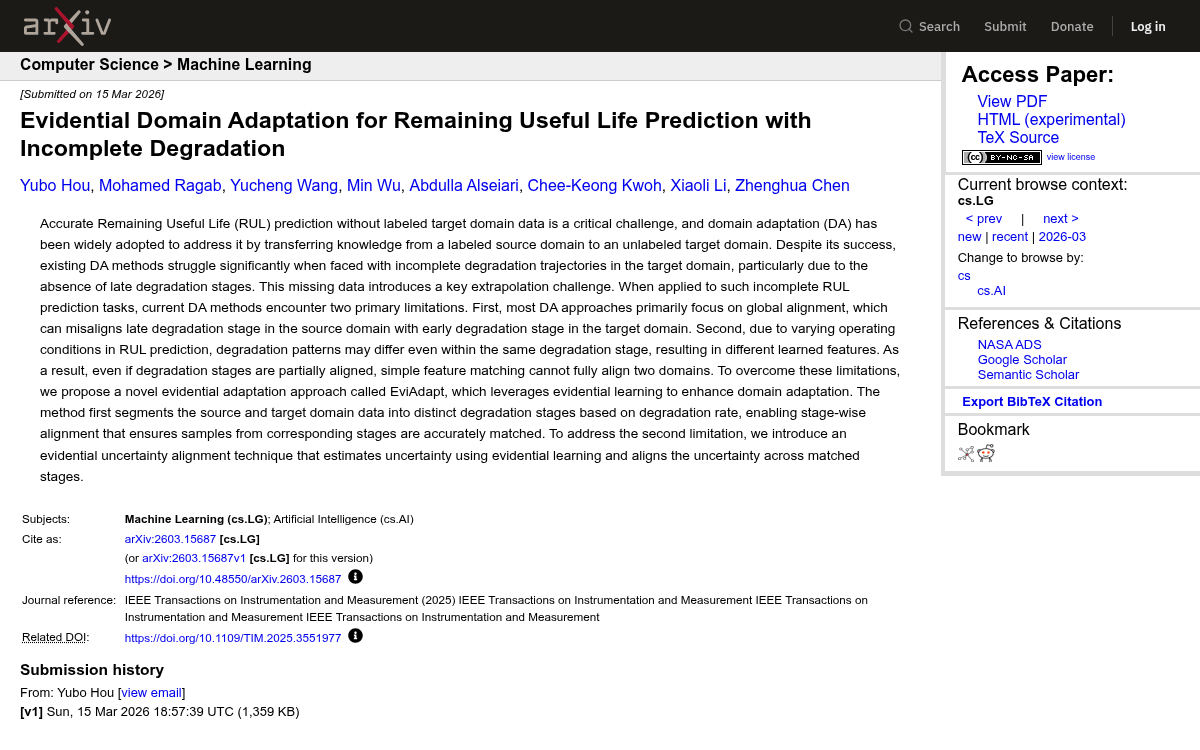
RUL prediction is the workhorse of prognostics and health management, and domain adaptation (DA) is the usual trick for making a model trained on one machine work on another. Domain adaptation has been widely adopted to transfer knowledge from a labeled source domain to an unlabeled target domain when target labels are unavailable. The catch is that existing DA methods struggle significantly when faced with incomplete degradation trajectories in the target domain, particularly due to the absence of late degradation stages, and this missing data introduces a key extrapolation challenge.
The authors identify two very concrete failure modes. Most DA approaches focus on global alignment, which can misalign the late degradation stage in the source domain with the early degradation stage in the target domain. On top of that, varying operating conditions mean degradation patterns can differ even within the same degradation stage, so even if stages are partially aligned, simple feature matching cannot fully align two domains.

Stage-wise alignment, plus uncertainty
EviAdapt attacks both problems at once. First, it slices each run into distinct degradation stages based on how fast the health indicator is dropping, then aligns stage-for-stage instead of dumping all samples into one global bucket. Second, it borrows a tool from evidential deep learning, a technique that trains a network to output the parameters of a distribution over its predictions rather than a single point estimate, giving you a principled uncertainty score without ensembles or Monte Carlo sampling.
The method segments source and target data into distinct degradation stages based on degradation rate, enabling stage-wise alignment that ensures samples from corresponding stages are accurately matched, and introduces an evidential uncertainty alignment technique that estimates uncertainty using evidential learning and aligns the uncertainty across matched stages. Aligning uncertainty distributions, rather than raw features, sidesteps the trap where two engines are technically in the same degradation phase but look different in feature space because they were run at different loads or temperatures.
How the pipeline is wired together
Architecturally, the model has three pieces. A source encoder and shared predictor are pretrained to learn the RUL distribution and its uncertainty on the source domain using evidential learning. During adaptation, source and target data are segmented into different degradation stages, and the target encoder is trained to align the uncertainty of the same degradation stages between the source and target domains.

In practice this means the workflow looks like:
- Train an evidential model on labeled source runs to get RUL predictions with per-sample uncertainty.
- Use quantile prediction and pseudo-labeling to assign each unlabeled target window to a degradation stage.
- Train a target encoder so that, within each stage, the target-side uncertainty distribution matches the source-side one.
What the numbers say
EviAdapt was tested on three standard prognostics benchmarks: C-MAPSS and N-CMAPSS (NASA aero-engine simulations) and PHM2010 (a milling tool wear dataset). Results show that EviAdapt surpasses state-of-the-art methods on the C-MAPSS, N-CMAPSS, and PHM2010 datasets, with average improvements of 16%, 42%, and 2%, respectively. The huge N-CMAPSS gain is the interesting one, because that dataset has the most diverse operating conditions and the most severe incomplete-trajectory setup, which is exactly where global-alignment baselines fall apart.
Where it fits, and where it doesn’t
The real breakthrough here is not another DA architecture, it is treating uncertainty itself as the alignment target. If you are trying to deploy a fatigue or wear model on machines that are yanked from service before failure, and you only have unlabeled sensor traces from those machines, EviAdapt is directly applicable. It is a strong fit for aero-engine health monitoring, bearing prognostics, and tool wear estimation where run-to-failure target data is a luxury nobody has.
The main limitation the authors themselves flag is that the method still needs the full labeled source dataset at adaptation time. In future work, they plan to develop a source-free domain adaptation method for RUL prediction, since in many industrial settings production data is highly sensitive and often contains confidential information, making it infeasible to share. Anyone working with proprietary fleet data will recognize that problem immediately.
Code is available on the authors’ GitHub repository, so the stage-segmentation and evidential-alignment losses can be dropped into existing PyTorch pipelines without reimplementing the whole framework from the IEEE paper.