
Every AI Model Tested Defaults to Masculine When Translating Basque, Study Finds
New Basque-language benchmarks reveal that every major LLM and MT system defaults to masculine forms, even for jobs that are 96% female in the real world.
 Pro
Takeaways
- Two new datasets released: WinoMTeus and FLORES+Gender benchmark gender bias in translation involving Basque.
- Universal masculine default: Every model tested -- GPT-5, Claude 4, Google Translate, NLLB-200 -- systematically chose masculine forms for gender-neutral Basque occupations.
- Worst case: "housekeeper" is 96.5% female in Basque labor data, yet models consistently translated it as masculine across Spanish and French.
- GPT-5 and NLLB-200-3.3B showed the best alignment with real-world labor statistics (Pearson r > 0.4); Llama 3.1 8B scored near zero (r = 0.066).
- Basque-adapted Latxa models significantly outperformed their base Llama counterparts, showing language-specific fine-tuning reduces gender bias.
- Translation quality gap: Most models translated masculine Spanish sentences slightly better than feminine ones into Basque, though only Batua showed statistically significant differences.
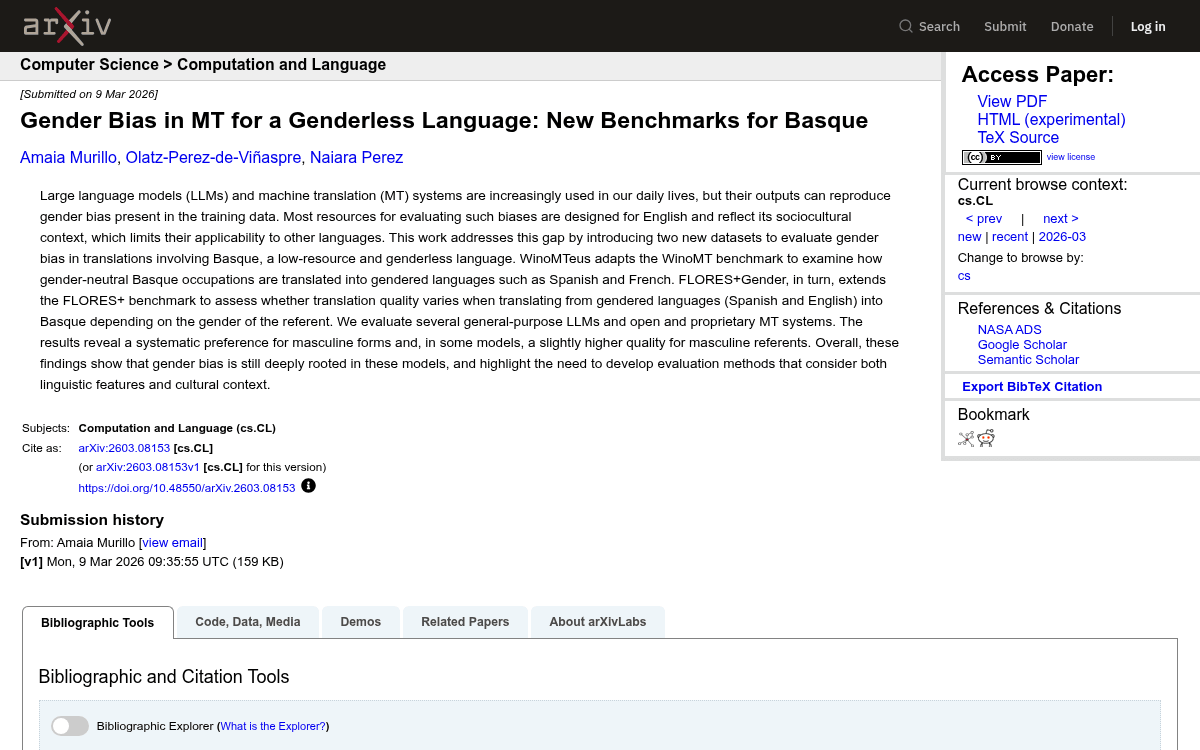
Gender bias in machine translation is a well-documented problem, but almost every benchmark built to measure it was designed with English in mind. A new paper from researchers at the University of the Basque Country's HiTZ Center changes that, releasing two datasets that put a spotlight on Basque, a language spoken by roughly 750,000 people that has no grammatical gender at all. The findings are striking: every single model tested, from GPT-5 to Google Translate to open NMT systems, systematically defaults to masculine forms when translating gender-neutral Basque text into Spanish or French.
Why Basque is the perfect stress test
Most bias benchmarks exploit gendered pronouns to detect stereotyping. English has "he" and "she"; Spanish has masculine and feminine noun agreement. Basque has neither. Basque does not have grammatical gender, unlike its neighboring languages Spanish and French, and even personal pronouns are gender-neutral. That absence is precisely what makes it such a revealing lens: when a model translates a Basque sentence containing the word for "housekeeper" into Spanish, it must invent a gender from scratch. Whatever it picks exposes its internal priors.
The problem is that research on gender bias has a long tail of rarely studied languages. The most investigated language pair is en-de (included in 58 studies), followed by en-fr (47) and en-es (46). Basque, sitting outside the Indo-European family entirely, has been almost completely ignored in this literature.
Two new benchmarks, two directions of bias
The team introduces two complementary datasets that probe bias in opposite translation directions.
- WinoMTeus -- translating from Basque into gendered languages. WinoMTeus adapts the WinoMT benchmark to examine how gender-neutral Basque occupations are translated into gendered languages such as Spanish and French. The original WinoMT benchmark is a set of sentences where each one contains two occupations and a pronoun that refers to one of them; models must resolve the ambiguity. Since Basque has no gendered pronouns, the team translated the dataset into Basque (using GPT-4o, followed by human post-editing and cultural adaptation), creating 1,827 sentences. Crucially, each occupation was also manually linked to official Basque labor statistics from Lanbide, the regional employment service, so results can be compared against real-world gender distributions.
- FLORES+Gender -- translating into Basque from gendered languages. FLORES+Gender extends the FLORES+ benchmark to assess whether translation quality varies when translating from gendered languages (Spanish and English) into Basque depending on the gender of the referent. The team identified 363 Spanish sentences and 155 English sentences with gendered references, then manually produced masculine and feminine versions of each, keeping the meaning identical. Each sentence was also annotated for three confounding factors: multiple gendered entities, proper names, and the "unmarked masculine" (Spanish's generic use of masculine forms like los investigadores to mean "researchers" of any gender).

The models tested
The evaluation is unusually broad, covering three categories of system:
- General-purpose LLMs: GPT-5, Claude Sonnet 4, DeepSeek-V3.2-Exp, Llama 3.1 (8B and 70B), and Latxa 3.1 (8B and 70B -- Basque-adapted versions of Llama)
- Open NMT models: MADLAD-400-3B-MT, NLLB-200-3.3B, and HiTZ Center's own Basque MT models
- Proprietary MT services: Google Translate, Elia, Batua, and Itzuli (the last three being Basque-specific services)
Every model defaults to masculine -- even for "housekeeper"
Results from the WinoMTeus experiment show that all models systematically favour masculine realizations of occupations, both in Spanish and French. The most egregious case is the word for "housekeeper," a job that is 96.5% female in the Basque labor market. In Spanish, Claude 4 Sonnet, Elia, and DeepSeek-V3.2-Exp deviate the most from the expected gender distribution for this profession, whereas Latxa 3.1 70B, NLLB-200-3.3B, and GPT 5 produce more faithful translations. Other heavily female-dominated jobs -- tailor (92.7% female), receptionist (89.3%), cashier (86.8%), hairdresser (86.2%) -- all showed the same masculine bias across both target languages.
The paper measures this using the GRAPE metric (Gender RAtion ProbabilitiEs), which quantifies how far a model's output distribution diverges from the real-world baseline. A GRAPE-M score of 1.0 means a model produces masculine forms twice as often as the real-world data would predict. Instances of feminine overrepresentation were rare: only ten cases display GRAPE-F values above 1.0, and most correspond to translation errors or lexical ambiguities. The only occupation that consistently skewed feminine across models was "nurse."
On the correlation side, GPT-5 and NLLB-200-3.3B came out on top, with Pearson correlations above 0.4 against real labor statistics for Basque-to-Spanish translation. Llama 3.1 8B scored just 0.066 -- essentially random. A closer look at the Llama-based models reveals that Latxa's adaptation to Basque notably improves alignment compared to its Llama 3.1 counterparts of the same size, suggesting that targeted language adaptation can enhance a model's sensitivity to gender patterns present in specific linguistic contexts.

Does gender affect translation quality into Basque?
The FLORES+Gender results are more nuanced. At first glance, results suggest that, in general, models translate better when the referent is masculine in the Spanish-Basque direction. Nevertheless, most differences are small and not significant. The one clear exception is Batua, a Basque government-backed MT service, which showed statistically significant better performance on masculine sentences in both chrF++ and TER metrics. For English-to-Basque, NLLB-200-3.3B actually showed a significant advantage in the opposite direction -- slightly better on feminine sentences.
The fine-grained annotations revealed where bias concentrates. Among the examined variables, the use of unmarked masculine (only applicable in Spanish) had the most consistent impact. Systems like NLLB-200-3.3B, Itzuli and Elia achieved better results for sentences containing unmarked masculine forms compared to their feminine counterparts. In other words, when Spanish uses the generic masculine ("los parisinos" for "Parisians" of any gender), models trained on that data perform better on it than on the explicitly feminine equivalent.
What this actually means for practitioners
The bias here is not subtle. A model that consistently translates "housekeeper" as masculine when the job is 96.5% female is not just statistically off -- it is actively reinforcing a stereotype in every deployment. This matters for:
- Basque-language applications: Any product translating Basque content to Spanish or French (government services, media, education) will systematically masculinize occupations.
- Low-resource language work broadly: The methodology here -- using a genderless language as a pivot to expose bias -- is transferable to Turkish, Finnish, Hungarian, and other grammatically genderless languages that are similarly underrepresented in bias research.
- Model selection: GPT-5, NLLB-200-3.3B, and the Basque-adapted Latxa 70B showed the best alignment with real-world labor statistics. General-purpose smaller models like Llama 3.1 8B were essentially useless for gender-fair translation in this setting.
What the benchmarks cannot do
The authors are candid about limitations. Both datasets treat gender as a binary variable, which reflects the grammatical systems of Spanish and French but ignores non-binary identities. WinoMTeus is template-based, which is useful for controlled experiments but does not reflect natural language use. FLORES+Gender is also small -- 363 Spanish and 155 English sentences -- which can limit statistical power. And automatic metrics like chrF++ may not capture the full nuance of gender-related translation errors.
Both datasets are publicly available: WinoMTeus and FLORES+Gender are on GitHub. The full paper is on arXiv. No fine-tuned model is released, but the evaluation code and prompts are included. For teams building or auditing MT systems that touch Basque, or any genderless language, these are now the go-to resources for gender bias evaluation -- and the results are a clear signal that the problem is far from solved.