
EVE Solves AI Exploration Without Rollouts Using Eigenvectors
A new spectral algorithm called EVE finds maximum-entropy exploration policies from transition dynamics alone, skipping expensive on-policy rollouts entirely.
 Pro
Takeaways
- EVE solves maximum-entropy exploration via eigenvectors of a tilted transition matrix, no rollouts required.
- Reformulates the problem in the average-reward setting, avoiding discount-factor bias on long-horizon coverage.
- Single fixed-point iteration balances forward and backward transition flows in log-space.
- Proven contraction under Hilbert's projective metric for inverse temperature beta greater than or equal to 1.
- Posterior policy iteration removes KL regularization bias, recovering the pure MaxEnt solution.
- Code released at github.com/JacobHA/EVE; deterministic dynamics only, tabular experiments so far.
Exploration is the awkward child of reinforcement learning. When rewards are sparse or missing, agents need a principled way to spread themselves across the state space, and the textbook answer, maximizing the entropy of the long-run visitation distribution, has a nasty circularity baked in: the objective depends on the very distribution the policy induces. A new paper introduces EVE (EigenVector-based Exploration), which sidesteps that loop by pulling the answer straight out of the eigenvectors of a problem-dependent transition matrix.
The circular problem with maximum entropy exploration
The maximum entropy exploration setup asks for a policy whose induced stationary distribution over state-action pairs is as uniform as possible. Many existing exploration approaches require estimating state visitation frequencies through repeated on-policy rollouts, which can be computationally expensive. The issue is structural: because the objective is defined in terms of the policy-induced distribution, improving the policy requires repeatedly estimating its corresponding distribution, creating a circular dependency between policy updates and visitation estimates.
There is also a second, subtler problem. Standard RL discounts future rewards with a factor gamma, but a discount factor inherently introduces a finite timescale for the agent's decision-making capacity. To solve the exploration problem, an agent should visit many states, even those beyond this artificially chosen temporal horizon. Discounted entropy maximization gets you the entropy of a discounted occupancy measure, which is not the same object as the true steady-state distribution you actually care about.
Eigenvectors instead of rollouts
EVE reframes the whole thing as an average-reward problem with an intrinsic reward equal to the negative log of the visitation probability, then leans on a spectral trick from prior work on entropy-regularized average-reward RL. The key object is a "tilted matrix" that combines the transition dynamics, a prior policy, and the reward function. The corresponding dominant eigenvalue encodes the exponential of the entropy-regularized average reward-rate. The left eigenvector encodes the optimal policy, while the right eigenvector represents a quasi-stationary distribution.
The elegant piece is that the steady-state distribution induced by the optimal policy and transition dynamics can be expressed through the element-wise product of the two eigenvectors. Set the reward to the negative log of that product, and the fixed point of the resulting self-referential system directly encodes the maximum-entropy policy. No rollouts, no visitation counting.
How the update actually works
After some algebra, the two eigenvector equations collapse into a single fixed-point iteration on one function u(s,a). The update balances two flows:
- A forward term (numerator): a soft maximum over successor state-action pairs, weighted by the transition dynamics and prior policy.
- A backward term (denominator): a soft minimum over predecessor state-action pairs. This is why the method needs a model of "parent" transitions, not just forward ones.
Written in log-space with q(s,a) = log u(s,a), the equation resembles a two-sided Bellman update. The q function balances between the flows out of a state and the flows into the state. The first term represents a soft maximum over the next state-action pairs while the second term represents a soft minimum over the preceding state-action pairs.
Convergence is not obvious, since there is no discount factor providing a contraction constant. The authors prove it anyway: the fixed-point iteration is a contraction under Hilbert's projective metric and converges linearly to a unique fixed point for inverse temperatures beta greater than or equal to 1. To reach the pure, unregularized MaxEnt objective, they wrap the whole thing in posterior policy iteration (PPI): repeatedly update the prior policy to match the current optimal policy, driving the KL regularization term to zero at convergence.
What the experiments show
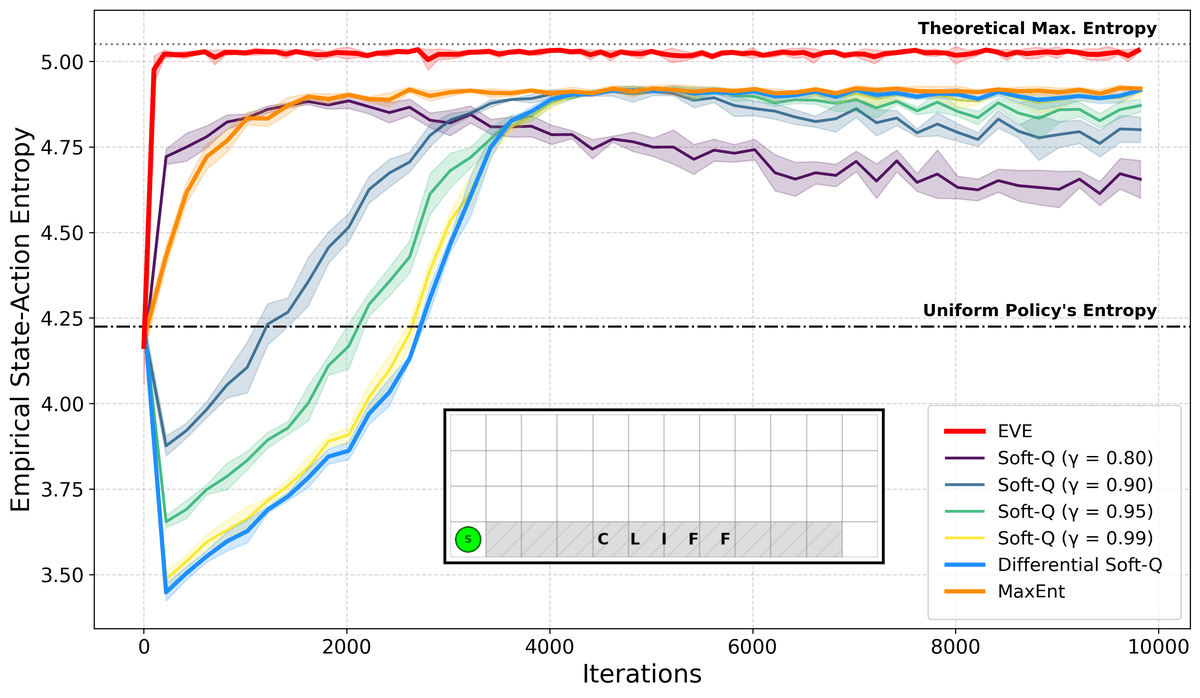
The empirical section uses tabular GridWorld and a "CliffWorld" variant where stepping into the cliff resets the agent. Baselines include the MaxEnt algorithm from Hazan et al. and rollout-based methods using both discounted and average-reward soft Q-learning.
EVE finds policies that nearly obtain the maximum possible entropy, log|S||A|. The rollout-based baselines needed extra machinery to work at all: the authors observed oscillatory behavior and had to introduce a finetuned learning rate to slowly mix consecutive reward functions, plus warmstarting the RL loop with the previous value function. EVE has none of that: the distribution and reward are built into the update, so no oscillation and no learning rate to tune.
What it is good for, and where it breaks
The obvious use case is reward-free pretraining. An agent initialized with this maximum entropy policy can uniformly cover the state-action space, which is especially valuable in sparse-reward environments. The prior policy in the KL term is also flexible: use a uniform prior for pure exploration, or plug in a task's optimal policy to bias exploration toward the neighborhood of a known good behavior.
Limitations are real and worth noting:
- Deterministic dynamics only. The current solution method only applies for the case of deterministic dynamics, though an extension to stochastic dynamics exists and requires an additional loop over biasing functions.
- Not for noisy-TV problems. Pure entropy maximization will happily park an agent in front of a stochastic screen. These setups need information-theoretic intrinsic rewards instead.
- Tabular experiments. The demonstration is on small grid-worlds with a known transition matrix. Extending to continuous, high-dimensional problems needs function approximation and a learned backward dynamics model.
Reference implementation and experiment code are available at github.com/JacobHA/EVE. The broader takeaway is that maximum-entropy exploration can be solved through a single fixed-point problem, allowing exploratory policies to be computed directly from the transition dynamics without estimating visitation frequencies through rollouts. That is a clean reframing of a problem that has historically been messy.