
EVD Beats Sora and Runway by Fixing How Video AI Handles Physics
A new arXiv paper proposes gating video diffusion updates by learned event activity, cutting interaction failures without changing the solver.
 Pro
Takeaways
- New arXiv paper Event-Driven Video Generation targets interaction failures in text-to-video models.
- Adds a lightweight event head to a pretrained DiT that predicts token-aligned event activity.
- Introduces event realization, consistency, and ordering losses to tie state changes to events.
- Event-gated sampling with hysteresis suppresses updates outside active interactions.
- Beats DiT-30B baseline on EVD-Bench: VBench Dynamics 95.7 vs 88.7, wins 97.1% of dynamics votes.
- Only 0.04% extra parameters on a 30B model, no change to solver or step count.
Text-to-video models can render photorealistic frames while still botching the simplest physical interactions: a hand reaches for a cup and the cup starts sliding before contact, a book stacks itself with no visible placement, or a chair keeps drifting after being pushed. A new arXiv paper, Event-Driven Video Generation (EVD), argues this is not a scale problem but a sampling problem, and proposes a minimal fix that plugs into existing Diffusion Transformer (DiT) video backbones.
The core diagnosis is that state-of-the-art text-to-video models often look realistic frame-by-frame yet fail on simple interactions: motion starts before contact, actions are not realized, objects drift after placement, and support relations break. The author attributes this to frame-first denoising, where the sampler updates latent state everywhere at every step without an explicit notion of when and where an interaction is active.

Turning the sampler into an event detector
EVD reframes video generation as persistent state punctuated by discrete interaction events. On top of a pretrained video DiT, it adds three pieces:
- A lightweight event head that predicts a token-aligned event activity map from the final DiT features.
- Event-grounded losses that couple event activity to state change during training.
- Event-gated sampling with hysteresis and an early-step schedule that suppresses spurious updates and concentrates changes during actual interactions.
Concretely, at each sampling step the model computes a token-wise gate g_k from the predicted event activity, then modulates the classifier-free guidance velocity before handing it to the solver. When the gate is near zero, the latent barely moves; when it lights up, the DiT update proceeds normally. The paper notes this is compatible with any ODE sampler (Euler/Heun/DPM-style) used for DiT video generation because only the direction field changes.

The training objective, in three parts
On top of the standard Flow Matching loss, EVD adds:
- Event realization loss: penalizes update energy in tokens where predicted activity is low, killing the "missing event" case where state changes appear with no interaction.
- Event consistency loss: enforces that updates during an active event stay coherent across nearby diffusion times rather than oscillating.
- Ordering and termination loss: uses hysteresis thresholds to suppress pre-event motion and residual post-event drift.
All auxiliary terms are time-weighted to emphasize early denoising steps, matching the intuition that coarse dynamics are locked in early. A 3x3 spatial smoothing operator on the patch grid stabilizes the activity map, and hysteresis thresholds (tau_on=0.62, tau_off=0.38) prevent gate flicker.
Benchmarks and what actually improves
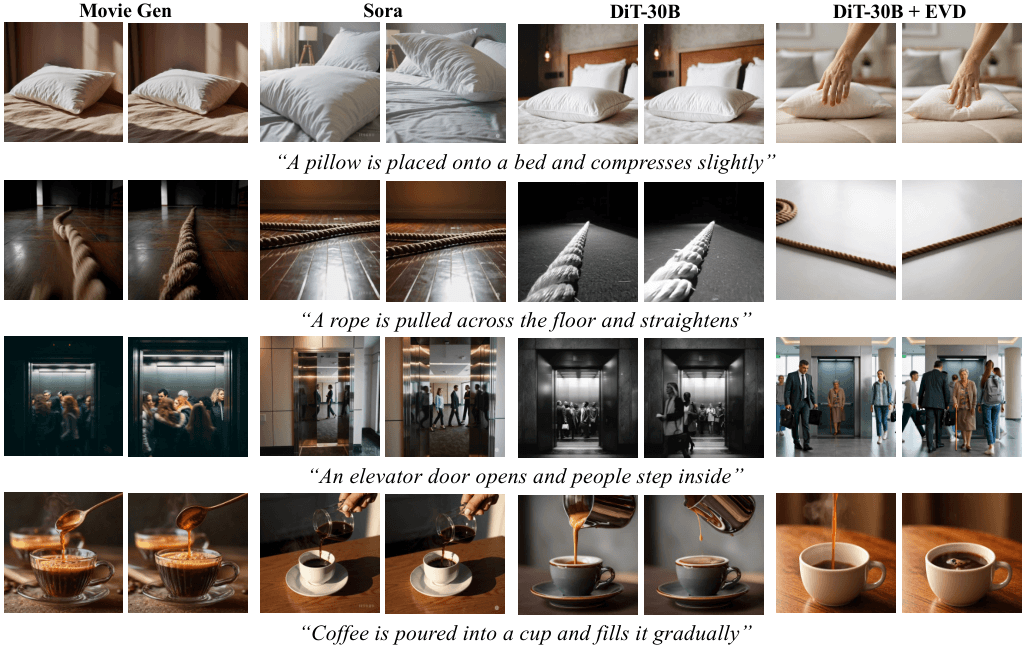
The paper introduces EVD-Bench, a curated set of 150 short interaction-centric prompts that stress causal event realization, grouped into State Persistence, Spatial Accuracy, Support Relations, and Contact Stability. Baselines are pretrained DiT-4B and DiT-30B, with EVD applied as an additive modification.
Under matched sampling settings, DiT-30B + EVD beats plain DiT-30B on human 2AFC preferences by wide margins: 89.7% on text faithfulness, 92.4% on quality, and 97.1% on dynamics. On automatic metrics, VBench Dynamics jumps from 88.7 to 95.7 while Appearance actually ticks up from 73.8 to 78.1, so the gains do not come at the cost of visual quality. EVD-augmented models also win preference votes against Kling 3.0 Pro, Runway Gen-4.5, Veo 3.1, and Sora 2 Pro on the same benchmark.
Cost and caveats
EVD is cheap to bolt on. The event head adds roughly 12.0M parameters (0.04%) to a 30B backbone, training throughput drops by about 3%, and inference overhead is roughly 2%. The number of DiT evaluations per step and total sampling steps (K=50) stay the same as vanilla CFG.
The author is upfront about where the method breaks. It struggles when Zoomed-out motion: interactions occupy a small fraction of the frame, reducing the signal-to-noise ratio of event cues. Thin or turbulent fluids: fine-grained liquid behavior (splashes, thin streams) can exceed the resolution of the latent space. Dense clutter and occlusion: event localization becomes ambiguous when contact is heavily occluded or multiple interactions overlap. Highly non-rigid articulation: subtle deformations (fingers, fabric folds) may require more specialized priors than our event field.
There is also no public code release referenced in the paper, and the fine-tuning data comes from a closed-source internal video pool, so exact reproduction outside a lab with an existing DiT-30B checkpoint is difficult. What the paper does provide is a clean recipe: swap in an event head, add three loss terms, gate the solver, and keep everything else. For anyone working on video generation systems that keep hallucinating physics, that is a compact intervention worth trying before reaching for bigger models or new backbones.