
EVA Teaches Robot Video Models to Stop Hallucinating Broken Arms
A new reinforcement learning framework uses an inverse dynamics model as a reward signal to close the gap between pretty videos and executable robot motions.
 Pro
Takeaways
- EVA closes the executability gap between visually plausible video rollouts and physically feasible robot actions.
- An inverse dynamics model is repurposed as a dense reward critic during GRPO post-training.
- Reward penalizes velocity, acceleration, jerk, and any violation of the robot's embodiment limits.
- Boosts real-robot success from 52% to 64% on seen tasks and 42% to 60% on OOD tasks.
- Kinematic plausibility rated by humans improves by 20.9 points over the unaligned baseline.
- Limitations include reward hacking, no contact-force modeling, and slow diffusion sampling for reactive control.
Video generation models have quietly become a favorite backbone for robotics research. The idea is elegant: let a video model imagine the future frames of a task, then have an inverse dynamics model (IDM) read those frames and emit the joint commands that would produce them. Splitting perception from control this way lets robots benefit from internet-scale video data. The catch is that a rollout can look great and still be physically nonsense for a real arm.
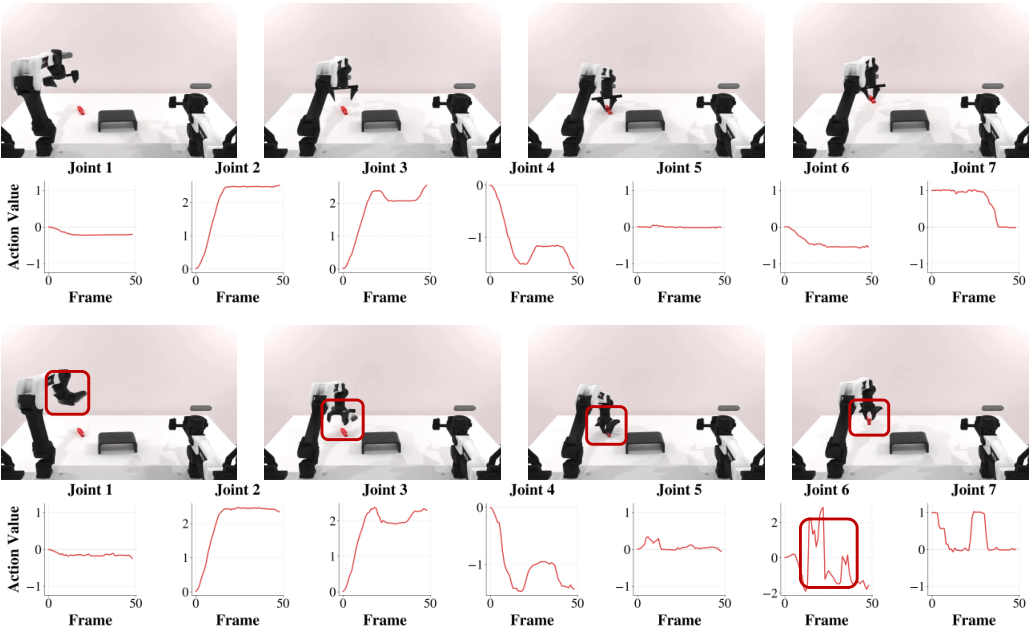
A new paper, EVA (Executable Video Alignment), puts a name on this failure mode and converts it into a training signal. The authors call it the executability gap: visually coherent rollouts that violate rigid-body and kinematic consistency, producing unstable or infeasible control commands when decoded by an IDM. Rather than filter bad samples at inference, they use the gap itself to fine-tune the video generator.

Why pretty frames break real arms
When a diffusion video model hallucinates a robot arm, it optimizes for pixels, not joints. The IDM operates strictly as an open-loop extractor during deployment, so it cannot correct upstream generative errors. If the video model synthesizes frames with morphological deformations or temporal artifacts, the IDM blindly translates those visual flaws into unstable, out-of-bounds motor commands, ending in catastrophic task failures. Think melted elbows, joints that briefly point the wrong way, or a wrist that teleports ten centimeters between adjacent frames.