
ETS Montreal's SFDA-PFT Personalizes Emotion AI With Just One Neutral Video
SFDA-PFT adapts facial expression models to new users using only a neutral video clip, with 100x fewer parameters than image-based rivals and state-of-the-art accuracy across four benchmarks.
 Pro
Takeaways
- Core result: SFDA-PFT personalizes facial expression recognition models using only a short neutral video of a new user, with no source data required.
- Efficiency win: Achieves up to 100x fewer parameters and 17x fewer FLOPs than the best image-translation baseline (SFDA-IT), while outperforming it on all four benchmarks.
- Benchmark performance: 78.31% F1 on BioVid (pain), 69.92% on StressID (stress), 57.40% on BAH, and 54.46% on Aff-Wild2 -- top across all datasets.
- Key innovation: Translates subject identity in latent feature space using statistical moment matching, avoiding noisy pixel-level image synthesis entirely.
- Limitation: Performance degrades for older subjects whose expressions are subtler; a gap remains versus supervised fine-tuning (~94% oracle accuracy).
- Open source: Code available at github.com/MasoumehSharafi/SFDA-PFT, compatible with ResNet and ViT backbones.
Facial expression recognition (FER) models are widely used in video-based affective computing applications, such as human-computer interaction and healthcare monitoring. But deploying them in the real world is harder than it looks. A model trained on one group of people will often fail on someone new, not because the model is bad, but because faces are deeply personal. The way one person grimaces in pain looks nothing like how another does. Researchers from ETS Montreal and Queen's University have now published a method that solves this personalization problem under the most constrained conditions imaginable: no labeled data, no source training data, and only a short neutral video of the new user.
Deep FER models often struggle with subtle expressions and high inter-subject variability, limiting performance in real-world settings. Source-free domain adaptation (SFDA) has been proposed to personalize a pretrained source model using only unlabeled target data, avoiding privacy, storage, and transmission constraints. The new method, called SFDA-PFT (Source-Free Domain Adaptation with Personalized Feature Translation), takes this a step further by working with only neutral-expression footage from the new subject.
Why neutral-only is such a hard constraint
Most domain adaptation methods assume you have access to a variety of examples from the target domain. In FER, that would mean having labeled video of a person looking angry, happy, or in pain. The paper addresses a particularly challenging setting where source data is unavailable and the target data contains only neutral expressions. Existing SFDA methods are not designed for adaptation from a single target class, while generating non-neutral facial images is often unstable and expensive.
This constraint is not just academic. In real healthcare deployments, you might be able to ask a patient to sit still for a baseline recording, but you cannot ask them to perform a range of expressions on demand. Privacy regulations in clinical settings also make it impossible to share training data across hospitals or institutions. More recent subject-aware adaptation frameworks treat each subject as a domain and adapt across users, yet still depend on source data. These constraints motivate the need for SFDA, which enables model personalization without accessing source samples, offering a more practical solution for privacy-sensitive FER applications.
Feature translation instead of image translation
The key insight behind SFDA-PFT is to skip pixel-level image generation entirely and work directly in the model's latent feature space. Prior state-of-the-art methods like SFDA-IT used generative models (think GAN-style networks) to synthesize what the target person would look like in the source domain's visual style, then fed those synthetic images to the frozen classifier. This is expensive, fragile, and often distorts the subtle muscle activations that carry expression information.

SFDA-PFT instead trains a lightweight translator network that lives in the embedding space. The translator is a copy of the source encoder augmented with small subject-adaptive layers. It learns to remap one person's feature representation to look like another person's, while keeping the expression content intact. The result: SFDA-PFT achieves higher accuracy while requiring up to 100x fewer parameters and 17x fewer FLOPs than SFDA-IT, highlighting its efficiency and suitability for deployment.
How it works, step by step
The method has two phases: source pre-training and target adaptation.
- Source pre-training. The source classifier (feature extractor
F+ classifier headC) is first trained normally on labeled source data with cross-entropy loss. Then, withFfrozen, the translatorTis trained on pairs of source subjects. Given two source subjectsiandj, the translator takes subjecti's features and maps them toward subjectj's identity style, while preserving the expression label. Two losses guide this: an expression consistency loss (KL divergence between the classifier's output before and after translation) and a style-aware loss (matching per-channel mean and standard deviation of intermediate feature layers between the translated features and the reference subject). - Target adaptation. Given a handful of neutral frames from a new target subject, only the lightweight adaptive layers of
Tare updated. The source backbone and classifier remain completely frozen. Since all target frames are from the same identity, no style alignment is needed here -- only expression consistency is enforced. This self-distillation anchors the translator to the classifier's existing decision boundary. - Inference. The personalized translator maps new target frames into a source-aligned feature space, and the frozen classifier predicts the expression. No source data is accessed, no images are synthesized, and no extra parameters are added at inference time.

The style loss deserves a closer look. Rather than matching raw activations (which would overfit to specific samples), the method matches only the first two statistical moments -- mean and standard deviation -- of feature channels at intermediate layers. This formulation is inspired by the observation that per-channel statistics encode subject-dependent appearance cues (e.g., facial geometry, texture, or lighting) that are orthogonal to expression dynamics. By matching only these moments, the translator adapts identity without memorizing sample-specific noise.
Benchmarks and numbers
The method was evaluated on four video FER datasets, each representing a different real-world scenario:
- BioVid -- controlled lab recordings of thermal pain stimuli (binary: no pain vs. high pain)
- StressID -- self-reported stress recognition from facial video, heavily class-imbalanced
- BAH -- naturalistic recordings for ambivalence/hesitancy recognition (over 86 hours of video)
- Aff-Wild2 -- in-the-wild 7-class basic emotion recognition with noisy annotations
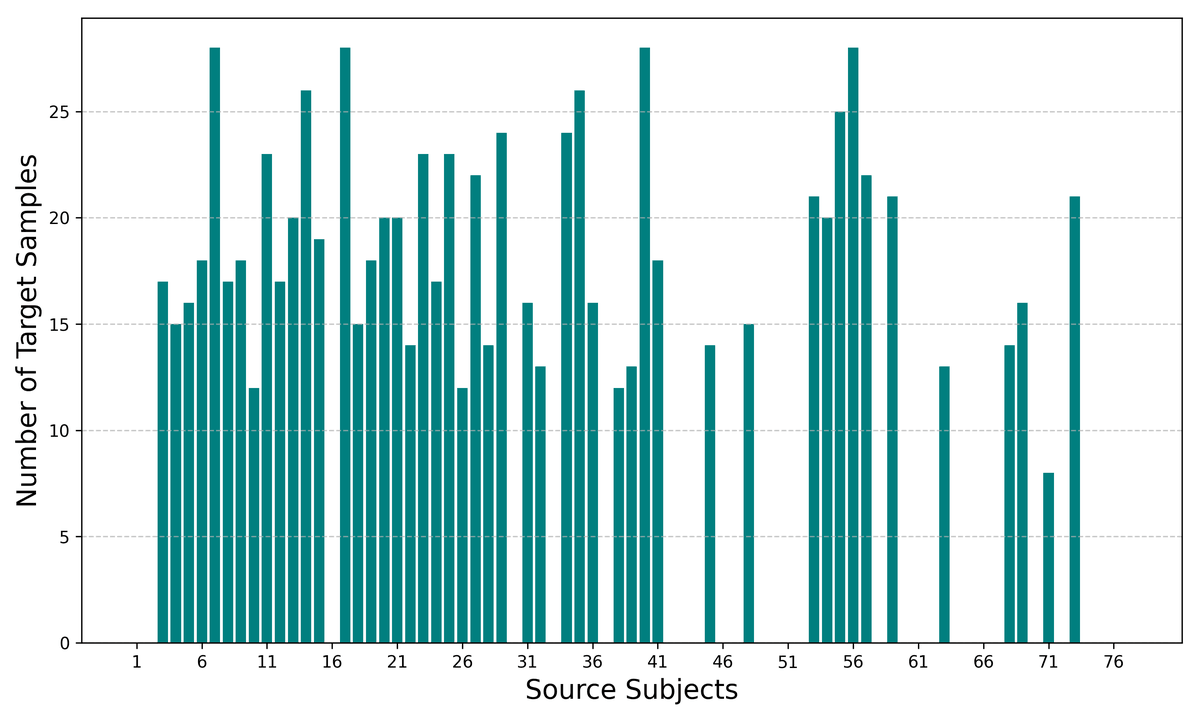
Each subject was treated as an independent target domain. Adaptation used only neutral expression frames per subject, with no source data available. SFDA-PFT was compared against six baselines: SHOT, NRC, TPDS, DSFDA, SFIT, and SFDA-IT.
On BioVid, SFDA-PFT obtains an average F1 of 78.31, outperforming DSFDA by almost 10 points. On StressID, which is strongly imbalanced, SFDA-PFT reaches 69.92%, over 7 points higher than the best competing method, showing that it can handle skewed class distributions while still capturing subject-specific patterns. On the in-the-wild datasets, SFDA-PFT delivers 57.40% F1 on BAH and 54.46% on Aff-Wild2, again leading all baselines.
Efficiency is just as striking as accuracy. SFDA-PFT achieves the best accuracy with far fewer updates and sub-second adaptation per batch, showing that feature-space adaptation is markedly more efficient and scalable. Specifically, SFDA-PFT converges in 135 gradient steps at 0.95 seconds per batch, while SHOT requires 1,155 steps at 54 seconds per batch.
Where it struggles
The method is not without blind spots. The main failure case is Sub-10, where SFDA-PFT drops to 58.08. A closer look shows that this subject is from an older age group, where pain-related facial reactions tend to be weaker and more varied. This is consistent with a broader known challenge in FER: older adults' expressions are systematically harder to classify. The authors suggest age-aware or group-based adaptation strategies as a future direction. On Aff-Wild2, extreme pose variation, motion blur, and 7-class imbalance also limit gains relative to the oracle (supervised fine-tuning), which sits around 94% accuracy versus SFDA-PFT's 59%.
The real unlock
What this paper quietly enables is privacy-preserving, on-device personalization for affective AI. Before SFDA-PFT, adapting a FER model to a new user in a clinical or consumer setting required either sharing sensitive training data, running expensive generative models, or collecting labeled emotional footage -- all practically infeasible. Now, a short neutral baseline video is enough. The translator's lightweight design (only the adaptive layers are updated) means this could realistically run on edge hardware.
The code is publicly available on GitHub, implemented in PyTorch with a ResNet-18 backbone. Ablation studies confirm the method is robust across backbones -- both ViT-B/32 and ResNet-50 show consistent gains -- making it a genuine plug-and-play module for existing FER pipelines. For anyone building healthcare monitoring tools, pain assessment systems, or stress detection applications where data privacy is non-negotiable, SFDA-PFT offers a practical and principled path forward.