
ETH Zurich Trains AI to Read Grammar Books and Translate 7,000 Languages
Researchers use RL with a simple translation score as reward to teach LLMs to read grammar books for languages they've never seen before — and it beats both fine-tuning and in-context learning.
Takeaways
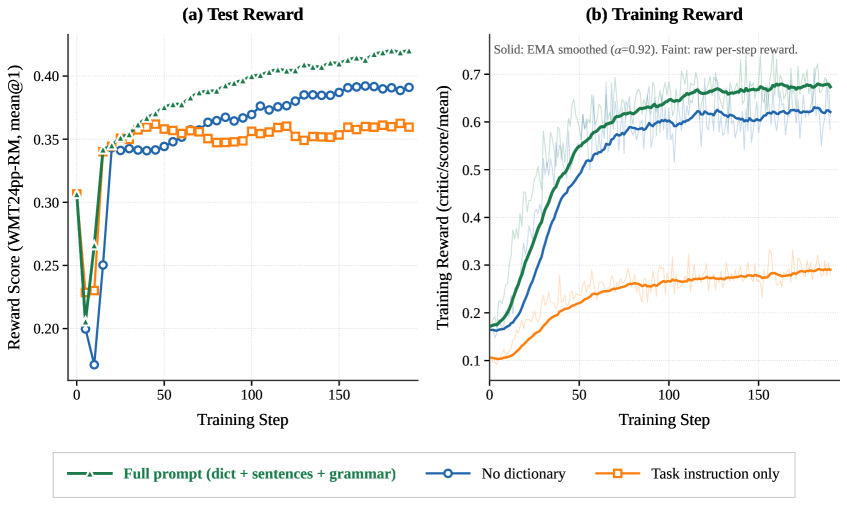
- Core finding: RL training with a simple chrF translation reward teaches LLMs to use grammar books for completely unseen languages at test time.
- Beats baselines: RL-trained models outperform both supervised fine-tuning and in-context learning on zero-shot unseen language translation.
- Key insight: Models must learn a transferable meta-skill of reading linguistic context, not memorize specific languages — fine-tuning fails because it overfits.
- RLVR extended: The same training recipe behind DeepSeek-R1's math/coding gains now works for language learning from context — a new domain for the paradigm.
- Context used: Grammar rules, morphological paradigms, bilingual lexicons, and interlinear glossed text are provided at inference time for unseen languages.
- No code released yet: Paper is available on arXiv; no model weights or public repo announced alongside the preprint.
There are roughly 7,000 languages spoken on Earth. Most large language models handle fewer than 100 of them well. For the rest , the endangered, the underdocumented, the languages spoken by small communities , the standard playbook breaks down fast. A new paper from researchers at the University of Zurich, ETH Zurich, and Queen's University Belfast proposes a surprisingly clean fix: use reinforcement learning to teach a model how to learn a language from a grammar book, rather than memorizing any specific one.
The paper, titled "Reinforcement Learning Elicits Contextual Learning of Unseen Language Translation," targets what the authors call the core bottleneck in extremely low-resource translation: models that learn a language during training can't generalize that skill to a completely different language at test time.
The wall that fine-tuning hits
Prior work has shown that LLMs can translate unseen or low-resource languages by undergoing continued training or even by encoding a grammar book in their context , but both methods typically overfit specific languages, with limited zero-shot transfer at test time. In other words, if you fine-tune a model on Swahili grammar, it gets better at Swahili. It does not get better at reading a grammar book for a language it has never encountered.
Rather than memorize the content or knowledge of any specific language, an LLM should acquire the ability to generalize across new languages by reasoning over an accompanying context with rich linguistic features, grammatical descriptions, morphological paradigms, and lexicons. The authors refer to this transferable ability as a meta-skill of contextual leveraging, and view it as the key property that any general-purpose method for very low-resource languages should target.
Think of it as the difference between a student who memorizes French vocabulary versus one who learns how to use a dictionary and grammar reference for any language. The second student can walk into an exam on a language they've never studied and still produce something reasonable.