
ETH Zürich Teaches Drones to Soar Like Albatrosses With 97.3% Success
An ETH Zürich team built a control stack that lets a fixed-wing UAV harvest energy from wind shear, validated in real gusts up to 14 m/s.
 Pro
Takeaways
- ETH Zürich and NTNU propose a full autonomous dynamic soaring framework for fixed-wing UAVs (paper).
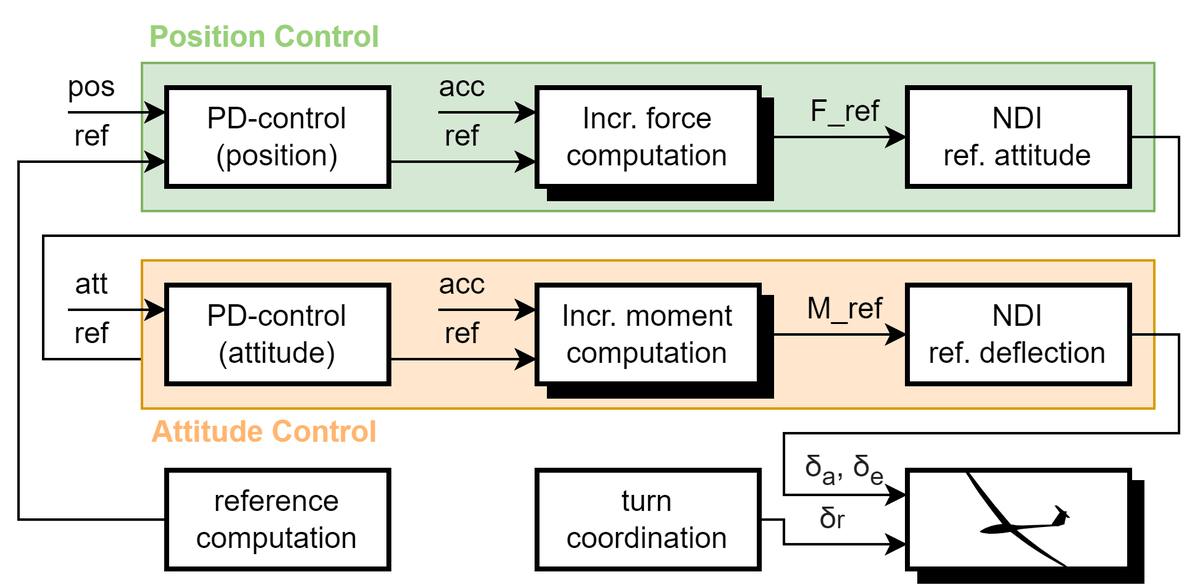
- Three modules: parametric wind estimator, robust trajectory optimizer over 5 wind fields, INDI path controller.
- Robust paths trade nominal efficiency for feasibility under 25 percent wind perturbations.
- Simulation achieved 97.3 percent success rate across 300 eight-cycle rollouts with Dryden turbulence.
- Real flights at Chasseral tracked paths with 2.46 m RMSE in gusts up to 14 m/s.
- Full closed-loop energy-positive dynamic soaring still pending; no public code released yet.
Wandering albatrosses can cover more than 5,000 kilometers in five days without flapping, riding invisible energy hidden in the vertical wind gradients above the ocean. A team from ETH Zürich, NTNU, and CSIRO wants to teach fixed-wing drones the same trick, and they just published a framework that gets meaningfully closer to that goal than any previous attempt.
The paper proposes an end-to-end pipeline for autonomous dynamic soaring, the technique of extracting kinetic energy by repeatedly crossing layers where wind speed changes with altitude. Exploiting energy in wind shear layers could enable indefinite flight without onboard energy sources, and the authors offer a full framework to do it with a fixed-wing UAV.
Why nobody has pulled this off yet
Dynamic soaring theory has been studied for over a century, and offline trajectory optimizers can compute elegant figure-eight paths that gain energy on paper. The gap has always been reality. Thermal soaring has been demonstrated in multiple works, yet full autonomous dynamic soaring has never been shown on a real UAV. Previous efforts stumbled on the same brutal problem: wind fields are noisy, partially observable, and drift in time, so any trajectory optimized for a nominal wind field becomes infeasible the moment reality deviates from the model.
The authors argue that robustness is the only way forward, and they design it into every module rather than bolting it on at the end.