
ETH Zurich's Walking Robot Arm Beats Wheelchair-Mounted Systems at Cybathlon 2024
ETH Zurich's quadruped-plus-arm system won third at Cybathlon 2024 and validated in a real home, controlled entirely by a mouth joystick and voice.
 Pro
Takeaways
- ETH Zurich built an on-demand quadruped assistance robot controlled by a mouth joystick and voice commands.
- ANYmal D plus DynaArm carries 6 kg, walks at 1.3 m/s, and reaches places wheelchairs cannot.
- Placed third at Cybathlon 2024, solving 8 of 10 everyday tasks in 8 minutes 12 seconds.
- Two-robot strategy with red-light/green-light traversal locks cut idle time from 25 to 7 percent.
- At-home study: 13 of 15 shared-autonomy runs succeeded, beating a Hello Robot Stretch baseline on fetch time.
- Manipulation still relies on teleoperation; single-operator study and no public code release.
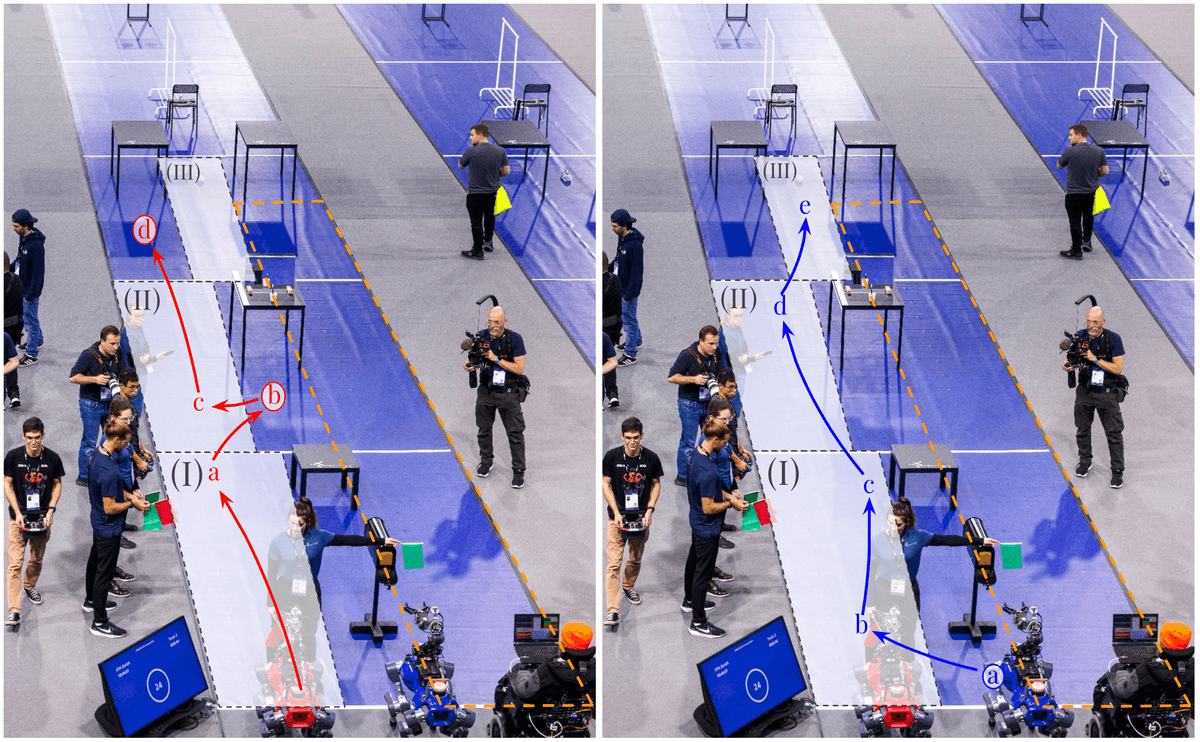
Most robotic arms designed for wheelchair users bolt directly onto the wheelchair. That works, but it bloats the chair, drains the same battery, and caps the arm's payload. A team at ETH Zurich's Robotic Systems Lab has been quietly building an alternative: a four-legged robot with its own arm that walks over on demand, does the task, and walks away. They took it to Cybathlon 2024's Assistance Robot Race as the only team not using a wheelchair-mounted arm, then brought it home to see if it actually works outside the arena.
The full write-up landed on arXiv and covers both the competition run and a follow-up at-home study with the same pilot, Samuel Kunz, a mechanical engineer with quadriplegia. The headline result: performance comparable to wheelchair-mounted systems, with more autonomy and access to places wheels cannot go.
Why bolting an arm onto a wheelchair keeps hitting a wall
The paper presents the first design of an on-demand quadrupedal assistance robot intended for people with severe motor impairments, reaching areas inaccessible to wheelchairs while freeing the operator from permanently carrying a robotic arm attachment. The trade-offs of the mounted approach are hard to escape: added size and weight hurt maneuverability, shared batteries constrain runtime, and commercial arms like the iARM top out at roughly 1.5 kg of payload.
A separate mobile robot sidesteps all of that. It has its own power, its own compute, and it can pitch, lean, and climb stairs to reach things a wheelchair cannot. It can also work in a different room while the operator does something else, which turns out to be a huge lever during a timed race.

The hardware stack
The robot itself is an ANYbotics ANYmal D quadruped carrying a Duatic DynaArm. A Robotiq 140F gripper and an Intel RealSense L515 camera sit at the end effector. The base tops out at 1.3 m/s and the arm can continuously carry 6 kg, roughly four times what a typical wheelchair-mounted system handles. Onboard, a Jetson Orin handles high-bandwidth GPU work, and a laptop mounted on the wheelchair relays camera feeds and receives operator input.
Two low-level controllers run underneath everything:
- A model predictive controller (OCS2) for precise six-DoF end-effector control. It uses the whole body, tilting and translating the base to extend reach while keeping the feet planted.