
ETH Zurich's ViserDex Teaches Robot Hands to Reorient Objects 200 Times Straight
A new framework lets a robot hand reorient complex objects from a single RGB camera by training pose estimators on augmented 3D Gaussian Splats instead of ray-traced renders.
 Pro
Takeaways
- ViserDex enables monocular RGB in-hand reorientation on an Allegro Hand using 3D Gaussian Splatting for sim-to-real transfer.
- Pre-rasterization augmentations perturb Gaussian clusters directly, simulating lighting and material variation without ray tracing.
- Achieves 37.6 consecutive successes under nominal lighting and ~25 under adversarial lighting across five diverse objects.
- Trains on a single consumer RTX 4090 GPU, an order-of-magnitude VRAM reduction versus DeXtreme's 8-A40 setup.
- Ablations show Global Shift augmentation is the single most critical component for adversarial robustness.
- Code released as an Isaac Lab extension at github.com/leggedrobotics/ViserDex.
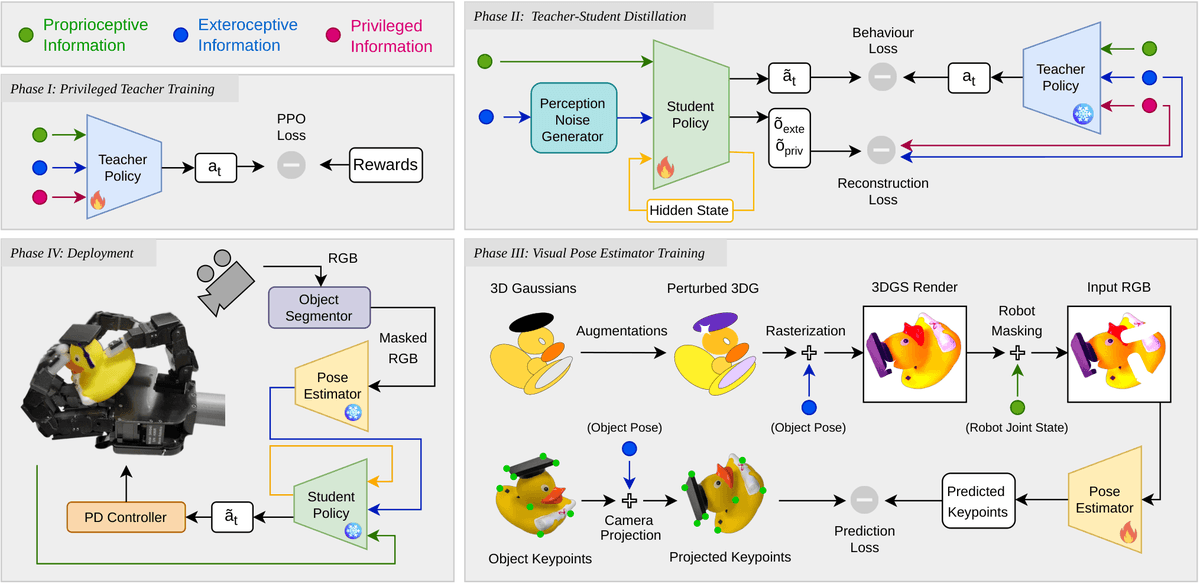
Getting a robotic hand to fluidly twist an object into a target pose has, for years, been a benchmark that separates flashy demos from working systems. The hard part is not the fingers, it is the eyes: fast motion, self-occlusion by the fingers, and reflections make it extremely difficult to know where the object actually is. A new framework called ViserDex from the Robotic Systems Lab at ETH Zurich attacks that perception bottleneck by rendering training data with 3D Gaussian Splatting (3DGS) instead of ray tracing, and by randomizing the scene directly in the Gaussian representation before it is ever turned into pixels.
The resulting monocular RGB pipeline achieves over 25 consecutive successful reorientations on average under extreme visual conditions that cause traditional estimators to fail, and it trains on a single consumer GPU.
Why RGB dexterity has been stuck
Prior sim-to-real work on in-hand reorientation typically leaned on tactile arrays, depth cameras, or multi-camera rigs to sidestep the perception problem. RGB is attractive because it carries dense semantic cues, but existing solutions rely on multi-camera setups or costly ray tracing, and generating enough photorealistic variety for reinforcement learning to transfer to reality has historically required enormous compute. OpenAI's DeXtreme, the strongest prior vision-based baseline, needed eight A40 GPUs over 60 hours just to train the control policy.
The authors' insight is that 3DGS, an explicit scene representation better known for real-time novel-view synthesis, gives you a fast, differentiable proxy for a photorealistic renderer. Vanilla 3DGS is optimized for static scenes and tangles up lighting with geometry, which breaks the domain randomization tricks that usually bridge the sim-to-real gap. ViserDex fixes that with a set of augmentations that operate directly on Gaussians before they hit the rasterizer.