
ETH Zurich's Pythia, Hermes, and Sibyl Beat Decades of Memory Heuristics
Researchers show that swapping hand-tuned prefetchers, cache predictors, and storage policies for lightweight online learners beats decades of hand-crafted heuristics.
 Pro
Takeaways
- ETH Zurich's SAFARI group replaces hand-tuned memory policies with lightweight online ML across cache and storage layers.
- Pythia uses RL for prefetching and beats Bingo by up to 20.2% in bandwidth-constrained systems using only 25.5 KB per core.
- Hermes uses a perceptron to predict off-chip loads with 77.1% accuracy and fires speculative DRAM requests early.
- Sibyl is an RL agent for hybrid storage placement, improving latency up to 68.8% over prior placement policies.
- All three fit modest hardware or OS-layer budgets and require no application-level software changes.
- Follow-up work (Athena, Harmonia) uses multi-agent RL to coordinate these mechanisms rather than stacking them naively.
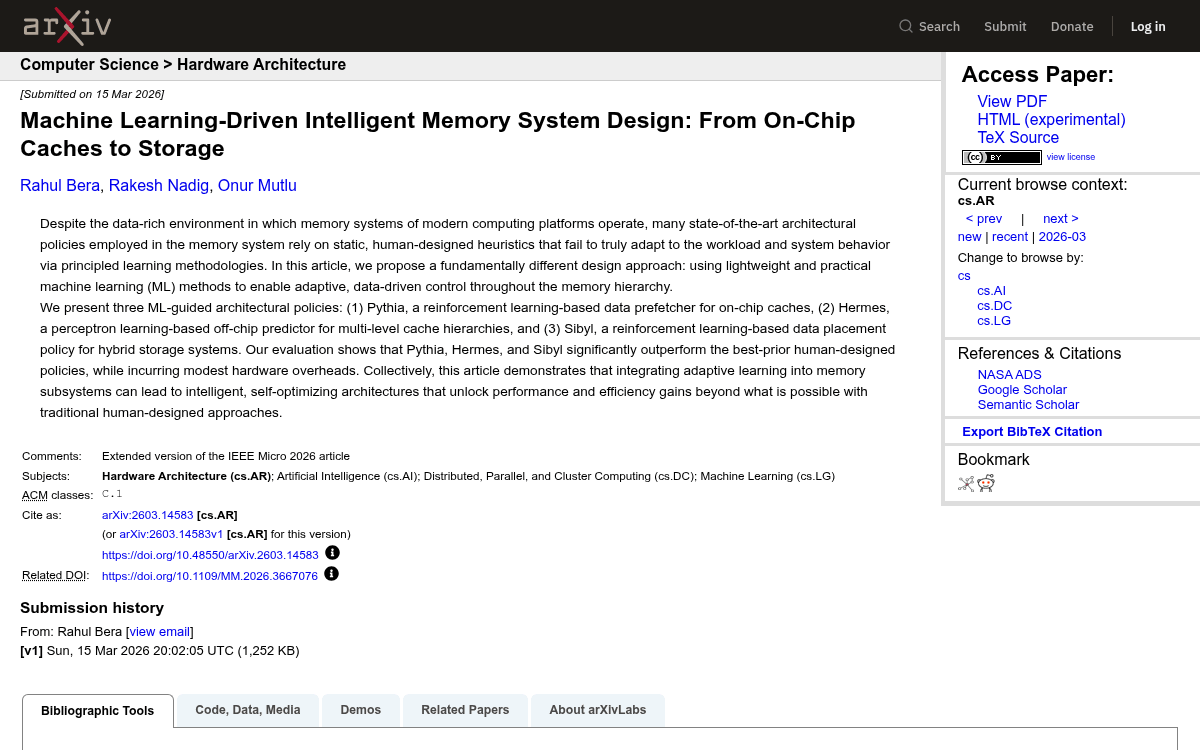
Memory systems have become the bottleneck of modern computing, and yet the policies that decide what to prefetch, what will miss the cache, and where data lives across storage tiers are still largely dictated by static human-designed rules. A team from the SAFARI Research Group at ETH Zurich argues that this is leaving significant performance on the table, and they back it up with three concrete systems that replace these heuristics with lightweight online machine learning. Their IEEE Micro paper ties the work together and shows the memory hierarchy, from L1 caches down to hybrid SSD/HDD storage, can be turned into an adaptive, self-optimizing stack.
Why hand-tuned heuristics keep losing
The core critique is simple. Most existing architectural policies make human-design-driven decisions that predominantly rely on fixed and often myopic hand-crafted heuristics with limited adaptability to complex system state and workload demands. A prefetcher, for example, typically picks one signal such as the program counter of a load instruction and rides that choice for the life of the chip. That is fine on the workloads it was tuned for and brittle on everything else.
The authors demonstrate the problem with a quick head-to-head. Bingo achieves similar prefetch coverage on Ligra-CC as on PARSEC-Canneal with fewer overpredictions, yet it degrades performance by 1.9% on the first and improves it by 6.4% on the second, because it has no awareness of memory bandwidth usage. Similar mismatches show up in off-chip prediction and storage tiering, where prior policies either look at a single feature or ignore device-level characteristics.
Three learners, one memory hierarchy
The paper proposes three policies that each attack a different layer:
- Pythia is a reinforcement learning-based data prefetcher for on-chip caches.
- Hermes uses perceptron learning to predict which loads will miss every cache and go to DRAM, so the request can be launched to the memory controller in parallel.
- Sibyl is an RL agent that decides, per I/O, whether a page belongs on the fast or slow device of a hybrid storage system.
All three are designed to be practical. They use small tables and simple update rules rather than deep networks, so they can plausibly live on real silicon or inside an OS block layer.
Pythia: prefetching as an RL agent

Pythia is an RL agent that learns accurate, timely, and system-aware prefetch decisions by interacting with the processor and memory subsystem. At each timestep, corresponding to a new demand request, Pythia observes system state and takes a prefetch action. The state is a vector of program features covering both control flow (load PC, branch PC history) and data flow (cacheline address, page offset, deltas). The action is a prefetch offset in the range of -63 to +63 cachelines within the current 4 KB page, with zero meaning do not prefetch.
The clever piece is the reward. Pythia defines five reward levels: accurate and timely, accurate but late, loss of coverage across page boundaries, inaccurate, and no-prefetch. The last two are split further based on whether memory bandwidth is currently high or low, which teaches the agent to hold back its trigger finger when the memory bus is saturated. Under the hood there is a Q-Value Store table and a small FIFO Evaluation Queue that tracks in-flight prefetches so rewards can be assigned when the actual demand arrives. Pythia requires only 25.5 KB of storage per core.
The payoff scales with pressure. Pythia outperforms MLOP and Bingo by 3.4% and 3.8% in single-core, 7.7% and 9.6% in twelve-core, and 16.9% and 20.2% in bandwidth-constrained configurations, while incurring only 1.03% area overhead over a desktop-class processor and no software changes in workloads. That last number matters: the more cores you cram onto a die, the less bandwidth each one gets, and static prefetchers start hurting rather than helping.
Hermes: skipping the cache hierarchy on predicted misses

Modern CPUs keep growing their cache hierarchies, which means loads that ultimately miss everything still pay the full latency of walking L1, L2, and LLC just to discover they have to hit DRAM. On average only 5.1% of the total loads generated by a workload go off-chip in the presence of a sophisticated data prefetcher, but those few loads dominate the tail. Prior off-chip predictors were weak: the prior-best hit-miss predictor (HMP) and the tag-tracking-based predictor (TTP) provide only 47% and 16.6% accuracy, respectively.
Hermes uses a perceptron predictor called POPET. Each program feature indexes into a small weight table, the weights are summed, and if the sum crosses an activation threshold the load is predicted to miss everywhere. When that happens, Hermes fires a speculative request straight to the memory controller in parallel with the normal cache walk. Training is a one-bit outcome check when the real load resolves. The whole thing fits in 4 KB per core and delivers 77.1% average accuracy, giving a 5.4% average performance gain over Pythia and roughly 90% of the gain of an ideal off-chip predictor.
Sibyl: RL for tiered storage placement
Sibyl moves the same philosophy down to the storage stack. It runs in the OS block layer and, for every I/O, decides whether to place the page on the fast device (say, an Optane SSD) or the slow one (a SATA SSD or HDD). Its 6-dimensional state includes request size and type, access interval and count, remaining fast-device capacity, and the page's current location. The reward is essentially the reciprocal of the observed request latency, minus an eviction penalty that discourages hoarding the fast tier.
Sibyl is implemented as two parallel threads, an inference network that makes placement calls on the hot path and a training network that updates in the background using an experience buffer, with weights periodically copied over. On real hardware across fourteen Microsoft Research Cambridge traces, Sibyl improves performance by 28.1%, 23.2%, 36.1%, and 21.6% over CDE, HPS, Archivist, and RNN-HSS on a performance-oriented HSS, and by 19.9%, 45.9%, 68.8%, and 34.1% on a cost-oriented HSS. A three-device version generalizes with only state and action space tweaks.

What this unlocks, and what to watch
The real breakthrough is not any single number, it is the demonstration that classical, tabular RL and single-layer perceptrons are enough to beat decades of hand-tuned heuristics at multiple layers of the memory system with kilobyte-scale storage budgets. That is a very different message from the usual deep-learning-in-systems pitch: no GPUs, no giant models, just online learners that adapt to whatever workload happens to be running.
All three artifacts are open source. The Pythia repository ships as a ChampSim-based simulator with a Chisel HDL prototype, and Hermes and Sibyl come with their evaluation infrastructure. That means you can plug in a new workload trace, define a new program feature, or tweak the reward structure without waiting for anyone to fab a chip.
The limits are worth naming. These policies are per-mechanism today, and a naive combination of, say, Hermes on top of Pythia does not fully realize the joint potential. The authors' follow-ups Athena and Harmonia use multi-agent RL to coordinate across mechanisms, which is a good hint that anyone deploying multiple ML-driven policies in the same system should be thinking about how they interact rather than treating each one as a drop-in replacement.