
ETH Zurich's Pretrain-Then-Fine-Tune Trick Cuts Robot Training Time by 37%
ETH Zurich researchers show that pretraining a robot's inverse dynamics model before RL cuts training time by 37% and boosts final performance across 9 tasks and 3 robot bodies
 Pro
Takeaways
- Core idea: Pretrain a Proprioceptive Inverse Dynamics Model (PIDM) on task-agnostic exploration data, then use its weights to warm-start PPO actor-critic training for any locomotion task.
- Key results: 36.9% improvement in sample efficiency and 7.3% improvement in final task performance vs. random initialization, averaged across 9 environments.
- Three robot bodies tested: ANYmal-D quadruped (7 tasks including parkour), Unitree Go1 quadruped, and Unitree G1 humanoid -- all trained in Isaac Lab.
- Task-agnostic: One pretrained model per robot body works as a drop-in for any downstream task -- no changes to reward functions, curricula, or PPO hyperparameters needed.
- Exploration data collection: An ensemble-disagreement-driven policy gathers diverse early-stage transitions, covering the state distribution of any new task's first 100 training iterations.
- Limitation: ~4x parameter count vs. vanilla MLP; PIDM prediction error is 40-50%; no public code release announced yet.
Every time you want to teach a legged robot a new trick -- walking faster, climbing stairs, crouching under obstacles -- you start from zero. The neural network gets random weights, and the robot spends millions of simulation steps stumbling around before it learns anything useful. Individual skills are often learned from scratch despite the high likelihood that some generalizable knowledge is shared across all task-specific policies belonging to the same robot embodiment. A new paper from ETH Zurich's Robotic Systems Lab proposes a fix borrowed straight from the LLM playbook: pretrain first, fine-tune later.
The work introduces a novel pretraining-finetuning paradigm for actor-critic RL in robot motion control, with the core hypothesis that warm-starting RL with embodiment-aware knowledge, integrated into the initial model weights, can significantly improve policy performance and sample efficiency. The result: sample efficiency improves by 36.9% and final task performance by 7.3% across diverse robot embodiments and tasks.
Why robots keep relearning the same physics
The dominant approach to robot locomotion today is reinforcement learning with Proximal Policy Optimization (PPO) -- an algorithm where an agent learns by trial and error, collecting rewards for good behavior. RL with PPO has been used to achieve a wide range of robust and agile motions, but skill acquisition is slow and resource-intensive because RL is generally sample-inefficient and each new task is typically learned tabula rasa, even within the same embodiment.
The waste here is real. A quadruped robot's joints, mass distribution, and contact dynamics don't change between tasks. Whether it's walking, jumping, or using its leg as a manipulator arm, the underlying physics of its body is identical. For a specific robot embodiment, there is knowledge that is sharable across solutions to different tasks -- for example, the joint kinematics and dynamics of the model. Yet standard practice throws all of that away every single time.
Prior work has tried to address this in different ways. Some approaches use motion capture datasets of expert skills, others train a library of primitive behaviors first. But these methods assume you already have high-quality demonstrations, or that your new task is closely related to the old ones. The ETH approach is task-agnostic, focusing solely on encapsulating embodiment-specific knowledge, and does not need reward signal of the task-specific downstream MDPs to be present in the pretraining dataset.
The three-stage pipeline
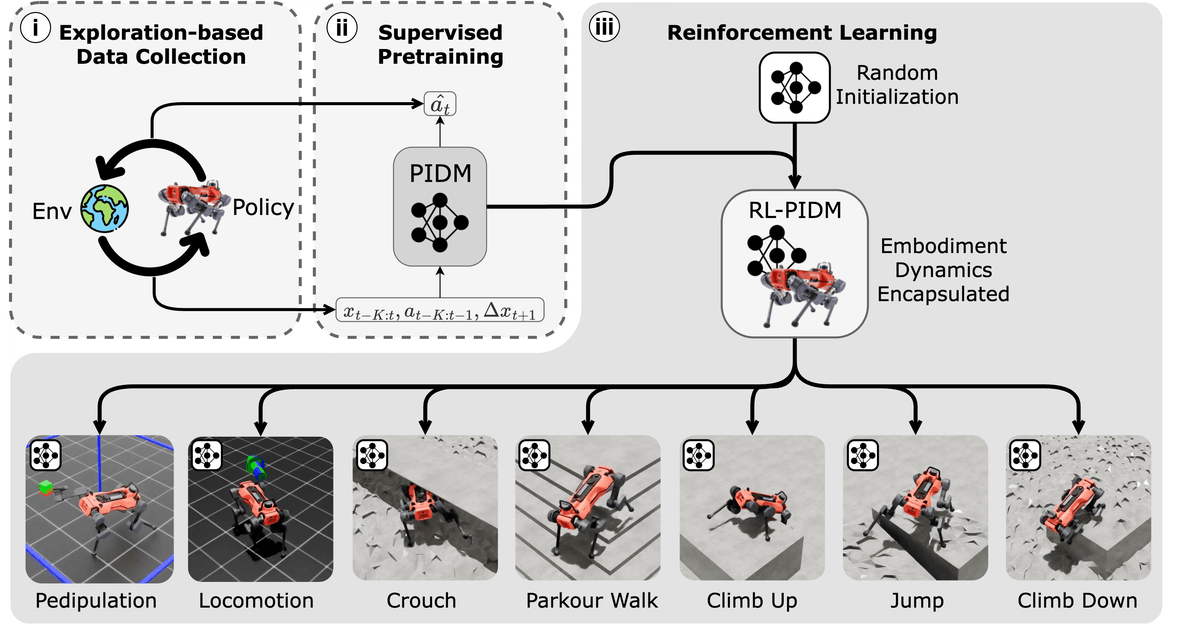
The method works in three stages. The key idea is to train a Proprioceptive Inverse Dynamics Model (PIDM) -- a model that, given a history of joint positions and a desired next state, predicts what action (joint torques) would get you there. Think of it as teaching the network to understand the robot's body before asking it to do anything useful with that body.
- Stage 1 -- Exploration-based data collection: A task-agnostic approach gathers diverse, dynamic transition data from the early, exploratory stages of an RL training process, achieved by training an exploration policy with PPO where transitions from on-policy rollouts are accumulated in a buffer. The exploration policy is guided by an ensemble of PIDM models: it is rewarded for visiting states where the ensemble disagrees, pushing it toward novel, informative transitions rather than just high-magnitude jitter.
- Stage 2 -- PIDM pretraining: The collected data is used to train a Proprioceptive Inverse Dynamics Model (PIDM) through supervised learning. The model takes a history of proprioceptive observations (joint angles, velocities, IMU readings) and a target delta-state, and predicts the action needed to reach it. Training uses L1 loss, symmetry augmentation, and observation noise for robustness.
- Stage 3 -- Warm-start RL: The pretrained weights are then loaded into both the actor and critic networks to warm-start the policy optimization of actual tasks. Task-specific modules (an Intention Encoder and Action Synthesizer) are added with random initialization, and the whole network trains end-to-end with standard PPO.
A critical design detail: the PIDM backbone is modular. Because different tasks have different observation spaces and command structures, the pretrained core is kept fixed in shape while small randomly-initialized adapters handle the task-specific input/output dimensions. Except for the architectures of the actor and critic networks and the way the weights are initialized, the method does not require any modifications to the POMDP or to the PPO update rules and hyperparameters -- the task-dependent Intention Encoder and Action Synthesizer can adapt to any configuration and dimension of the input and output.
What the data actually looks like
To validate that the exploration data is the right data, the authors project proprioceptive observations into 2D using UMAP (a dimensionality reduction technique) and compare the exploration dataset against the first 100 iterations of actual task-specific RL training.

The green exploration cloud covers and extends beyond both the red (pedipulation) and blue (velocity tracking) task distributions. This confirms the central bet: the early stages of any new task look similar to each other, and the exploration policy captures all of it without needing to know what the downstream task will be.
Benchmarks across 9 environments
The method was validated with 9 distinct robot locomotion RL environments comprising 3 different robot embodiments. These include:
- ANYmal-D (quadruped): velocity-tracking locomotion, pedipulation (using a leg as a hand), and 5 parkour tasks (walk, climb up, climb down, crouch, jump)
- Unitree Go1 (quadruped): velocity-tracking locomotion
- Unitree G1 (humanoid): velocity-tracking locomotion
All training ran in Isaac Lab, NVIDIA's GPU-accelerated simulation framework, using the RSL-RL library. RSL-RL is a lightweight RL library developed at ETH Zurich specifically for locomotion tasks. The comparison is clean: vanilla 4-layer MLP with random init vs. PIDM architecture with random init vs. PIDM with pretrained weights. Results are averaged over five random seeds.
The headline numbers hold up across the board. Compared with the randomly initialized PIDM architecture, the pretrained version showcases an improvement of 7.3% on final performance and enhances sample efficiency by 36.9%. The pretrained PIDM also outperforms the vanilla MLP in 7 out of 9 tasks. The two tasks where it only matches (not beats) the vanilla MLP are likely addressable with hyperparameter tuning -- notably, the authors deliberately did not re-tune any hyperparameters from the original task implementations.
Where it struggles
The PIDM is not a perfect inverse dynamics solver. While accurate data-driven modeling of robot locomotion may be achievable with models that are many orders of magnitude larger, actor and critic networks in motion-policy learning have traditionally been extremely lightweight -- and large models are known to make reinforcement learning substantially more challenging, raising concerns about whether existing methods can still be applied without modification. The pretrained PIDM achieves a normalized prediction error of around 40-50%, which sounds poor for a dynamics model but turns out to be sufficient to meaningfully bias the network toward useful representations.
The method also comes with a roughly 4x parameter count increase over a vanilla MLP, due to the history-based architecture. This is the cost of capturing temporal dynamics. And while the paper shows a sim-to-real transfer demonstration, the full sim-to-real validation is limited in scope -- the method's robustness on hardware across all 9 tasks remains to be shown.
The real unlock: one pretrain, many tasks
The most practically significant result is the generalization across tasks. You pretrain the PIDM once per robot embodiment. Then you can warm-start any downstream task with those weights -- different reward functions, different observation spaces, different terrain curricula. The approach is task-agnostic, focusing solely on encapsulating embodiment-specific knowledge across tasks, and serves as a user-friendly plug-in that does not require modifications to the established paradigm of locomotion learning.
An ablation study confirmed that pretraining both actor and critic is better than pretraining just one. Another ablation compared using the exploration-based data versus data from the early stages of a specific task (pedipulation): both beat random init, but the exploration-based approach wins by a margin and is more principled since it doesn't require running any task-specific RL first.
For teams building locomotion controllers for a specific robot platform -- whether that's a Go1, ANYmal, or a humanoid -- this is a compelling drop-in improvement. Especially in legged locomotion and other high-DoF systems, guidance is crucial: as the dimensionality of the problem grows, manual reward shaping or curriculum design becomes less viable. Shaving 37% off training time, without touching reward functions or PPO hyperparameters, is the kind of gain that compounds across an entire research program. Code availability has not been announced at time of writing.