
ETH Zurich's PAINT Teaches Robots to Co-Carry Heavy Loads Without Force Sensors
ETH Zurich's PAINT framework lets legged robots co-carry payloads with humans by reading partner intent through joint feedback alone, no force sensors required.
 Pro
Takeaways
- PAINT from ETH Zurich enables legged robots to co-carry objects by inferring partner intent from joint proprioception alone.
- Hierarchical design: a high-level teacher-student policy infers interaction forces, a low-level locomotion backbone handles rough terrain.
- No force-torque sensors, no motion capture, no payload tracking at deployment time.
- Beats damped-arm, pure RL, and behavior-cloning baselines on tracking error and intent alignment across payload masses.
- Zero-shot scales to decentralized teams of 2-4 ANYmal robots carrying up to 28 kg without retraining.
- Main weakness: no obstacle awareness, so the robot follows the leader even into walls.
Carrying a couch with a friend is easy for humans. You feel the tug, the twist, the pause, and adjust without a word. Getting a quadruped robot to do the same on a gravel path, without expensive force sensors or motion capture, has been surprisingly hard. A team from ETH Zurich's Robotic Systems Lab is proposing a fix called PAINT, a learning framework that lets a legged robot infer what its human or robot partner wants to do just from the wiggle of its own joints.
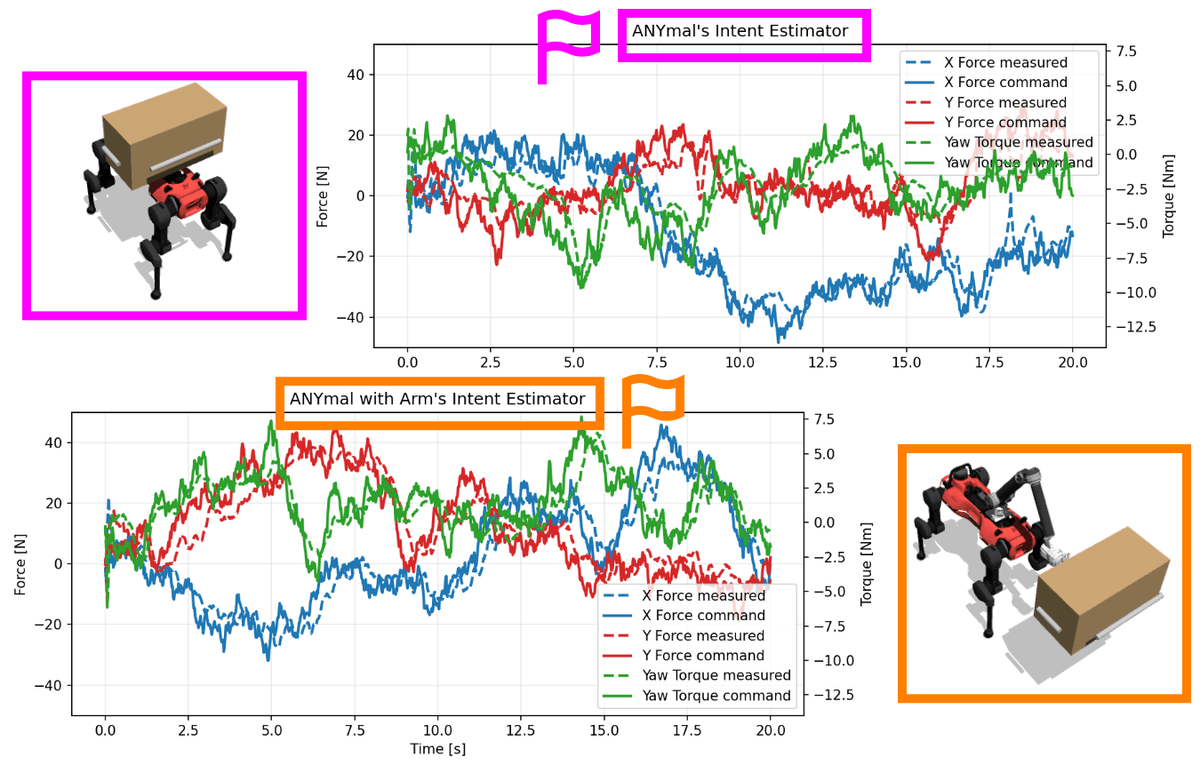
PAINT is a lightweight hierarchical learning framework for partner-agnostic intent-aware collaborative legged transport that infers partner intent directly from proprioceptive feedback. In plain terms, the robot figures out which way you want to push the box by feeling how its own arm joints are being nudged around, without any force-torque sensor at the wrist and without tracking the payload with cameras.
Why co-carrying is harder than it looks
Collaborative transport combines two nasty problems at once: staying upright on rough terrain while carrying a load, and continuously guessing what a partner is trying to do through the shared object. Prior systems typically punted on one of them. Many intent-aware transport systems rely on external sensors such as force-torque units to estimate interaction intent, but those are often too expensive and fragile for high-impact, high-wear deployment on factory floors, and they pick up locomotion-induced noise that is hard to filter out.
The other common shortcut is testing everything on flat lab floors, which leaves robustness on uneven terrain largely unexplored. Multi-robot versions usually depend on motion capture rigs, remote control, or hard-coded team layouts, none of which travel well to a construction site.
The two-brain design
PAINT splits the problem into two policies stacked on top of each other. A high-level controller worries about what the partner wants and how the arm should move. A low-level controller worries about not falling over.