
ETH Zurich's LeAD-M3D Beats 3D Detection Without Depth Sensors at 60 FPS
A new monocular 3D detection method uses asymmetric distillation to hit state-of-the-art accuracy on KITTI, Waymo, and Rope3D while running in real time.
 Pro
Takeaways
- LeAD-M3D delivers real-time monocular 3D detection without LiDAR, stereo, or ground-plane inputs, with a paper on arXiv.
- A2D2 distillation trains the student on MixUp-blended images while the teacher sees clean ones, transferring depth reasoning.
- CM3D matching adds 3D MGIoU to prediction-to-ground-truth assignment, stabilizing training under crowded scenes.
- CGI3D runs 2D/3D regression only on top-k confident patches, cutting head FLOPs about 75 percent without accuracy loss.
- Sets state-of-the-art AP3D on KITTI, Waymo, and best car AP on Rope3D across a five-size model family.
- Runs 3.6x faster than prior top-accuracy monocular model MonoDiff, with 60+ FPS via TensorRT on RTX 8000.
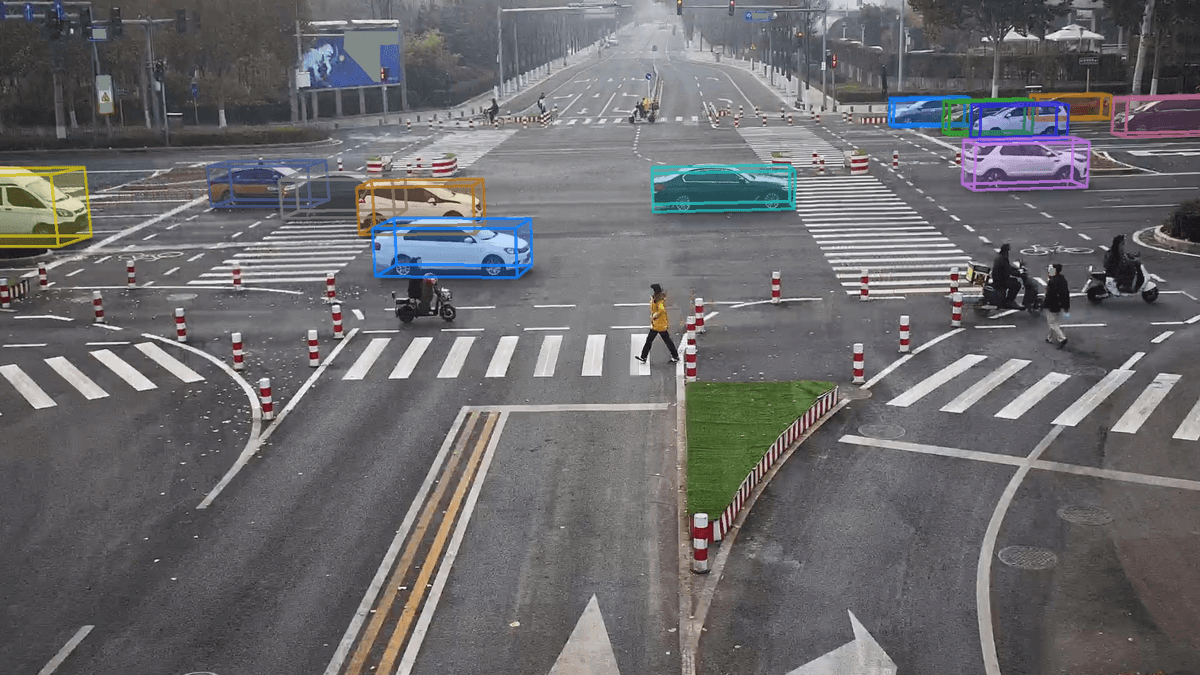
Detecting 3D objects from a single camera image is one of the hardest problems in perception. There is no depth sensor to lean on, no stereo baseline to triangulate against, and the model has to infer where every car, pedestrian, and cyclist sits in 3D space from pixels alone. Most approaches either bolt on LiDAR during training, bake in geometric assumptions like flat ground, or trade away inference speed to squeeze out extra accuracy points. A team from DeepScenario, ETH Zurich, TU Munich, TU Darmstadt, and Microsoft proposes a different tradeoff with LeAD-M3D, a monocular 3D detector that claims a new accuracy-efficiency Pareto frontier without any of those crutches.
The tradeoff no one wanted to make
Monocular 3D detection aims to predict the 3D position, orientation, and size of objects from a single RGB image, and it shows up in autonomous driving, robotics, medicine, and city infrastructure. Inferring depth from a single 2D image introduces strong ambiguities and is the dominant source of error, a problem that intensifies for non-zero roll and pitch viewpoints like roadside cameras.
Existing work splits into three camps. Some methods use LiDAR during training to teach the model about depth. Others hard-code geometric priors, for example the assumption that an object's 2D height in the image is inversely proportional to its distance. A third group trains only on 3D box labels but pays for it with heavy compute. The authors focus on this last category to maximize applicability across camera viewpoints and datasets, allowing full flexibility with respect to object orientation rather than being constrained by viewpoint-specific priors.
Three ideas stacked on a YOLO backbone
LeAD-M3D sits on top of YOLOv10 with added 3D detection heads for offset, dimension, orientation, depth, and uncertainty. The authors ship a family of five sizes (N, S, M, B, X) mirroring the YOLO convention. Three components do the heavy lifting on top of that baseline.

Asymmetric Augmentation Denoising Distillation (A2D2) comes first. Instead of the standard trick where the teacher gets extra data like LiDAR while the student sees only images, A2D2 flips the setup: the teacher sees clean images and the student sees a MixUp blend of two images pixel-mixed together. The student has to reproduce the teacher's depth features despite that noise. MixUp preserves object geometry in image coordinates, so projected centers, depths, dimensions, and orientation remain consistent, which makes it a valid denoising target. Distillation happens on the depth head features rather than generic backbone activations, and the loss is weighted by two signals: how accurate the teacher was on each object (relative depth error) and how important each feature channel is to the final depth prediction.
3D-aware Consistent Matching (CM3D) comes next. Standard YOLO-style detectors match predictions to ground truth using 2D IoU and class scores. LeAD-M3D extends that scoring with a 3D overlap term based on Marginalized Generalized IoU, a 3D-overlap surrogate that remains informative even without 3D box intersection, which is common early in training or for small objects. The 2D term stabilizes learning when 3D estimates are still crude, and the 3D term helps disambiguate overlapping predictions once they sharpen up.
Confidence-Gated 3D Inference (CGI3D) closes out the trio. Most monocular detectors run their regression heads densely across the entire feature map, even though most locations are background. CGI3D runs only the classification head densely, picks the top-k confident spots, extracts 3x3 patches around them, and applies the expensive 2D and 3D regression heads only to those patches. Because the head's effective receptive field is exactly 3x3, the outputs are identical to dense evaluation with no accuracy loss. On the smallest model, this cuts head FLOPs by roughly 75 percent.

What the numbers look like
On the KITTI test benchmark, the largest variant outperforms all existing methods in AP3D across all difficulty levels, including those that leverage perspective geometric priors or extra training data, while running 3.6x faster than the previous state-of-the-art MonoDiff. The smaller variants also punch above their weight. Here's how the lightweight family stacks up on KITTI car detection:
| Model | Params (M) | Time (ms) | AP3D Mod. |
|---|---|---|---|
| MonoLSS (prior best, no extras) | 21.5 | 20.2 | 19.15 |
| LeAD-M3D S | 10.1 | 10.2 | 18.87 |
| LeAD-M3D M | 19.7 | 13.3 | 19.47 |
| LeAD-M3D B | 24.9 | 13.9 | 20.17 |
| LeAD-M3D X | 36.3 | 23.6 | 21.20 |
On Rope3D, the roadside camera benchmark that breaks most car-view models, LeAD-M3D X takes the top spot for the Car category and, for the rare Big Vehicle category, comes in second only to MonoFlex, which requires ground-plane inputs. On Waymo, the largest model surpasses the previous best by 2.97 AP on the primary metric, and even the second-largest variant beats all prior methods. With TensorRT, even the X-size model clears 60 FPS on a single GPU.
What actually drives the gains
The ablation is worth reading closely. On a B-size model, adding only MixUp denoising lifts AP by 1.31 points; adding only A2D2 distillation lifts it by 1.73; combining both stacks to 3.53. The saliency analysis suggests why: without denoising and distillation, the model attends to noisy background regions, while with both, attention concentrates on the actual object. Depth features turned out to be a better distillation target than generic backbone features, and offline distillation (with a frozen teacher trained beforehand) beat online self-distillation by 0.85 AP because the strongest distillation targets emerge only late in training, coinciding with the learning rate decay necessary for depth convergence.
A2D2 also generalizes beyond the authors' own architecture. When plugged into MonoLSS and MonoCD as a self-distillation scheme, it improved moderate AP by 1.76 and 2.73 points respectively, suggesting the technique is portable to other monocular 3D detectors.
Where it fits and where it doesn't
This is useful if you are:
- Building a driving or robotics perception stack that cannot ship LiDAR at inference time
- Deploying roadside or drone-mounted cameras where ground-plane assumptions break
- Looking for a monocular baseline with a real model family (5 sizes) rather than a single fixed configuration
- Trying to add a distillation stage to an existing YOLO-based 3D detector
What it does not solve: this is still supervised training on 3D box annotations, which are expensive to collect. The authors themselves flag semi-supervised, open-vocabulary, and video/multi-view extensions as future work. Domain generalization results are strong (training on nuScenes and evaluating on KITTI beats specialized DG methods) but not a replacement for target-domain data when available. And while the family scales down to 3.8M parameters, the largest teacher still takes 34 hours to train on KITTI on a single RTX 8000, with student training up to 60 hours.
Code is promised on the project page, though as of the paper's release the repository was not yet live. For teams already invested in the YOLO ecosystem for 2D detection, LeAD-M3D is the closest thing to a drop-in 3D upgrade path that has shown up in a while.