
ETH Zurich's HandControlVideo Fixes AI's Broken Hand Problem With 3D Joints
A new framework uses sparse 3D hand joints to generate first-person videos with realistic finger articulation, working across human and robotic hands.
 Pro
Takeaways
- ETH Zurich team proposes using sparse 3D hand joints instead of 2D tracks for egocentric video generation, detailed in the paper.
- Occlusion-aware conditioning penalizes hidden joints in source frames and uses depth-weighted feature propagation for target frames.
- Built on WAN 2.1 with LoRA rank 64; control module adds only ~20k parameters.
- Automated pipeline yields 1M annotated Ego4D clips using WiLoR-based hand reconstruction and bipartite tracking.
- Cuts MPJPE from 9.77 to 1.42 on Ego4D versus retrained WAN-Move, with 16% FVD reduction over MotionStream.
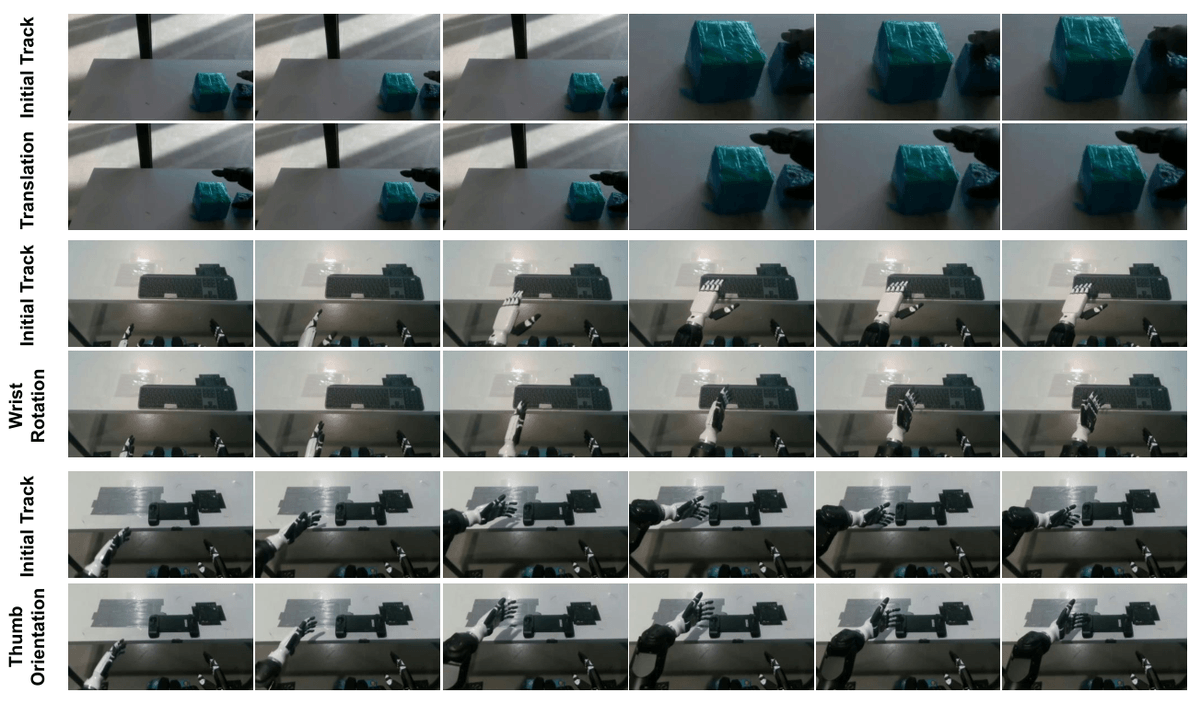
- Supports interactive per-joint dragging and transfers to robotic hands (Unitree G1, H1-Inspire) with light finetuning.
Generating first-person video where hands actually behave like hands has been one of the stubbornly hard problems in controllable video synthesis. Fingers overlap, thumbs occlude index fingers, objects hide half the palm, and any generator relying on 2D signals ends up producing melted, floaty, or anatomically confused articulations. A team from ETH Zurich, ETH AI Center, MPI for Informatics, and Microsoft is proposing a fix by throwing out 2D control signals altogether and conditioning the video model on sparse 3D hand joints instead.
The result, called HandControlVideo, generates egocentric clips from a single reference image plus a trajectory of 3D joint positions. It handles severe self-occlusion, allows users to drag individual finger joints in 3D space, and, because the control signal doesn't assume human anatomy, transfers to robotic dexterous hands with only light finetuning.
Why 2D control breaks for hands
Motion-controllable video generation has largely converged on two paradigms, and both struggle with egocentric hands. Track-based methods treat motion flows as isolated 2D point trajectories, discarding the rigid structural integrity of the hand and inherently lacking depth awareness, resulting in unrealistic motion details when facing complex interactions. Pose-based methods either compress poses into low-frequency latent codes, which smooths out fine articulation, or project them into 2D skeleton maps that collapse 3D geometry into ambiguous 2D signals. When fingers intersect or occlude each other, overlapping structures create visual clutter and ambiguous ordering cues that hinder precise control.

Egocentric video makes this worse because the camera sits on the user's head, so hands are constantly occluding themselves and the objects they manipulate. The authors identify two distinct failure modes: source occlusion, where a hidden joint in the reference frame gets assigned incorrect texture that later leaks into revealed articulations, and target occlusion, where a foreground finger crossing over a background finger causes features to mix incorrectly across depth layers.
Sparse 3D joints as the control signal
The core bet is that a sparse set of 3D joint coordinates (up to 42 points for two hands) is a better control signal than dense 2D tracks or skeleton maps. The paper argues three things: explicit 3D geometry disambiguates occlusion because you know which finger is in front, sparse joints give users an intuitive interface for dragging individual points, and the representation carries no human-specific kinematic assumptions, so it works for robot hands too.
The framework is built on top of WAN 2.1, a state-of-the-art image-to-video diffusion transformer, adapted with LoRA at rank 64. The new control module itself is tiny, roughly 20k parameters, because it plugs into the existing latent space rather than sitting alongside as a heavyweight ControlNet branch.

How the occlusion-aware conditioning works
The control module runs in three stages, each targeting a specific ambiguity:
- Occlusion-removed context aggregation. For each 3D joint in the reference frame, the model samples local VAE features using a Gaussian heatmap centered at the projected 2D location. To avoid contamination when one joint sits in front of another, it computes a pairwise occlusion penalty combining spatial overlap and depth ordering. If a joint is likely occluded, its feature contribution is suppressed via a gated average pooling so hidden articulations don't inherit the wrong textures.
- Occlusion-aware feature propagation. Clean source features are propagated to target frames along the joint trajectories. To resolve this trajectory conflict, we propose a 3D-based weighting mechanism. It acts as a differentiable Z-buffer, dynamically assigning higher importance to joints closer to the camera during feature propagation. A softmax over log-heatmap plus disparity ensures that when two fingers overlap in image space, the foreground one wins the pixel.
- 3D geometric embeddings. A parallel stream encodes each joint's projected 2D position, disparity, and a learnable identity index (thumb tip, index MCP, and so on) via sinusoidal positional encoding and a small MLP. These embeddings are splatted onto the spatial grid and passed through a causal 3D convolution before being concatenated with the noisy latent.
The causal convolution matters here: it applies asymmetric padding along the time axis so the geometric guidance for the current frame only sees historical context, preventing information leakage from future frames during rollout.
A million-clip dataset built from Ego4D
Because Ego4D ships without 3D hand annotations, the team built an automated pipeline that runs YOLO for hand detection, then WiLoR for in-the-wild 3D reconstruction predicting MANO parameters. A bipartite matching stage assigns detections to persistent left/right track slots using a spatial cost plus a handedness penalty, with a hysteresis threshold to prevent identity flips during close-proximity interactions and a gap-reset that flushes tracks after 10 occluded frames.
Filtering discards clips where hands appear in fewer than 20% of frames, MANO validity drops below 5%, or more than two hands are visible for over a quarter of the sequence. The output is roughly 1 million filtered egocentric clips paired with accurate 3D joint trajectories, trained on 16 NVIDIA GH200 GPUs for about 48 hours.
The numbers
Evaluations run on Ego4D (in-domain) and EgoDex (out-of-domain dexterous tabletop manipulation), against Mask2IV, WAN-Fun, MotionStream, and WAN-Move. Metrics cover both visual quality (FID, FVD, PSNR, SSIM) and control precision (MPJPE and MPVPE, measured by extracting hands from generated video with WiLoR and comparing to ground truth).

On Ego4D, HandControlVideo reports FID 67.70 versus 88.90 for WAN-Move retrained on the same data, and MPJPE of 1.42 versus 9.77. On EgoDex, MPJPE drops to 1.80 versus 5.71 for WAN-Move. The ablation shows each component contributes: occlusion-removed context aggregation alone beats prior 2D-track baselines, adding occlusion-aware propagation cuts MPJPE another 23% on Ego4D, and adding the 3D geometric embeddings cuts it a further 32%.
What it unlocks
Two capabilities stand out beyond raw benchmark wins. First, interactive fine-grained editing: because joints are explicit 3D points, a user can drag a single fingertip in a UI and the model generates a plausible video where only that digit moves while the rest of the hand stays coherent. During training, 5% of joints are randomly masked to zero, teaching the model to fill in missing articulations, which is what makes sparse user input work at inference.
Second, cross-embodiment transfer to robots. Because 3D joints carry no bone-length or kinematic-chain assumptions, the same finetuned model drives different humanoid hand morphologies from the Humanoid Everyday dataset, including Unitree G1-Dex3-1 and H1-Inspire hands, with only light finetuning on small robotic datasets.
Caveats and where it falls short
A few practical limits are worth flagging:
- The whole pipeline assumes you can supply accurate 3D joint trajectories. In practice that means either running a hand tracker like WiLoR on source footage or authoring joints manually, both of which introduce error the model has to absorb.
- The dataset pipeline discards heavily degraded clips, so the 1M-clip training distribution is cleaner than raw in-the-wild egocentric video.
- Robotic transfer still requires finetuning on target-embodiment data, so "cross-embodiment" is closer to easy adaptation than pure zero-shot.
- The paper does not release code or model weights at the time of writing; the project page hosts qualitative results only.
The real breakthrough here is less about a new architecture and more about choosing the right control representation. Once hand motion is expressed as sparse 3D points with explicit visibility reasoning, a lot of downstream problems (occlusion handling, interactive editing, robot transfer) become tractable with a lightweight adapter rather than a redesigned generator. For anyone building egocentric world models, VR content pipelines, or robot learning systems that consume synthetic first-person video, this points at a control interface that is cheaper to integrate and more geometrically honest than the 2D approaches currently dominating the field.