
ETH Zurich's BioTrain Trains AI on a Hearing-Aid Power Budget
A compiler framework squeezes full-network backpropagation onto a wearable-class microcontroller, cutting training memory 8x while personalizing EEG and EOG models on-chip.
Takeaways
- BioTrain enables full-network fine-tuning of CNN biosignal models on MCUs at under 50 mW power draw
- Cuts peak training memory 8.1x, from 5.4 MB to 0.67 MB, on the GAP9 chip
- Delivers up to 35% accuracy gains over unadapted models and 7% over last-layer-only updates
- Achieves 17 samples/s for EEG and 85 samples/s for EOG training throughput on-device
- Replaces batch norm with group norm plus gradient accumulation to fit small scratchpad memory
- Open-sourced as part of pulp-platform/Deeploy on GitHub
Running a neural network on a smartwatch-class chip is one thing. Training that network on the same chip, powered by a coin-cell battery, is another matter entirely. A team from ETH Zurich, University of Bologna, and Politecnico di Torino has shown it can be done for real biosignal models, and they have open-sourced the compiler that makes it work.
Their framework, called BioTrain, performs full-network fine-tuning of state-of-the-art biosignal models under milliwatt-scale power and sub-megabyte memory constraints. On the GAP9 microcontroller, it hits 17 training samples per second for an EEG model and 85 samples per second for an EOG model, all under 50 mW. That is roughly the power budget of a hearing aid.
Why on-device training is hard for biosignals
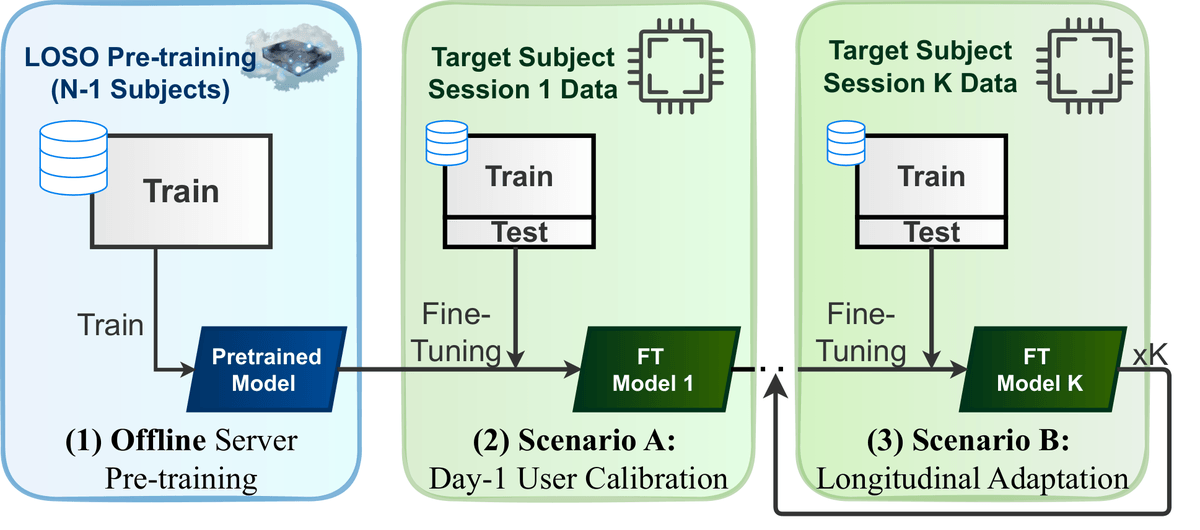
EEG (brain), EOG (eye movement), and similar physiological signals are notoriously unstable. Electrode-skin impedance, perspiration, and sensor displacement shift the signal distribution between users, between sessions, and even over the course of a single day. A model trained in the cloud on other subjects tends to degrade sharply once it lands on a new person's device.
The obvious fix is to fine-tune on-device. That preserves privacy, avoids a network round-trip, and lets the model track drift over time. The catch is that backpropagation is expensive in memory. Storing intermediate activations and gradients for a full training pass typically overflows the tiny scratchpad SRAM on wearable MCUs. Prior on-device training work has mostly worked around this by cutting corners: updating only the last classifier layer (linear probing), sparse updates, or pruning. These choices are not driven by raw compute limits, since full backpropagation is viable for a wide range of small networks on edge devices. The fundamental limitation lies in memory management during training.