
ETH Zurich's AudioTSLM Beats 8B Models at Hearing Heart Disease
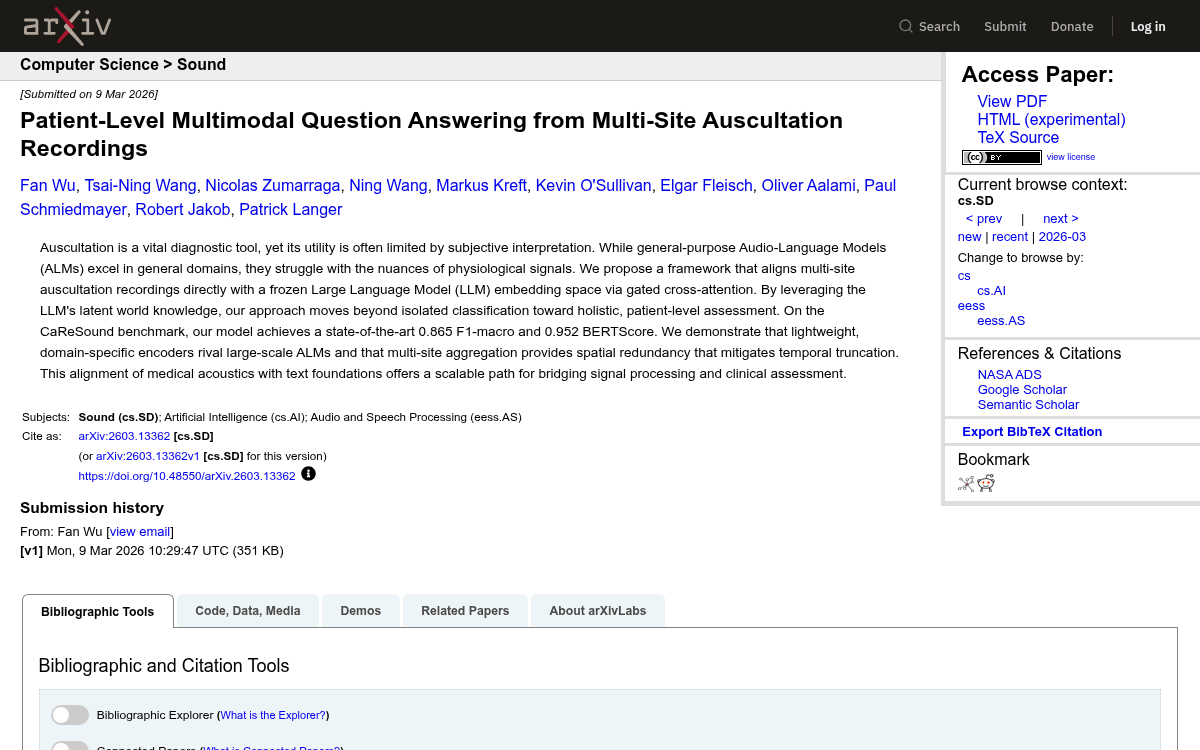
A new framework fuses stethoscope recordings from multiple body sites with a frozen LLM, beating 8B audio models with only 1.4B trainable parameters.
 Pro
Takeaways
- AudioTSLM aligns multi-site heart and lung recordings with a frozen LLaMA-3.2-1B via Flamingo-style gated cross-attention
- Achieves 0.865 F1-macro and 0.952 BERTScore on the CaReSound benchmark, beating CaReAQA (3B) and Audio-Flamingo3 (8B)
- Improves Contains-Match accuracy by 7.75 points over the prior state of the art at only 1.4B trainable parameters
- Raw-waveform tokenization from scratch matches or beats Wav2Vec2, Whisper, and CLAP for medical audio
- Multi-site aggregation via Perceiver Resampler compensates for shorter clip durations across anatomical sites
- Code release pending acceptance at Interspeech 2026; benchmark data available from source datasets like CirCor and ICBHI
Stethoscopes have been around since 1816, but interpreting what you hear through one is still stubbornly subjective. A team from ETH Zurich, Stanford, and Eindhoven has proposed a way to let a large language model do the listening, and their approach outperforms audio-language models many times its size on cardiac and respiratory diagnostics.
The paper introduces AudioTSLM, a framework that pipes multi-site auscultation recordings straight into a frozen LLM's embedding space using gated cross-attention borrowed from Flamingo. On the CaReSound benchmark, the model reaches a 42.6% Contains-Match (+7.75 points) and 0.865 F1-macro over the CaReAQA baseline, with a 0.952 BERTScore.
Why stethoscope AI has been stuck
Auscultation, the clinical practice of listening to internal body sounds, has two properties that break most audio models. Medical auscultation contains domain-specific signals with subtle pathological patterns such as murmurs or crackles that are often obscured by noise or overlapping physiological signals. General audio-language models like Audio Flamingo or Qwen-Audio were trained on speech and environmental sounds, so those subtle patterns get lost.
The second problem is structural. Medical auscultation signals are temporally structured and relatively long, up to 30 seconds, yet current approaches rely on short-window segmentation of 2 to 5 seconds. Chopping a 30-second recording into 3-second slices destroys the rhythmic context of full respiratory or cardiac cycles. Worse, clinicians never diagnose from a single recording. They compare sounds from the aortic, pulmonic, tricuspid, and mitral valve positions, and prior models tend to ignore those cross-site relationships.
Gated cross-attention meets the chest wall
The architecture builds on OpenTSLM-Flamingo, a time-series language model framework. The pipeline has three stages: turn each recording into acoustic tokens, compress the whole patient's set of recordings into a fixed number of latent vectors, then inject those into a frozen LLaMA-3.2-1B via gated cross-attention layers wedged between the transformer blocks.

The compression step is the interesting one. A Perceiver Resampler uses K learnable latent queries that attend jointly across all temporal and clip dimensions. Instead of averaging recordings or concatenating them into an unwieldy token stream, the resampler adaptively pools across sites, letting the model capture things like aortic-mitral valve co-variation while keeping the input to the LLM a fixed size.
A tanh(α) gating parameter on each cross-attention layer starts near zero and gradually opens. The gating parameter regulates the influence of acoustic features, preserving pretrained language priors while progressively aligning the medical acoustic patterns with textual embeddings. The LLM's weights stay frozen; only the encoder, resampler, and adapters train, roughly 1.4B parameters.
The benchmark and what the numbers say
CaReSound is a benchmark for medical QA on cardiac and respiratory auscultation audio, built from public datasets including ICBHI, KAUH, CirCor, SPRSound, and ZCHSound. Textual metadata and annotations are transformed into open-ended diagnostic dialogues using GPT-4o, simulating clinical scenarios where physicians analyze patient recordings and provide diagnostic feedback. The total is 2,951 patients, 8,361 audio files, and 32,577 QA pairs.
Against zero-shot foundation ALMs, the results are lopsided. Audio-Flamingo3 (8B) scores 5.5% Contains-Match. Qwen2.5-Omni (0.5B) gets 6.7%. The 1.4B AudioTSLM lands at 42.6%. Even against fine-tuned CaReAQA (3B), it wins across every metric.
| Model | Yes/No F1 | Contains-Match | ROUGE-L | BERTScore |
|---|---|---|---|---|
| Audio-Flamingo3 (8B) | 0.545 | 5.51% | 0.288 | 0.885 |
| Qwen2-Audio (7B) | 0.171 | 4.33% | 0.295 | 0.900 |
| CaReAQA (3B) | 0.846 | 34.85% | 0.612 | 0.942 |
| AudioTSLM (1.4B) | 0.865 | 42.60% | 0.673 | 0.952 |
Two counterintuitive findings
The paper's more interesting contributions are the ablations. First, the authors tested five audio front-ends: two lightweight ones trained from scratch (raw waveform patches and mel-spectrograms) and three heavyweight pretrained encoders (Wav2Vec2, Whisper, CLAP). The RawAudioTokenizer achieves the highest F1-macro at 0.865, ROUGE-L at 0.673, and BERTScore at 0.952, validating that lightweight, scratch-trained front-ends can provide superior semantic alignment for physiological audio. Large-scale encoders like Wav2Vec2 slightly underperform across both binary and generative tasks.
The mechanism matters here. Raw-waveform tokenization is a 1D convolution over 40ms patches, roughly the audio equivalent of ViT patches. It has no built-in bias toward speech phonemes, so it doesn't have to unlearn anything before picking up cardiac murmurs.
Second, the temporal context ablation reveals a compensation effect between space and time:
- Multi-site datasets (CirCor, ICBHI, SPRSound) stay robust when clips are truncated from 30s to 10s because information from other body sites fills the gap
- Single-recording datasets take a serious hit: in KAUH, ROUGE-L drops sharply from 0.845 to 0.542 when truncated to 10 seconds, and ZCHSound F1-macro falls from 0.980 to 0.864
- Full 30-second context wins overall, but four recordings from four valves buy a lot of forgiveness on clip length
What is and isn't shipping
The authors state that code will be released upon acceptance, and the manuscript is under review for Interspeech 2026, so there is no public checkpoint or repo yet. CaReSound itself was introduced by the CaReAQA paper and derives from public sources like CirCor DigiScope and ICBHI, which anyone can download today.
Practically, the target application is telemedicine screening and diagnostic standardization in low-resource settings, places where a nurse with a digital stethoscope could capture multi-site recordings and get a grounded, natural-language interpretation. The limits are the usual ones: dataset bias, the black-box problem with medical AI, and validation only on the datasets that fed CaReSound. But the recipe, freeze a small LLM, tokenize physiological signals as a native modality, and let a Perceiver Resampler handle multi-instance aggregation, is a template that generalizes far beyond stethoscopes.