
ETH Zürich Finds Reasoning Models Secretly Reinvent How Teachers Write Wrong Answers
A new study dissects how DeepSeek-V3.2 and GLM-4.7 produce multiple-choice wrong answers, finding their reasoning quietly mirrors decades of learning-science guidance.
 Pro
Takeaways
- New multi-institution study analyzes how reasoning LLMs generate multiple-choice distractors on 429 Eedi math problems.
- DeepSeek-V3.2 and GLM-4.7 solve first, then inject errors in 92 to 98 percent of traces.
- Surface-level similarity heuristics appear in only about 3 percent of generations, contrary to prior assumptions.
- Revealing the correct answer in the prompt lifts alignment with human distractors by roughly 8 percent.
- Main failure modes are wrong solutions and overly aggressive curation, not error simulation or missing structure.
- Code, prompts, and taxonomy are open source at eth-lre/llm-student-modeling-strategies.
Writing a good multiple-choice question is deceptively hard. The correct answer is the easy part. The wrong answers, called distractors, are what separate a useful assessment from a bad one, because they need to be tempting to a student who holds a specific misconception without being technically correct. A new paper from researchers at ETH Zürich, Bocconi University, and the University of Central Florida takes a microscope to how modern reasoning models actually perform this task, and the answer is more interesting than raw accuracy scores would suggest.
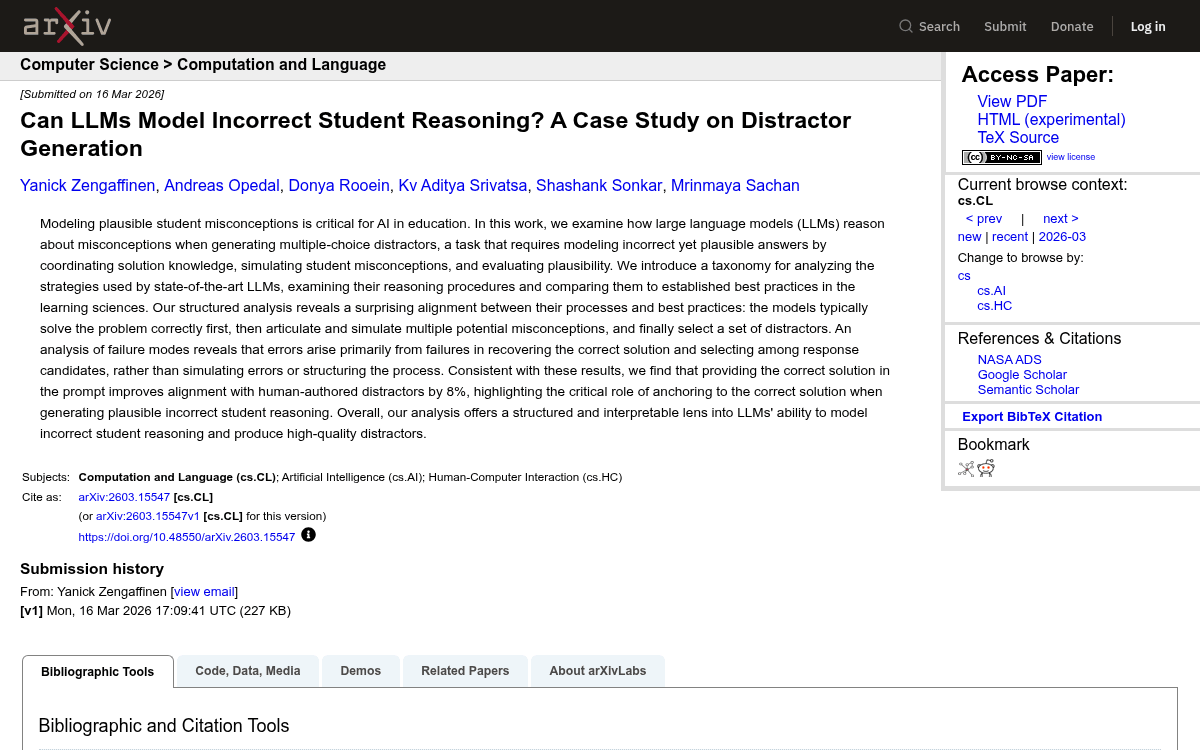
The team examines how large language models reason about misconceptions when generating multiple-choice distractors, a task that requires modeling incorrect yet plausible answers by coordinating solution knowledge, simulating student misconceptions, and evaluating plausibility. Their central claim: when you crack open the reasoning traces of frontier models, they turn out to independently rediscover the pipeline that education researchers have advocated for decades.
Why wrong answers are harder than right ones
Solving a math problem requires knowing the correct procedure. Writing a plausible distractor requires knowing the correct procedure and a menu of realistic ways students might botch it, plus a sense of which of those botches are common enough to fool a real learner. Prior work has largely focused on performance measured with respect to the final response, but the authors argue it is of equal importance to evaluate how the models arrive at distractor candidates.
That matters because explainability has been shown to play a key role for establishing trust in AI-based educational tools among teachers. If a tutoring system is going to auto-generate quiz items, teachers want to see the reasoning, not just a black-box list of options.
Building a taxonomy from the ground up
The authors combine two sources: the learning-science literature on distractor design, and open coding of actual LLM reasoning traces. Open coding is a qualitative research technique where you read text and label recurring concepts without predefined categories, then merge and refine those labels. They did this manually on 24 traces and then scaled it up by having DeepSeek-V3.2 perform sentence-level coding on 500 more.
The resulting taxonomy has eight strategies:
- INTER (Task Interpretation): parsing what the question is actually asking for.
- CORR (Correct Answer Reference): computing or citing the correct solution.
- ERR_DESC (Error Description): naming a misconception at an abstract level.
- ERR_SIM (Error Simulation): actually running through the flawed procedure.
- INST (Outcome Instantiation): stating the concrete wrong answer that results.
- PLAUS (Plausibility Check): asking whether a student would really pick this.
- CURATE (Final Set Curation): choosing a clean, non-overlapping set of three.
- RECON (Reconsideration): backtracking on earlier decisions.
What the traces actually show
The team applied this taxonomy to 240 distractor-generation traces from DeepSeek-V3.2 and GLM-4.7 on expert-written MCQs from the Eedi Math dataset. After filtering out questions that reference images or depend on the answer choices themselves, they were left with 429 grade-school math problems.
The headline finding is that models overwhelmingly use a solve-first, misconception-based workflow. In 92.5% of DeepSeek-V3.2 traces and 97.8% of GLM-4.7 traces, the model constructs a full step-by-step solution before proposing distractors. In 71.2% and 76.3% of these cases respectively, the model diverges at a specific step to inject an error, closely mirroring misconception-based design.
The lazy alternative that item-writing textbooks warn against, generating distractors by superficially perturbing the correct answer, barely shows up. Similarity-based strategies are rare (roughly 3% of samples) and largely confined to narrow settings such as rounding or magnitude-estimation problems. Models also explore far more candidates than they output: DeepSeek-V3.2 in reasoning mode considers an average of 12.6 hypothetical student solution paths, compared to 5.9 in chain-of-thought.
Reasoning helps, but not the way you might think
Turning reasoning on produces a real jump in output quality. Under a metric called proportional match, which measures overlap with human-written distractors:
| Prompt | DeepSeek-V3.2 | GLM-4.7 |
|---|---|---|
| Direct | 0.34 | 0.42 |
| Chain-of-thought | 0.51 | 0.50 |
| Reasoning | 0.52 | 0.52 |
More striking is what disappears. For DeepSeek-V3.2, accidentally correct responses drop from 0.39 under direct prompting to 0.02 with reasoning, and repetitions decrease from 0.19 to 0.02. Reasoning models are much better at not accidentally handing students the right answer as one of the wrong options.
Where things break
The taxonomy also lets the authors localize failures. They test four hypotheses about where distractor generation goes wrong, and rule out most of them:
- Error simulation is not the problem. When given an explicit misconception and asked to simulate a student making it, DeepSeek-V3.2 hits a mean accuracy of 0.92, suggesting that error simulation failures are rare.
- Reasoning structure is not the problem. A prompt that explicitly walks the model through solve, enumerate errors, simulate, evaluate, curate, and select scores 0.55 versus 0.52 for the simple prompt, a difference the authors note is not statistically significant. Models self-organize this pipeline without being told.
- Solution recovery is a problem. Explicitly revealing the final answer significantly improves proportional match over the simple prompt without it (0.56 vs. 0.52). When the model gets the correct answer wrong internally, everything downstream collapses.
- Over-conservative curation is a problem. Models discard an average of 0.97 candidate distractors per problem that are incorrect yet consistent with a plausible error description. Good candidates are being thrown out during final selection.
What this means in practice
For anyone building assessment tooling on top of reasoning LLMs, the paper offers a few concrete levers. Giving the model the correct answer up front, rather than trusting it to derive one, is the single biggest intervention. Encouraging broader retention during curation, rather than aggressive pruning, is another. And explicit multi-step scaffolding turns out to be unnecessary for capable models, though a follow-up experiment with GPT-oss-20b suggests smaller models do benefit, going from 0.30 to 0.35 with the structured prompt.
The code, prompts, and annotation pipeline are available in the accompanying GitHub repository, and the underlying MCQ data comes from the public Eedi Mining Misconceptions in Mathematics Kaggle competition. One caveat worth flagging: the ground truth in Eedi is a single set of human-written distractors, and the authors found that model-generated answers matched a Eedi distractor in only 62% of cases even when the error was implemented faithfully. Benchmarks in this space likely underrate the models by a meaningful margin, and better evaluation will require multiple valid distractors per misconception.