
ESPIRE Benchmark Exposes Gemini 2.5 Pro Failing Basic Robot Spatial Tasks
ESPIRE puts frontier vision-language models inside a physics simulator and asks them to actually pick and place, exposing sharp weaknesses in 3D rotation reasoning.
 Pro
Takeaways
- ESPIRE is a new simulation benchmark for embodied spatial reasoning in VLMs, built on Isaac Sim.
- Splits robotic tasks into generative localization plus 6-DoF execution, not VQA.
- Ships 2,220 pick and place tasks across 148 spatial-reasoning types and 65 instruction families.
- Gemini 2.5 Pro leads pick success at 34%, but all models collapse below 21% on placement.
- Rotation prediction is the main bottleneck; pitch matters for pick, roll for constrained place.
- Code and assets are open source at github.com/spatigen/espire.
A new diagnostic benchmark called ESPIRE tries to answer a question that most spatial reasoning evaluations have quietly avoided: can a vision-language model actually act on what it sees, not just answer trivia about it? The team behind it argues that today's multiple-choice benchmarks are giving VLMs too much credit, and they built a simulated robot lab to prove it.
Why VQA benchmarks are misleading
Most spatial reasoning evaluations for VLMs are static, VQA-style tests where the model picks from a list of options. Because they rely on distractors they are prone to biases, and they depart from practical scenarios, where VLM agents must proactively act upon instructions in 3D rather than passively selecting an answer from a predefined set. Real-world robotic evaluation fixes this but is expensive, hardware-dependent, and hard to reproduce.
A middle ground has emerged in the form of pointing, where models output 2D pixel coordinates for a target. But the execution phase that typically follows localization in robotics tasks has been overlooked or overly simplified. ESPIRE closes that gap by testing both stages inside a physically grounded simulator.
How the benchmark works
ESPIRE is built on NVIDIA Isaac Sim and splits every robotic task into two generative sub-problems:
- Localization: given a scene image and an instruction like "pick up the farthest book," the model outputs a 2D point on the image identifying the target.
- Execution: the model predicts a 6-DoF goal pose (position plus pitch, yaw, roll) that a motion planner (cuRobo) then attempts to reach.
Task instructions are represented as functional programs (borrowed from the CLEVR playbook) that execute on a 3D scene graph and yield ground-truth targets. Every task is characterized by three factors: spatial aspect, reference frame, and reference object, whose combination defines the task specification. That lets the authors systematically vary things like whether "behind the picture frame" uses the viewer's frame or the frame's own front-face.
The benchmark ships with a tabletop scene for pick tasks and a shelf scene for place tasks, with a total of 2,220 tasks, consisting of 1,095 pick tasks and 1,125 place tasks, spanning 148 spatial-reasoning types across 65 instruction families and three difficulty levels defined by scene clutter.
What frontier models actually do
The authors ran Gemini 2.5 Pro, InternVL3-78B, RoboBrain2.0-7B, and three sizes of Qwen3-VL through the suite. Overall task success rates were sobering, especially on placement:
| Model | Pick success | Place success |
|---|---|---|
| Gemini 2.5 Pro | 34.06% | 5.68% |
| Qwen3-VL-30B-A3B | 32.15% | 20.00% |
| Qwen3-VL-235B-A22B | 26.76% | 19.34% |
| InternVL3-78B | 17.26% | 9.67% |
| RoboBrain2.0-7B | 10.87% | 8.64% |
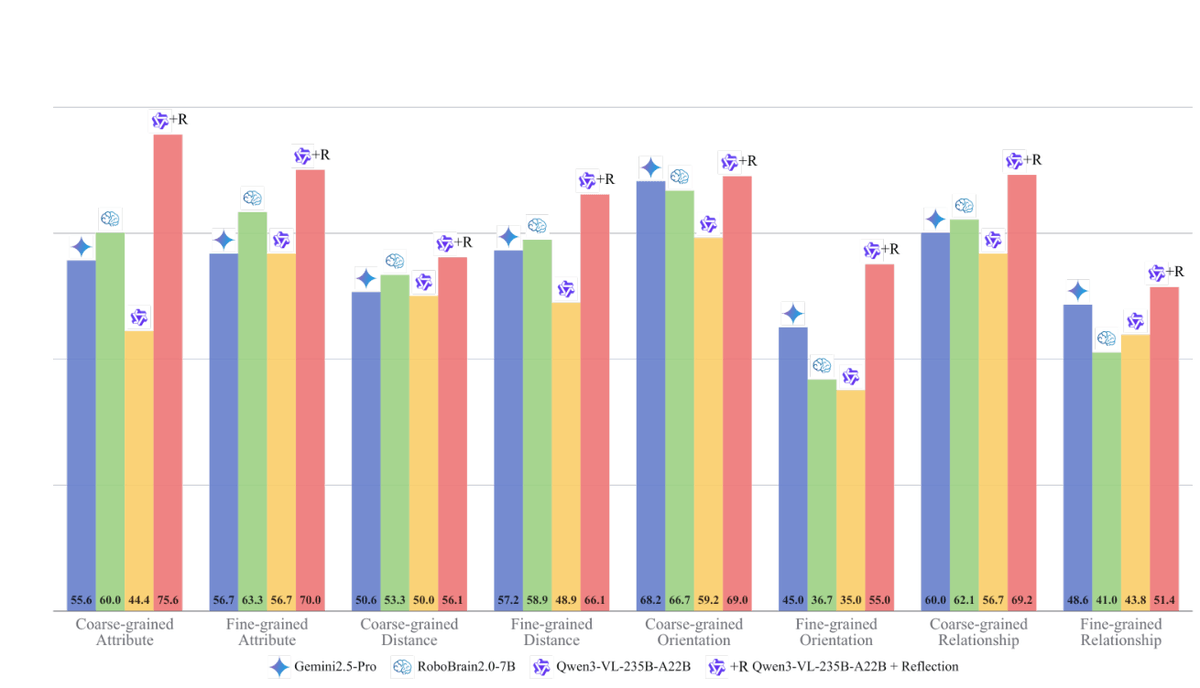
A few patterns stand out. Larger models do not necessarily lead to better performance, e.g., Qwen3-VL-30B with 3B activated parameters outperforms Qwen3-VL-8B and Qwen3-VL-235B. RoboBrain2.0-7B, which was post-trained on generic spatial reasoning data, tops localization but collapses in execution because it does not transfer to improved performance in execution that requires acting-oriented spatial reasoning about 3D rotational geometry.
Rotation is where things break
The most useful diagnostic finding comes from an ablation where the authors let Qwen3-VL-235B predict pitch, yaw, or roll instead of using ground truth. Acceptance on pick tasks drops from 52.73% (all ground truth) to 3.64% when the model must predict all three axes. Pitch and roll appear to be the key factors for pick tasks and constrained place tasks, respectively, since picking requires selecting a graspable face while constrained placement requires the right deviation from upright.
Reflection prompting, where the model sees its previous failure before retrying, improves localization for every Qwen3-VL variant but does not yield a comparable improvement in execution; conversely, it degrades execution performance. In other words, more thinking helps you find the object but not orient the gripper.
A human study on ambiguous reference frames adds a cognitive-science flavor. When the reference is a near, comparably sized object like an alarm clock, humans tend to prefer the intrinsic frame of the reference object while models favor the relative frame. Models default to viewer-centric thinking exactly where humans switch to object-centric thinking.
What it's good for, and what it isn't
ESPIRE is intentionally narrow. It targets high-level spatial reasoning in VLMs, not end-to-end vision-language-action policies, and the authors are explicit that it is not intended to replace real-world evaluation, but to complement it with a scalable, reproducible alternative that facilitates rapid, iterative model improvement. Its main limitation is that it lives entirely in indoor tabletop and shelf scenes, so scenarios involving kilometer-scale distances or cardinal directions are out of scope.
For teams building spatial VLMs or the vision-language backbones inside VLAs, the practical value is a scalable microscope: you can isolate whether a regression came from attribute reasoning, distance estimation, relationship parsing, or rotation prediction, without shipping a robot into a lab. The code is available on GitHub, and the authors report a 96.4% Spearman correlation between ESPIRE rankings and the real-image RefSpatial benchmark, which is a reasonable sanity check that the simulated numbers track something real.